

Yutte Stensgaard – Lust for a Vampire (1971) Mircalla Fiery Death Burning Stake Hammer Horror Photo
Limited Edition Photograph (learn more)
In stock
Yutte Stensgaard as Mircalla / Carmilla Karnstein screams amid the flames during the climactic destruction of Karnstein Castle in Hammer Film Productions’ Lust for a Vampire (1971). The exceptionally tight composition captures one of the film’s most dramatic moments, with Mircalla illuminated by the blazing fire behind her as the castle collapses around the Karnstein vampires.
The photograph comes from Mircalla’s fiery death sequence near the film’s conclusion. Villagers descend upon Karnstein Castle intending to destroy the vampire family and set the building ablaze. Fire itself cannot kill the Karnsteins, but as the castle burns, a flaming timber falls from above and pierces Mircalla through the heart, delivering the fatal wound that the flames alone cannot inflict.
The moment provides an especially memorable conclusion to Stensgaard’s portrayal of Mircalla. Richard LeStrange, played by Michael Johnson, has entered the burning castle attempting to save her, unable to abandon the woman he loves despite discovering her true identity. While Count and Countess Karnstein remain confident that fire cannot destroy them, Mircalla is accidentally struck through the heart by the burning beam—the very method capable of killing a vampire.
Directed by Jimmy Sangster from a screenplay by Tudor Gates, Lust for a Vampire stars Stensgaard alongside Michael Johnson, Ralph Bates, Suzanna Leigh, Barbara Jefford and Mike Raven. Stensgaard plays Mircalla/Carmilla Karnstein, resurrected by the Karnstein family before entering a nearby girls’ finishing school and becoming the center of the film’s supernatural mystery.
The film forms the middle chapter of Hammer’s Karnstein trilogy, following The Vampire Lovers (1970) and preceding Twins of Evil (1971). Inspired by characters and themes originating in Sheridan Le Fanu’s Carmilla, the trilogy became one of Hammer’s defining explorations of Gothic vampire mythology during the early 1970s.
Unlike the polished studio glamour portraits associated with Stensgaard’s promotion of the film, this image captures the actress within the actual dramatic climax, surrounded by fire and completely absorbed in Mircalla’s terror. The extreme close-up, intense expression and blazing background make it one of the most visually powerful Stensgaard images from Lust for a Vampire.
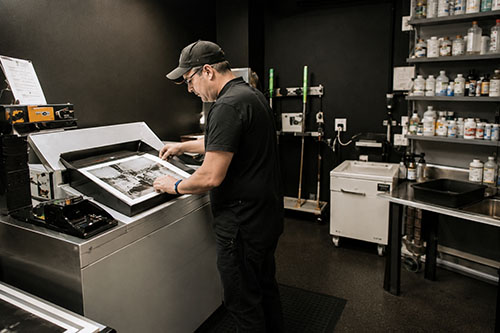
Carefully restored from archival source material and professionally lab-developed, this museum-quality photograph is presented uncropped*, preserving the complete image area contained in the archival source material. Meticulous restoration recovers* natural color balance, tonal detail, facial clarity, fire detail, texture and photographic integrity while retaining the authentic character of the original color image.
For collectors of Hammer Horror, vampire cinema and Yutte Stensgaard photography, this photograph captures one of Mircalla’s most memorable moments. The combination of Stensgaard’s terrified expression, the burning Karnstein Castle and Mircalla’s fatal destruction gives the image exceptional visual impact and an unmistakable connection to the climax of Hammer’s Lust for a Vampire.
Product Enquiry
Kodak Professional Endura Paper
Kodak Endura papers provide an incredible amount of detail and smooth transition of tones. Designed for the professional photographer in mind, looking for a more traditional photo print style, Kodak Endura provides an extended print life and color gamut almost at the level of a high end fine art paper print.
Archival Matte Paper
Archival Matte Paper, also known as Moab Lasal Photo Matte, is our house stock fine art paper and is an economical favorite for fine art reproductions and photo prints. It features a smooth surface, heavy weight (230 g, 9.5-mil), neutral white, matte paper engineered for accurate color reproduction that provides high contrast and high-resolution output. This paper is acid-free, making it the perfect choice for both photography & fine art reproductions.
Giclee William Turner Paper by Hahnemühle
The William Turner by Hahnemühle is one of the most popular papers used in the Giclee printing industry. This is a 310g natural white mould made natural line paper with 100% rag content making it highly archival. It has a slight coarse texture which gives photos and artwork an elegant look. These fine art paper prints (also known as Giclee) are ordered by galleries, individual artists and photographers. The papers and inks are not only archival but use some of the most accurate print technology for full color prints.
- Giclee prints use very expensive archival pigmented inks.
- Highest level of color gamut available in printing (12 color printing).
- Exceptional black & white printing.
- Fade resistant, pigmented inks which provide a superior color range compared to other types of inks. Widely preferred in fine art and photography circles.
- We ONLY use professional grade fine art and photo paper that resist yellowing and aging.
Framing
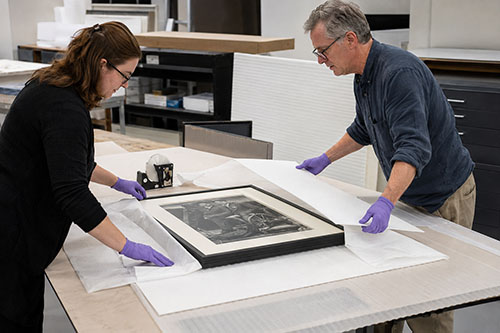
We offer wood and metal frames, custom cut & joined to order. Each framed print includes hanging hardware and foamcore backer.
Matting
We use conservation grade 100% virgin alpha-cellulose 2 ply mats with white core. Acid-free and lignin-free, these are both face resistant and meet all conservation quality standards set by the Fine Art Trade Guild. Mats are digitally cut for ultimate precision. The window will be 1/8″ smaller than the print dimensions.
Glazing (Acrylic Glass)
We offer custom cut panes of shatter-proof, acrylic glass, to protect your valuable artwork and prints.
Premium Clear
Framing grade clear acrylic is shatter resistant and lightweight.
Reflection Control
With its matte finish, Tru Vue Reflection Control® Acrylic scatters light to diminish unwanted glare.
Conservation Clear
Tru Vue Conservation Clear® Acrylic is a framing industry staple, blocking up to 99% of UV rays for ultimate protection.
Conservation Reflection Control
Tru Vue Conservation Reflection Control® Acrylic scatters and diffuses light to reduce unwanted glare. Blocks up to 99% of UV rays.
Related products
-

PETER CUSHING & SUSAN DENBERG – FRANKENSTEIN CREATED WOMAN (1967) Christina Bandage Experiment Hammer Publicity Photo
$30.00 -
MADELINE SMITH – FRANKENSTEIN AND THE MONSTER FROM HELL (1974) Sarah Color Publicity Portrait
$25.00 -
JIMMY SANGSTER & CAST – LUST FOR A VAMPIRE (1971) Relaxing on Set Behind-the-Scenes Photo
$38.00 -
TERENCE YOUNG & URSULA ANDRESS – DR. NO (1962) Director Briefing James Bond 007 BTS Photo
$38.00