

Klaus Kinski – Fitzcarraldo (1982) Brian Sweeney Fitzgerald Watches Molly Aida on Mountain, Camisea Peru Production Photo
Limited Edition Photograph (learn more)
In stock
Klaus Kinski stands alone as Brian Sweeney Fitzgerald before the enormous Molly Aida in this extraordinary 1981 color production photograph from Fitzcarraldo (1982), taken at Camisea, Peru. Seen completely from behind in Fitzcarraldo’s unmistakable white suit and straw hat, Kinski faces the steamship as it looms diagonally across the steep, mud-covered mountainside. Mist softens the upper portion of the vessel while the exposed earth, torn vegetation and immense difference in scale between man and ship create a breathtaking visual expression of one individual confronting the apparently impossible scale of his obsession.
The composition is remarkable for its simplicity. Kinski occupies only a small area near the bottom of the frame, while the massive vessel dominates the landscape above him. His white clothing stands sharply against the dark earth, making the character immediately visible even from behind, and the absence of other prominent figures gives the moment an almost contemplative quality. Archival exhibition material devoted to photographer Beat Presser’s work on Fitzcarraldo specifically identifies images of Klaus Kinski and the ship on the mountain at Camisea, Peru, in 1981.
Written and directed by Werner Herzog, Fitzcarraldo stars Klaus Kinski as Brian Sweeney Fitzgerald, known as Fitzcarraldo, alongside Claudia Cardinale as Molly. Thomas Mauch served as principal cinematographer. Cannes’ official archive confirms Herzog as director and screenwriter, Mauch as cinematographer, and Kinski and Cardinale among the principal cast.
Fitzcarraldo is an obsessive dreamer determined to build an opera house in the Peruvian Amazon. To finance his ambition, he attempts to gain access to an isolated rubber territory, devising an audacious plan that requires transporting his steamship from one river system to another across a mountain. The enormous vessel becomes both a practical object within the story and the central visual symbol of Fitzcarraldo’s seemingly impossible dream.
The ship is named Molly Aida, combining the name of Cardinale’s character Molly with Giuseppe Verdi’s opera Aida. Its journey over the mountain became the production’s defining achievement. Rather than representing the feat solely through conventional miniature or studio photography, Herzog’s crew physically hauled the full-size vessel across the steep terrain, turning the making of the film into an undertaking almost as extraordinary as the fictional story itself. The American Society of Cinematographers documents the ship at Camisea in 1981 and describes the heavy machinery and steel cables required to move it up the slope.
That physical reality gives this photograph exceptional power. Kinski is not posed before a painted backdrop or standing beside a miniature; the enormous ship visible above him occupied the same difficult Amazonian terrain. The raw mountainside and battered vegetation reveal the scale of the engineering work, while Fitzcarraldo’s solitary figure turns the production spectacle into an image of character and obsession.
The making of Fitzcarraldo became legendary in its own right. Documentary filmmaker Les Blank recorded the difficult production in Burden of Dreams (1982), while surviving production photography preserves the daily realities of working with an enormous ship, remote jungle locations and hundreds of participants. The challenge of moving the vessel became inseparable from Herzog’s reputation for pursuing physical authenticity under extraordinarily demanding circumstances.
Beat Presser was part of the production’s camera department and served as still photographer, documenting Kinski, Herzog, the Molly Aida and the Amazon locations from within the crew. The Deutsche Kinemathek records Presser as both camera personnel and still photographer on the production, making his surviving imagery an important photographic record of how Fitzcarraldo was actually made.
The relationship between Werner Herzog and Klaus Kinski also gives this image added historical significance. Fitzcarraldo was their fourth feature collaboration after Aguirre, the Wrath of God (1972), Nosferatu the Vampyre (1979) and Woyzeck (1979). Kinski’s volatile intensity was ideally suited to Fitzcarraldo, a character driven by an ambition so extravagant that the boundary between visionary determination and madness becomes increasingly difficult to define.
The finished film competed for the Palme d’Or at the 1982 Cannes Film Festival, where Werner Herzog received the Award for Best Director. Cannes describes the story itself in terms of a dreamer transporting an enormous steamship over a mountain with the assistance of hundreds of Indigenous participants, confirming how central the physical feat became to both the film and its international reputation.
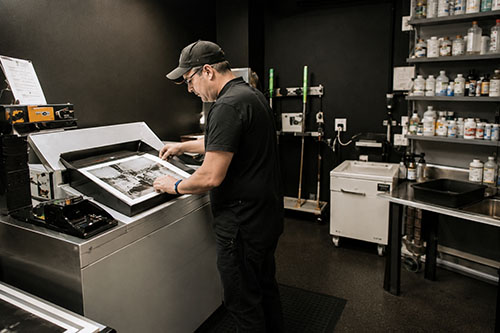
Carefully restored from historic photographic source material and professionally lab-developed, this museum-quality photograph is presented uncropped, preserving the complete image area contained in the source. Meticulous restoration recovers Kinski’s costume detail, ship structure, exposed earth, jungle vegetation, atmospheric mist, natural color balance and photographic clarity while retaining the documentary character of the original 1981 color production photograph.
For collectors of Klaus Kinski, Werner Herzog, Fitzcarraldo and motion-picture production history, this is an extraordinary image—Brian Sweeney Fitzgerald standing alone beneath the Molly Aida on the mountainside at Camisea, his small white-clad figure confronting the immense steamship above him and preserving one of the most visually powerful records of obsession, scale and practical filmmaking in modern cinema.
Product Enquiry
Kodak Professional Endura Paper
Kodak Endura papers provide an incredible amount of detail and smooth transition of tones. Designed for the professional photographer in mind, looking for a more traditional photo print style, Kodak Endura provides an extended print life and color gamut almost at the level of a high end fine art paper print.
Archival Matte Paper
Archival Matte Paper, also known as Moab Lasal Photo Matte, is our house stock fine art paper and is an economical favorite for fine art reproductions and photo prints. It features a smooth surface, heavy weight (230 g, 9.5-mil), neutral white, matte paper engineered for accurate color reproduction that provides high contrast and high-resolution output. This paper is acid-free, making it the perfect choice for both photography & fine art reproductions.
Giclee William Turner Paper by Hahnemühle
The William Turner by Hahnemühle is one of the most popular papers used in the Giclee printing industry. This is a 310g natural white mould made natural line paper with 100% rag content making it highly archival. It has a slight coarse texture which gives photos and artwork an elegant look. These fine art paper prints (also known as Giclee) are ordered by galleries, individual artists and photographers. The papers and inks are not only archival but use some of the most accurate print technology for full color prints.
- Giclee prints use very expensive archival pigmented inks.
- Highest level of color gamut available in printing (12 color printing).
- Exceptional black & white printing.
- Fade resistant, pigmented inks which provide a superior color range compared to other types of inks. Widely preferred in fine art and photography circles.
- We ONLY use professional grade fine art and photo paper that resist yellowing and aging.
Framing
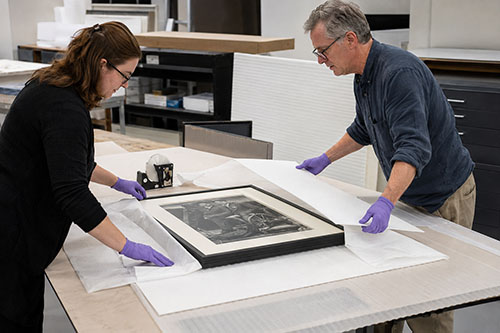
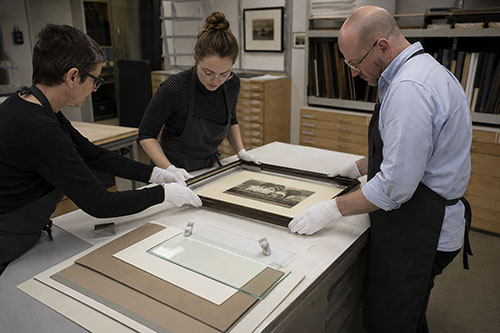
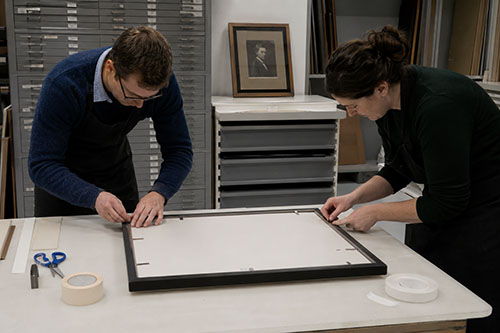
We offer wood and metal frames, custom cut & joined to order. Each framed print includes hanging hardware and foamcore backer.
Matting
We use conservation grade 100% virgin alpha-cellulose 2 ply mats with white core. Acid-free and lignin-free, these are both face resistant and meet all conservation quality standards set by the Fine Art Trade Guild. Mats are digitally cut for ultimate precision. The window will be 1/8″ smaller than the print dimensions.
Glazing (Acrylic Glass)
We offer custom cut panes of shatter-proof, acrylic glass, to protect your valuable artwork and prints.
Premium Clear
Framing grade clear acrylic is shatter resistant and lightweight.
Reflection Control
With its matte finish, Tru Vue Reflection Control® Acrylic scatters light to diminish unwanted glare.
Conservation Clear
Tru Vue Conservation Clear® Acrylic is a framing industry staple, blocking up to 99% of UV rays for ultimate protection.
Conservation Reflection Control
Tru Vue Conservation Reflection Control® Acrylic scatters and diffuses light to reduce unwanted glare. Blocks up to 99% of UV rays.
Related products
-

Christopher Lee & Caroline Munro – Dracula A.D. 1972 Laura Bellows Black Mass Aftermath Vampire Attack Hammer Horror Photo
$30.00 -
Hazel Court – Holiday Camp (1947) Joan Huggett Two-Piece Swimsuit Ladder Glamour Publicity Photo
$30.00 -
Klaus Kinski – Fitzcarraldo (1982) Brian Sweeney Fitzgerald Leopard Tapestry Publicity Photo
$25.00 -
Yutte Stensgaard – Lust for a Vampire (1971) Mircalla Carmilla Karnstein Nightgown Hammer Horror Photo
$30.00


