

King Kong Escapes (1967) Mechani-Kong Battle Toho Kaiju Promotional Artwork
Limited Edition Photograph (learn more)
In stock
King Kong and Mechani-Kong dominate this spectacular black-and-white promotional artwork for King Kong Escapes (1967), confronting one another amid smoke, destruction and towering industrial machinery. Kong raises one massive arm as his robotic duplicate advances from the opposite side, while beams of light, explosions and dense clouds of smoke transform the composition into an extraordinary piece of 1960s kaiju spectacle. The contrast between Kong’s organic power and Mechani-Kong’s mechanical construction captures the central visual appeal of one of the most unusual chapters in King Kong screen history.
The artwork is designed for immediate impact. Kong occupies the left side of the composition, his dark fur and powerful silhouette standing sharply against the lighter smoke surrounding him. Opposite, Mechani-Kong towers above the destruction in metallic armor, with segmented limbs, mechanical features and heavy body construction creating a deliberately artificial counterpart to the living monster. Between them rises a massive industrial structure, reinforcing the film’s mixture of monster fantasy, science fiction and technological menace.
This King Kong Escapes 1967 Mechani-Kong image is especially compelling because it concentrates the film’s central monster rivalry into a single dramatic composition. Mechani-Kong was conceived as a robotic duplicate of Kong, built to reproduce the giant ape’s strength for the purposes of the villainous Dr. Who. The idea transforms the familiar monster-versus-monster formula into a confrontation between a living creature and a technological imitation of itself.
Directed by Ishirō Honda, King Kong Escapes was produced through the unusual collaboration between Toho and Rankin/Bass, bringing the American King Kong tradition into the visual language of Japanese kaiju cinema. The film stars Rhodes Reason, Linda Miller, Akira Takarada, Mie Hama and Eisei Amamoto, while Toho’s celebrated special-effects tradition gives both Kong and Mechani-Kong the scale and physical presence associated with the studio’s giant-monster productions.
Special-effects work was supervised by Eiji Tsuburaya, whose influence on Japanese science-fiction and kaiju filmmaking was already firmly established through the Godzilla series and numerous Toho productions. King Kong Escapes applies that tradition to an internationally recognized monster, surrounding Kong with miniature environments, elaborate machinery and an entirely new mechanical opponent.
The image is also notable for its promotional-artwork character rather than conventional scene photography. The monsters, industrial tower, beams of light and smoke are arranged for maximum drama, creating an exaggerated vision of destruction that communicates the film’s spectacle instantly. The monochrome presentation gives the composition additional graphic force, allowing the contrasting textures of fur, metal, smoke and machinery to remain clearly separated.
For collectors of King Kong, Toho kaiju cinema and vintage monster artwork, this image has particularly strong appeal because it brings together two of the production’s defining creatures in a single explosive design. Mechani-Kong’s distinctive robotic form makes the artwork immediately identifiable, while Kong’s opposing stance preserves the classic monster iconography at the center of the film.
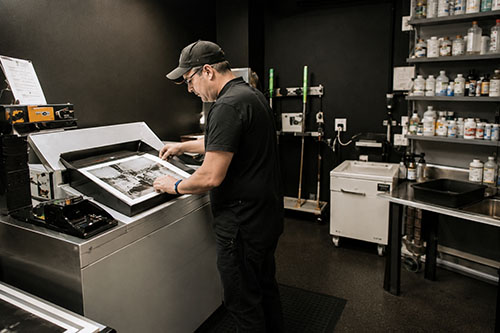
Carefully restored from historic promotional source material and professionally lab-developed, this museum-quality artwork is presented uncropped, preserving the complete image area contained in the source. Restoration recovers Kong’s fur detail, Mechani-Kong’s mechanical surfaces, industrial structure, light beams, smoke and explosion definition while maintaining the natural tonal gradation and character of the historic black-and-white artwork. The finished image contains no AI-generated image content.
Product Enquiry
Kodak Professional Endura Paper
Kodak Endura papers provide an incredible amount of detail and smooth transition of tones. Designed for the professional photographer in mind, looking for a more traditional photo print style, Kodak Endura provides an extended print life and color gamut almost at the level of a high end fine art paper print.
Archival Matte Paper
Archival Matte Paper, also known as Moab Lasal Photo Matte, is our house stock fine art paper and is an economical favorite for fine art reproductions and photo prints. It features a smooth surface, heavy weight (230 g, 9.5-mil), neutral white, matte paper engineered for accurate color reproduction that provides high contrast and high-resolution output. This paper is acid-free, making it the perfect choice for both photography & fine art reproductions.
Giclee William Turner Paper by Hahnemühle
The William Turner by Hahnemühle is one of the most popular papers used in the Giclee printing industry. This is a 310g natural white mould made natural line paper with 100% rag content making it highly archival. It has a slight coarse texture which gives photos and artwork an elegant look. These fine art paper prints (also known as Giclee) are ordered by galleries, individual artists and photographers. The papers and inks are not only archival but use some of the most accurate print technology for full color prints.
- Giclee prints use very expensive archival pigmented inks.
- Highest level of color gamut available in printing (12 color printing).
- Exceptional black & white printing.
- Fade resistant, pigmented inks which provide a superior color range compared to other types of inks. Widely preferred in fine art and photography circles.
- We ONLY use professional grade fine art and photo paper that resist yellowing and aging.
Framing
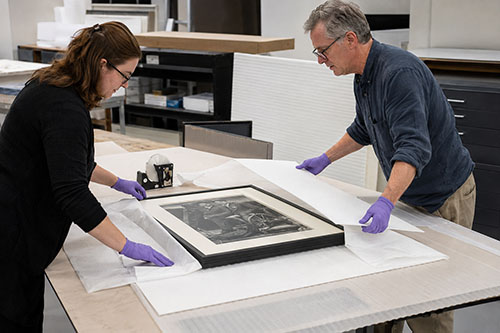
We offer wood and metal frames, custom cut & joined to order. Each framed print includes hanging hardware and foamcore backer.
Matting
We use conservation grade 100% virgin alpha-cellulose 2 ply mats with white core. Acid-free and lignin-free, these are both face resistant and meet all conservation quality standards set by the Fine Art Trade Guild. Mats are digitally cut for ultimate precision. The window will be 1/8″ smaller than the print dimensions.
Glazing (Acrylic Glass)
We offer custom cut panes of shatter-proof, acrylic glass, to protect your valuable artwork and prints.
Premium Clear
Framing grade clear acrylic is shatter resistant and lightweight.
Reflection Control
With its matte finish, Tru Vue Reflection Control® Acrylic scatters light to diminish unwanted glare.
Conservation Clear
Tru Vue Conservation Clear® Acrylic is a framing industry staple, blocking up to 99% of UV rays for ultimate protection.
Conservation Reflection Control
Tru Vue Conservation Reflection Control® Acrylic scatters and diffuses light to reduce unwanted glare. Blocks up to 99% of UV rays.
Related products
-

Peter Cushing – The Curse of Frankenstein (1957) Baron Victor Frankenstein Top Hat Publicity Photo
$30.00 -
Ingrid Pitt – Countess Dracula (1971) Countess Elisabeth Nádasdy High-Collar Publicity Photo
$38.00 -
King Kong (1933) New York Exhibition Escape Pre-Production Concept Artwork
$38.00 -
Fay Wray – King Kong (1933) Ann Darrow Torn Dress Skull Island Publicity Photo
$38.00


