

Clint Eastwood – Dirty Harry (1971) Harry Callahan Outdoor Publicity Photo
Limited Edition Photograph (learn more)
In stock
Clint Eastwood as Inspector Harry Callahan stands outdoors in this sunlit color publicity photograph associated with Dirty Harry (1971), dressed in a dark three-piece suit and patterned tie beneath an expansive blue sky. Turned slightly away from the camera with a restrained half-smile and relaxed expression, Eastwood presents a markedly quieter side of Callahan than the gunplay, pursuit and confrontation that dominate the film’s best-known imagery, giving this photograph a distinctive identity within a Dirty Harry collection.
The composition is notable for its simplicity. Eastwood occupies the right side of the frame, shown from approximately the waist upward while the open exterior space stretches behind him. His dark jacket, waistcoat and tie create a strong formal silhouette against the pale pavement and bright sky, while sunlight defines his face and swept-back hair. Rather than confronting the viewer directly, Callahan looks beyond the camera with an expression that appears confident and almost amused, lending the image an unusually informal quality.
That relaxed demeanor contrasts strongly with the character most audiences associate with the film. Harry Callahan is typically remembered in moments of tension: pursuing suspects through city streets, confronting criminals at gunpoint or challenging authority with his uncompromising approach to police work. Here there is no visible weapon, police badge, vehicle or dramatic action. The emphasis falls instead on Eastwood’s physical presence, tailored costume and understated expression, allowing the character to register without the usual visual shorthand of violence or pursuit.
The outdoor setting also gives the photograph a particularly open appearance. Low buildings and distant figures recede softly into the background, while the broad area of clear sky occupies much of the upper composition. The uncluttered surroundings and natural daylight separate this image from the darker streets, interiors and nighttime sequences that contribute to the film’s harder-edged atmosphere. The result is a clean, strongly recognizable Clint Eastwood Dirty Harry 1971 publicity image centered almost entirely on the actor and his characterization.
Directed by Don Siegel, Dirty Harry introduced Eastwood as San Francisco police inspector Harry Callahan, a role that became one of the defining characters of his career. Produced by The Malpaso Company and distributed by Warner Bros., the film places Callahan against a killer terrorizing San Francisco while repeatedly testing the boundaries between police procedure, individual judgment and the use of force. Eastwood’s controlled performance, spare dialogue and physical economy became central to the film’s identity.
San Francisco itself is equally important to the picture. The production made extensive use of real locations throughout the city, incorporating areas including North Beach, City Hall, Mount Davidson, Kezar Stadium and Golden Gate Park. That commitment to location photography gives Dirty Harry a strong sense of place, making streets, rooftops, parks and civic architecture part of Callahan’s world rather than merely background scenery.
For collectors of Clint Eastwood, Don Siegel and classic 1970s crime cinema, this photograph offers a less familiar but highly appealing representation of Harry Callahan. The dark three-piece suit, sunlit exterior, blue sky and restrained expression distinguish it from the film’s more aggressive promotional imagery while still presenting Eastwood at once as unmistakably Callahan.
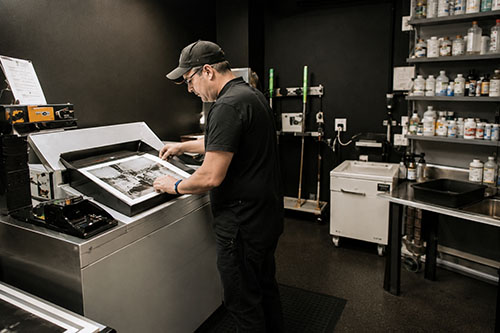
Carefully restored from historic photographic source material and professionally lab-developed, this museum-quality photograph is presented uncropped, preserving the complete image area contained in the source. Restoration recovers Eastwood’s facial detail, hair texture, suit and waistcoat definition, patterned tie, natural skin tones and the subtle detail of the sunlit exterior background while maintaining the natural color balance and authentic character of the historic photograph. The finished photograph contains no AI-generated image content.
Product Enquiry
Kodak Professional Endura Paper
Kodak Endura papers provide an incredible amount of detail and smooth transition of tones. Designed for the professional photographer in mind, looking for a more traditional photo print style, Kodak Endura provides an extended print life and color gamut almost at the level of a high end fine art paper print.
Archival Matte Paper
Archival Matte Paper, also known as Moab Lasal Photo Matte, is our house stock fine art paper and is an economical favorite for fine art reproductions and photo prints. It features a smooth surface, heavy weight (230 g, 9.5-mil), neutral white, matte paper engineered for accurate color reproduction that provides high contrast and high-resolution output. This paper is acid-free, making it the perfect choice for both photography & fine art reproductions.
Giclee William Turner Paper by Hahnemühle
The William Turner by Hahnemühle is one of the most popular papers used in the Giclee printing industry. This is a 310g natural white mould made natural line paper with 100% rag content making it highly archival. It has a slight coarse texture which gives photos and artwork an elegant look. These fine art paper prints (also known as Giclee) are ordered by galleries, individual artists and photographers. The papers and inks are not only archival but use some of the most accurate print technology for full color prints.
- Giclee prints use very expensive archival pigmented inks.
- Highest level of color gamut available in printing (12 color printing).
- Exceptional black & white printing.
- Fade resistant, pigmented inks which provide a superior color range compared to other types of inks. Widely preferred in fine art and photography circles.
- We ONLY use professional grade fine art and photo paper that resist yellowing and aging.
Framing
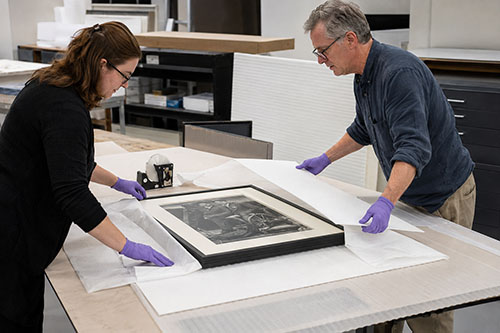
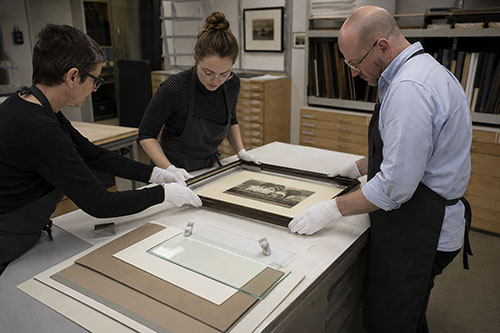
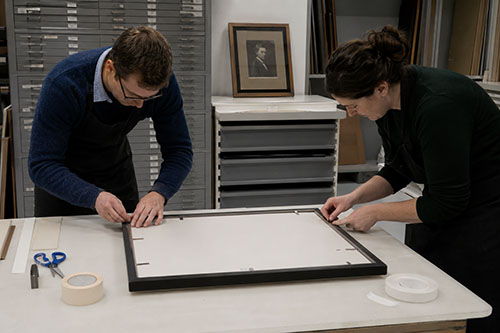
We offer wood and metal frames, custom cut & joined to order. Each framed print includes hanging hardware and foamcore backer.
Matting
We use conservation grade 100% virgin alpha-cellulose 2 ply mats with white core. Acid-free and lignin-free, these are both face resistant and meet all conservation quality standards set by the Fine Art Trade Guild. Mats are digitally cut for ultimate precision. The window will be 1/8″ smaller than the print dimensions.
Glazing (Acrylic Glass)
We offer custom cut panes of shatter-proof, acrylic glass, to protect your valuable artwork and prints.
Premium Clear
Framing grade clear acrylic is shatter resistant and lightweight.
Reflection Control
With its matte finish, Tru Vue Reflection Control® Acrylic scatters light to diminish unwanted glare.
Conservation Clear
Tru Vue Conservation Clear® Acrylic is a framing industry staple, blocking up to 99% of UV rays for ultimate protection.
Conservation Reflection Control
Tru Vue Conservation Reflection Control® Acrylic scatters and diffuses light to reduce unwanted glare. Blocks up to 99% of UV rays.
Related products
-

Christopher Lee – Dracula Has Risen from the Grave (1968) Count Dracula Bloody Lips Coffin Photo
$30.00 -
Peter Cushing & Neil Binney – Frankenstein Must Be Destroyed (1969) Sickle Scene Behind-the-Scenes Photo
$38.00 -
Peter Cushing, Susan Denberg, Anthony Nelson Keys & Terence Fisher – Frankenstein Created Woman (1967) Frensham Ponds Guillotine Behind-the-Scenes Photo
$30.00 -
Ingrid Pitt – Countess Dracula (1971) Countess Elisabeth Nádasdy Laughing in Costume Hammer Gothic Horror Photo
$38.00


