

Christopher Lee – Dracula: Prince of Darkness (1966) Count Dracula Frozen Moat Finale Bray Studios Behind-the-Scenes Photo
Limited Edition Photograph (learn more)
In stock
Christopher Lee stands as Count Dracula on the frozen-moat set during production of Dracula: Prince of Darkness (1966) in this extraordinary black-and-white behind-the-scenes photograph from Bray Studios. Lee’s solitary black-caped figure occupies the center of the artificial ice while a large motion-picture camera and elevated working platform dominate the foreground above him. Castle walls, Gothic architectural details and the exposed filmmaking equipment transform one of Hammer’s most memorable Dracula finales into a revealing document of the practical craftsmanship behind the finished sequence.
The photograph is particularly striking for its dramatic difference in scale. Lee appears surprisingly small within the constructed castle environment, while the camera, tripod and crew platform reveal how carefully the sequence had to be photographed from above. Rather than preserving the illusion of a remote Carpathian castle, the image exposes the physical Hammer set surrounding Dracula and offers collectors a rare view of actor, architecture and camera equipment working together during the creation of the climax.
Released in 1966, Dracula: Prince of Darkness was directed by Terence Fisher for Hammer Film Productions and marked Christopher Lee’s return to Count Dracula after his original Hammer performance in Dracula (1958). The film also stars Barbara Shelley as Helen Kent, Andrew Keir as Father Sandor, Francis Matthews as Charles Kent, Suzan Farmer as Diana Kent and Philip Latham as Klove.
The climactic sequence takes Dracula back to the frozen moat surrounding his castle. After Diana is rescued, the Count battles Charles on the ice until Father Sandor fires into the frozen surface, breaking it apart beneath Dracula. The vampire plunges into the running water below—fatal within the supernatural rules established by the film—and disappears beneath the ice in one of Hammer’s more unusual Dracula death scenes.
The sequence was created almost entirely through practical filmmaking. Contemporary production accounts describe the artificial frozen surface as part of the constructed castle environment on the Bray backlot, while different materials and mechanical effects were used to create the breaking ice and Dracula’s descent. The visible camera position in this photograph gives an especially useful indication of how the filmmakers approached the scene from above.
Michael Reed served as director of photography, with Cece Cooney operating the camera. Bernard Robinson was production designer, Don Mingaye art director and Roy Ashton responsible for makeup. Hammer’s production records confirm filming at Bray Studios from 26 April to 4 June 1965, with Black Park Lake also used for location work.
The finale also generated several stories that have become part of Hammer production lore. Accounts report that Lee lost one of his red contact lenses on the salt-covered artificial-ice surface; after it was retrieved and replaced, remaining salt caused considerable pain to his eye. The sequence was even more hazardous for Eddie Powell, Lee’s regular stunt double, who performed the underwater descent as Dracula. Reports state that Powell had difficulty locating the underwater air supply and came dangerously close to drowning beneath the false ice.
Powell’s participation is independently documented in Hammer production records, which credit him with stunt work on Dracula: Prince of Darkness. His resemblance to Lee made him a particularly valuable double throughout their Hammer collaborations, and he later worked on numerous other productions for the studio.
For Christopher Lee, the film restored the imposing physical Dracula that had transformed him into an international horror star. Unlike the Count in Hammer’s 1958 film, Dracula speaks no dialogue here; Lee instead relies on movement, stature, expression and sheer physical presence. That makes photographs of the actor actually working within the sets especially revealing, since they demonstrate how much of the character’s effect depended on Lee’s body and position within Hammer’s Gothic compositions.
The production represented Hammer operating at extraordinary efficiency. Dracula: Prince of Darkness was one of four films prepared in rapid succession at Bray alongside Rasputin the Mad Monk, The Plague of the Zombies and The Reptile, allowing sets, costumes and production resources to be shared. BFI identifies this period as one of the studio’s most ambitious production experiments.
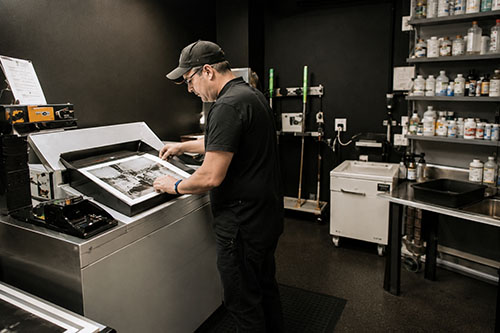
Carefully restored from historic photographic source material and professionally lab-developed, this museum-quality photograph is presented uncropped, preserving the complete image area contained in the source. Meticulous restoration recovers facial detail, cape texture, camera equipment, artificial-ice surface, castle architecture, tonal range and photographic clarity while retaining the documentary character of the original black-and-white behind-the-scenes production photograph.
For collectors of Christopher Lee, Dracula: Prince of Darkness, Hammer Horror and Bray Studios history, this is an exceptional production image—Count Dracula standing alone upon the frozen moat while the massive camera setup towers above him, preserving a rare behind-the-scenes view of the practical filmmaking behind one of Hammer’s most memorable vampire finales.
Product Enquiry
Kodak Professional Endura Paper
Kodak Endura papers provide an incredible amount of detail and smooth transition of tones. Designed for the professional photographer in mind, looking for a more traditional photo print style, Kodak Endura provides an extended print life and color gamut almost at the level of a high end fine art paper print.
Archival Matte Paper
Archival Matte Paper, also known as Moab Lasal Photo Matte, is our house stock fine art paper and is an economical favorite for fine art reproductions and photo prints. It features a smooth surface, heavy weight (230 g, 9.5-mil), neutral white, matte paper engineered for accurate color reproduction that provides high contrast and high-resolution output. This paper is acid-free, making it the perfect choice for both photography & fine art reproductions.
Giclee William Turner Paper by Hahnemühle
The William Turner by Hahnemühle is one of the most popular papers used in the Giclee printing industry. This is a 310g natural white mould made natural line paper with 100% rag content making it highly archival. It has a slight coarse texture which gives photos and artwork an elegant look. These fine art paper prints (also known as Giclee) are ordered by galleries, individual artists and photographers. The papers and inks are not only archival but use some of the most accurate print technology for full color prints.
- Giclee prints use very expensive archival pigmented inks.
- Highest level of color gamut available in printing (12 color printing).
- Exceptional black & white printing.
- Fade resistant, pigmented inks which provide a superior color range compared to other types of inks. Widely preferred in fine art and photography circles.
- We ONLY use professional grade fine art and photo paper that resist yellowing and aging.
Framing
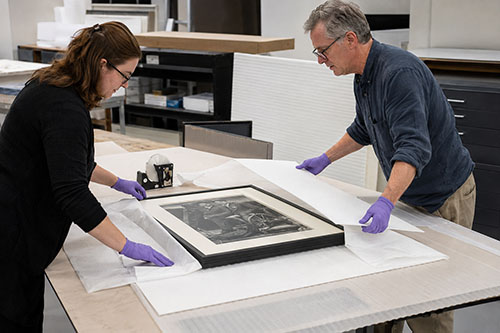
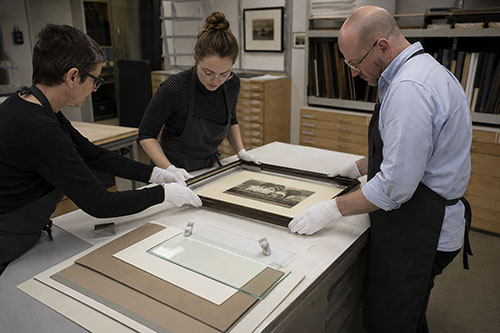
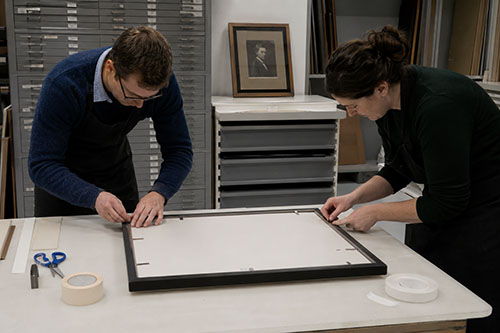
We offer wood and metal frames, custom cut & joined to order. Each framed print includes hanging hardware and foamcore backer.
Matting
We use conservation grade 100% virgin alpha-cellulose 2 ply mats with white core. Acid-free and lignin-free, these are both face resistant and meet all conservation quality standards set by the Fine Art Trade Guild. Mats are digitally cut for ultimate precision. The window will be 1/8″ smaller than the print dimensions.
Glazing (Acrylic Glass)
We offer custom cut panes of shatter-proof, acrylic glass, to protect your valuable artwork and prints.
Premium Clear
Framing grade clear acrylic is shatter resistant and lightweight.
Reflection Control
With its matte finish, Tru Vue Reflection Control® Acrylic scatters light to diminish unwanted glare.
Conservation Clear
Tru Vue Conservation Clear® Acrylic is a framing industry staple, blocking up to 99% of UV rays for ultimate protection.
Conservation Reflection Control
Tru Vue Conservation Reflection Control® Acrylic scatters and diffuses light to reduce unwanted glare. Blocks up to 99% of UV rays.
Related products
-

Christopher Lee & Caroline Munro – Dracula A.D. 1972 Laura Bellows Black Mass Aftermath Vampire Attack Hammer Horror Photo
$30.00 -
Dracula: Prince of Darkness (1966) Christopher Lee Original French Theatrical Design Hammer Horror 18×22 Fine Art Poster
$149.85 -
Christopher Lee – Taste the Blood of Dracula (1970) Red-Eyed Fanged Count Dracula Extreme Close-Up Hammer Horror Photo
$30.00 -
Circus of Fear (1966) Christopher Lee Australian One-Sheet Artwork 30×41 Fine Art Poster
$149.85


