

Bela Lugosi & Helen Chandler – Dracula (1931) Count Dracula & Mina Seward Carfax Abbey Grand Staircase Universal Horror Photo
Limited Edition Photograph (learn more)
In stock
Bela Lugosi as Count Dracula and Helen Chandler as Mina Seward stand within the immense Carfax Abbey interior in this extraordinary black-and-white photograph from Dracula (1931). Chandler’s pale, flowing gown creates a luminous focal point against the surrounding darkness, while Lugosi’s black formal silhouette follows ominously behind her beneath the towering Gothic architecture. A monumental stone staircase rises through the right side of the composition as pointed windows, decaying furnishings and enormous cobwebs disappear into shadow, making the two performers appear almost engulfed by Carfax Abbey’s cavernous scale and atmosphere.
The photograph is especially remarkable for the dominance of the set itself. Lugosi and Chandler occupy only a small portion of the frame, allowing the staircase, arches, rough stone surfaces and hanging webs to communicate Dracula’s world before either performer makes a gesture. Chandler’s light costume separates Mina visually from the surrounding darkness, while Lugosi’s black cape and evening dress seem almost to merge with the ruined Abbey—a striking visual expression of innocence drawn deeper into Dracula’s domain.
Released in 1931, Dracula was directed by Tod Browning for Universal Pictures and stars Bela Lugosi as Count Dracula, Helen Chandler as Mina, David Manners as John Harker, Dwight Frye as Renfield, Edward Van Sloan as Van Helsing and Herbert Bunston as Dr. Seward. Karl Freund served as cinematographer, while Charles D. Hall was the film’s art director.
The film was adapted from the stage version of Bram Stoker’s Dracula, developed by Hamilton Deane and John L. Balderston. Lugosi had already played Dracula in the 1927 American stage production, and his transition to the Universal film transformed his elegant, accented and hypnotic interpretation of the vampire into one of the most recognizable characterizations in motion-picture history.
Carfax Abbey becomes the Count’s London residence after Renfield travels to Transylvania to arrange its purchase. Later in the story, Dracula brings Mina under his control and takes her to the ruined Abbey, where the climactic pursuit by Van Helsing and John Harker unfolds. The enormous staircase and shadow-filled interior give those final sequences a scale and architectural grandeur rarely equaled in early sound horror cinema.
The Carfax Abbey interiors were among the production’s most imposing environments. Records identify Universal’s Stage 12 with the grand staircase and the interiors used for Dracula’s castle and Carfax Abbey, while contemporary production documentation credits Charles D. Hall with the film’s art direction. The Library of Congress has specifically noted the elaborate Hall-designed sets and Karl Freund’s cinematography as central to the film’s extraordinary visual character.
Freund’s photography was particularly important to the film’s atmosphere. His use of deep shadows, carefully controlled highlights and expansive architectural compositions helped bring an expressionistic quality to Universal’s Gothic environments. In a photograph such as this, the interaction between cinematography and production design is especially clear: the huge staircase and walls do not merely provide scenery—they visually dominate and threaten the human figures within them.
For Bela Lugosi, Dracula became the defining role of his career. His high-collared cape, formal evening clothes, deliberate movements and penetrating gaze established a screen image of Count Dracula that influenced countless later interpretations. AFI has recognized Lugosi’s Dracula among cinema’s great screen villains, reflecting the extraordinary longevity of a performance created during the earliest years of sound horror filmmaking.
Helen Chandler’s Mina provides the essential human counterpoint to Lugosi’s vampire. As Dracula increasingly exerts control over her, Chandler shifts from sophisticated young woman to hypnotized victim, and the contrast between her pale clothing and Lugosi’s dark figure became one of the film’s most effective visual motifs. In the Carfax Abbey setting, that contrast reaches an especially dramatic scale.
Dracula became one of the foundational films of Universal Horror, helping establish the studio’s extraordinary cycle of monster films that would soon include Frankenstein (1931), The Mummy (1932), The Invisible Man (1933), Bride of Frankenstein (1935) and many others. The film’s imagery—Lugosi’s Dracula, Freund’s shadows and Hall’s vast Gothic interiors—helped establish a visual vocabulary that continues to define the popular conception of cinematic Dracula.
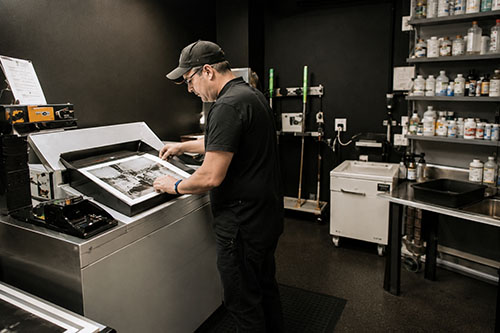
Carefully restored from historic photographic source material and professionally lab-developed, this museum-quality photograph is presented uncropped, preserving the complete image area contained in the source. Meticulous restoration recovers facial detail, stone texture, staircase definition, cobwebs, costume detail, shadow separation and photographic clarity while retaining the atmospheric depth of the original black-and-white image.
For collectors of Bela Lugosi, Helen Chandler, Dracula and Universal Horror, this is an exceptional image from Carfax Abbey—Count Dracula following Mina beneath the monumental Gothic staircase, surrounded by decaying architecture and immense cobwebs, preserving the extraordinary combination of performance, cinematography and production design that helped make Universal’s 1931 Dracula one of the defining visual achievements of classic horror cinema.
Product Enquiry
Kodak Professional Endura Paper
Kodak Endura papers provide an incredible amount of detail and smooth transition of tones. Designed for the professional photographer in mind, looking for a more traditional photo print style, Kodak Endura provides an extended print life and color gamut almost at the level of a high end fine art paper print.
Archival Matte Paper
Archival Matte Paper, also known as Moab Lasal Photo Matte, is our house stock fine art paper and is an economical favorite for fine art reproductions and photo prints. It features a smooth surface, heavy weight (230 g, 9.5-mil), neutral white, matte paper engineered for accurate color reproduction that provides high contrast and high-resolution output. This paper is acid-free, making it the perfect choice for both photography & fine art reproductions.
Giclee William Turner Paper by Hahnemühle
The William Turner by Hahnemühle is one of the most popular papers used in the Giclee printing industry. This is a 310g natural white mould made natural line paper with 100% rag content making it highly archival. It has a slight coarse texture which gives photos and artwork an elegant look. These fine art paper prints (also known as Giclee) are ordered by galleries, individual artists and photographers. The papers and inks are not only archival but use some of the most accurate print technology for full color prints.
- Giclee prints use very expensive archival pigmented inks.
- Highest level of color gamut available in printing (12 color printing).
- Exceptional black & white printing.
- Fade resistant, pigmented inks which provide a superior color range compared to other types of inks. Widely preferred in fine art and photography circles.
- We ONLY use professional grade fine art and photo paper that resist yellowing and aging.
Framing
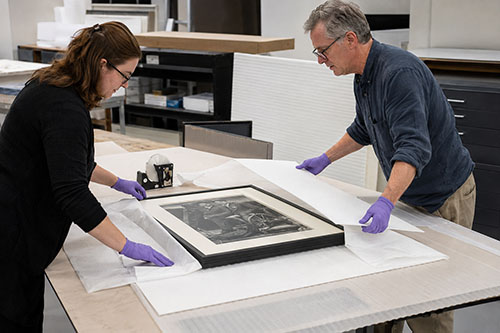
We offer wood and metal frames, custom cut & joined to order. Each framed print includes hanging hardware and foamcore backer.
Matting
We use conservation grade 100% virgin alpha-cellulose 2 ply mats with white core. Acid-free and lignin-free, these are both face resistant and meet all conservation quality standards set by the Fine Art Trade Guild. Mats are digitally cut for ultimate precision. The window will be 1/8″ smaller than the print dimensions.
Glazing (Acrylic Glass)
We offer custom cut panes of shatter-proof, acrylic glass, to protect your valuable artwork and prints.
Premium Clear
Framing grade clear acrylic is shatter resistant and lightweight.
Reflection Control
With its matte finish, Tru Vue Reflection Control® Acrylic scatters light to diminish unwanted glare.
Conservation Clear
Tru Vue Conservation Clear® Acrylic is a framing industry staple, blocking up to 99% of UV rays for ultimate protection.
Conservation Reflection Control
Tru Vue Conservation Reflection Control® Acrylic scatters and diffuses light to reduce unwanted glare. Blocks up to 99% of UV rays.
Related products
-

King Kong Escapes (1967) Gorosaurus & Mechani-Kong Toho Kaiju Battle Artwork
$25.00 -
Barbara Steele – The Long Hair of Death (1964) Flowing Hair Over-Shoulder Gothic Photo
$38.00 -
Barbara Steele – The Long Hair of Death (1964) Helen Karnstein Gothic Close-Up Photo
$38.00 -
Catherine Deneuve – Repulsion (1965) Carol Ledoux Uneasy Close-Up Photo
$30.00


