

Barbara Steele – The Long Hair of Death (1964) Helen Karnstein Gothic Close-Up Photo
Limited Edition Photograph (learn more)
In stock
Barbara Steele appears as Helen Karnstein in this haunting black-and-white close-up from The Long Hair of Death (1964), her enormous dark eyes, flowing hair and solemn expression creating an exceptionally concentrated image of Italian Gothic horror. Framed between pale architectural elements and surrounding shadow, Steele looks intently beyond the camera, her face carrying a mixture of apprehension, mystery and supernatural determination. The restrained composition turns Helen Karnstein into the complete emotional focus of the photograph.
The photograph’s power comes from the extraordinary simplicity of the framing. Steele’s long dark hair falls heavily over her shoulders and through the lower portion of the image, surrounding her pale face almost like an additional Gothic frame. Her eyes are sharply defined by the monochrome lighting, while the delicate trim of her dark period costume remains visible near the neckline. The vertical architectural surfaces at either side compress the composition further, suggesting that Helen is watching from the edge of a doorway or passage within the castle.
This Barbara Steele The Long Hair of Death 1964 photograph captures precisely the qualities that made Steele one of the defining faces of European Gothic cinema. There is no visible violence, elaborate makeup or overt supernatural effect. Instead, the atmosphere depends on Steele’s expression, her extraordinary long hair, the period costume and the enclosing architecture. The resulting image feels simultaneously romantic and threatening, perfectly suited to a story built around betrayal, death and supernatural revenge.
Directed by Antonio Margheriti, The Long Hair of Death was originally released in Italy as I lunghi capelli della morte. Steele is credited in the film as Helen Karnstein and Mary Karnstein, two identities central to the story’s supernatural mystery. Helen is the older daughter of Adele Karnstein, the woman condemned and burned as a witch. After attempting to expose the corruption behind her mother’s death, Helen herself is murdered. Years later, during a violent storm, a mysterious woman calling herself Mary appears bearing Helen’s unmistakable likeness.
That dual identity gives Steele’s appearance throughout the film an unusual ambiguity. Her face can suggest both the murdered Helen and the mysterious woman who returns from the past, allowing Margheriti to build uncertainty around resurrection, identity and vengeance. In a close-up such as this, that ambiguity becomes especially effective: Steele’s fixed gaze and enclosed position suggest someone observing events with knowledge and purpose that the other characters do not yet understand.
Set within a fifteenth-century feudal world of castles, witchcraft, plague and family corruption, the film surrounds Steele with heavy stone interiors and shadowed medieval architecture. Cinematographer Riccardo Pallottini photographed the production in black and white, giving the castle passages and period interiors a severe monochrome character that complements Steele’s dark hair and pale features. Much of the production was filmed at Castello Massimo in Arsoli, Italy, providing the Gothic story with substantial historic architecture.
For collectors of Barbara Steele and Italian Gothic horror photography, this close-up is particularly compelling because virtually everything unnecessary has been stripped away. The image depends almost entirely on Helen’s face, flowing hair, dark costume and the narrow architectural frame surrounding her. It is less a conventional scene photograph than a concentrated study of the haunted beauty and supernatural mystery that made Steele an enduring icon of 1960s horror cinema.
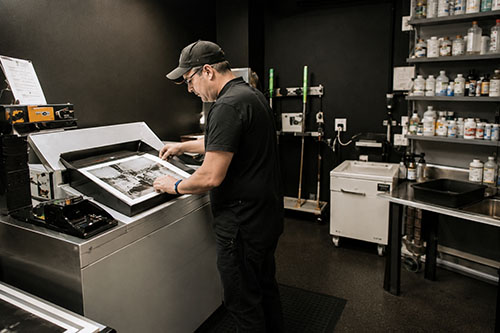
Carefully restored from historic photographic source material and professionally lab-developed, this museum-quality photograph is presented uncropped, preserving the complete image area contained in the source. Restoration recovers facial detail, eye definition, individual hair strands, costume trim and subtle architectural shadow while maintaining the natural tonal gradation and character of the historic black-and-white photograph. The finished photograph contains no AI-generated image content.
Product Enquiry
Kodak Professional Endura Paper
Kodak Endura papers provide an incredible amount of detail and smooth transition of tones. Designed for the professional photographer in mind, looking for a more traditional photo print style, Kodak Endura provides an extended print life and color gamut almost at the level of a high end fine art paper print.
Archival Matte Paper
Archival Matte Paper, also known as Moab Lasal Photo Matte, is our house stock fine art paper and is an economical favorite for fine art reproductions and photo prints. It features a smooth surface, heavy weight (230 g, 9.5-mil), neutral white, matte paper engineered for accurate color reproduction that provides high contrast and high-resolution output. This paper is acid-free, making it the perfect choice for both photography & fine art reproductions.
Giclee William Turner Paper by Hahnemühle
The William Turner by Hahnemühle is one of the most popular papers used in the Giclee printing industry. This is a 310g natural white mould made natural line paper with 100% rag content making it highly archival. It has a slight coarse texture which gives photos and artwork an elegant look. These fine art paper prints (also known as Giclee) are ordered by galleries, individual artists and photographers. The papers and inks are not only archival but use some of the most accurate print technology for full color prints.
- Giclee prints use very expensive archival pigmented inks.
- Highest level of color gamut available in printing (12 color printing).
- Exceptional black & white printing.
- Fade resistant, pigmented inks which provide a superior color range compared to other types of inks. Widely preferred in fine art and photography circles.
- We ONLY use professional grade fine art and photo paper that resist yellowing and aging.
Framing
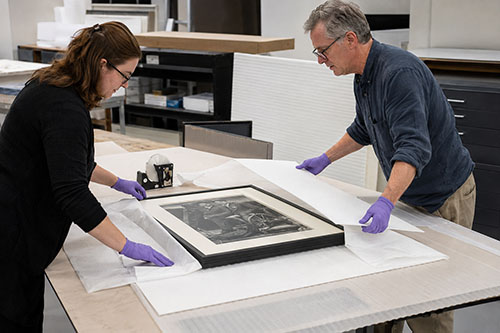
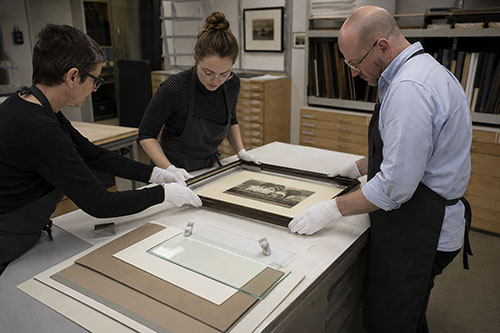
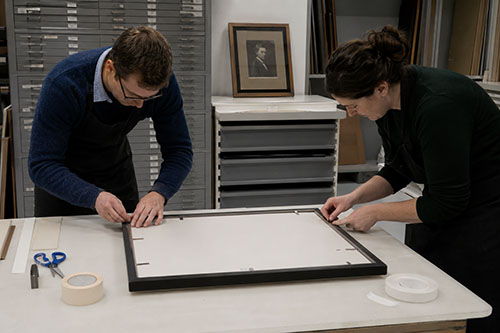
We offer wood and metal frames, custom cut & joined to order. Each framed print includes hanging hardware and foamcore backer.
Matting
We use conservation grade 100% virgin alpha-cellulose 2 ply mats with white core. Acid-free and lignin-free, these are both face resistant and meet all conservation quality standards set by the Fine Art Trade Guild. Mats are digitally cut for ultimate precision. The window will be 1/8″ smaller than the print dimensions.
Glazing (Acrylic Glass)
We offer custom cut panes of shatter-proof, acrylic glass, to protect your valuable artwork and prints.
Premium Clear
Framing grade clear acrylic is shatter resistant and lightweight.
Reflection Control
With its matte finish, Tru Vue Reflection Control® Acrylic scatters light to diminish unwanted glare.
Conservation Clear
Tru Vue Conservation Clear® Acrylic is a framing industry staple, blocking up to 99% of UV rays for ultimate protection.
Conservation Reflection Control
Tru Vue Conservation Reflection Control® Acrylic scatters and diffuses light to reduce unwanted glare. Blocks up to 99% of UV rays.
Related products
-

Barbara Steele – Black Sunday (1960) Princess Asa Vajda Witch’s Crypt Mario Bava Italian Gothic Horror Photo
$25.00 -
Leonard Whiting – Frankenstein: The True Story (1973) Victor Assembling the Creature Scene Photo
$25.00 -
Klaus Kinski – Fitzcarraldo (1982) Brian Sweeney Fitzgerald Leopard Tapestry Publicity Photo
$25.00 -
Barbara Steele – Black Sunday (1960) Princess Asa Vajda Mask of Satan Wounds Close-Up Photo
$30.00


