

Boris Karloff – Frankenstein (1931) Monster in Doorway with Outstretched Hands Universal Horror Photo
Limited Edition Photograph (learn more)
In stock
BORIS KARLOFF appears as Frankenstein’s Monster with both hands extended before him in this dramatic black-and-white image from Frankenstein (1931). Emerging from deep shadow beside a massive masonry doorway, Karloff dominates the composition through expression and physical gesture rather than action. His arms are opened toward the viewer, the large hands emphasized by the lighting and camera angle, while his raised shoulders and slightly forward posture give the Monster an unusually vulnerable presence. The dark costume merges into the surrounding shadows, concentrating attention on Karloff’s face, hands and the rough brickwork at the edge of the frame. The result is a remarkably direct image of the Monster in which body language becomes as important as Jack Pierce’s instantly recognizable makeup.
The photograph demonstrates one of the great strengths of Karloff’s performance: his ability to make the Monster communicate through movement. His extended hands can suggest uncertainty, appeal, confusion or apprehension without requiring an exaggerated pose. The doorway is equally important visually. Its heavy masonry provides a hard architectural boundary beside the figure, while the darkness behind Karloff allows him to appear as though he is emerging physically from the shadows. For collectors searching for Boris Karloff Frankenstein 1931 imagery, this photograph offers a particularly expressive presentation of the Monster rather than a conventional studio portrait.
Directed by James Whale and produced by Carl Laemmle Jr. for Universal Pictures, Frankenstein was released in 1931 and became one of the defining films of early American horror cinema. Colin Clive stars as Henry Frankenstein, with Mae Clarke as Elizabeth, John Boles as Victor Moritz, Edward Van Sloan as Dr. Waldman and Dwight Frye as Fritz. AFI confirms Karloff as the Monster and lists Universal Pictures as the production company, with cinematography by Arthur Edeson and production design by Charles D. Hall.
Karloff’s screen credit was famously withheld at the beginning of the film, where the Monster was listed with a question mark, before his name appeared in the closing credits. That decision helped intensify the mystery surrounding the character, but it was Karloff’s performance and physical presence that made the role enduring. Whale’s direction, Edeson’s high-contrast photography and Hall’s Gothic production environments created a visual style that became inseparable from the Universal Horror tradition. AFI’s production history also records the film’s importance within Universal’s developing cycle of horror films and notes that it was followed by Bride of Frankenstein, again directed by Whale and starring Karloff and Clive.
This image is especially appealing because it isolates the Monster’s human qualities. There are no laboratory machines, villagers or elaborate action competing for attention. Instead, the photograph depends upon Karloff himself: his stance, open hands, facial expression and the contrast between his dark figure and the surrounding stone. It is precisely the kind of image that shows why his largely speechless characterization remained so powerful.
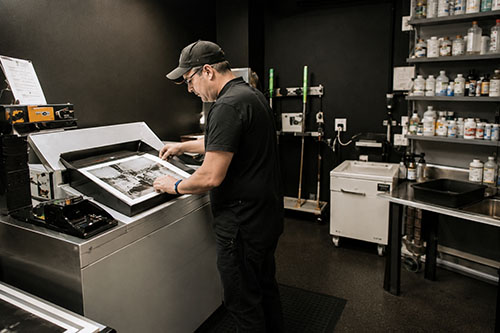
Carefully restored from historic photographic source material and professionally lab-developed, this museum-quality photograph is presented uncropped, preserving the complete image area contained in the source. The restoration recovers fine facial detail, the texture of Karloff’s makeup and costume, the contours of his extended hands, the rough masonry and the subtle tonal separation within the surrounding shadows while retaining the character of the original black-and-white photography. The finished photograph contains no AI-generated image content.
A compelling portrait of Boris Karloff as Frankenstein’s Monster, this photograph combines one of horror cinema’s most famous performances with an expressive composition that should appeal strongly to collectors of Universal Monsters, classic horror and early sound-era film photography.
Product Enquiry
Kodak Professional Endura Paper
Kodak Endura papers provide an incredible amount of detail and smooth transition of tones. Designed for the professional photographer in mind, looking for a more traditional photo print style, Kodak Endura provides an extended print life and color gamut almost at the level of a high end fine art paper print.
Archival Matte Paper
Archival Matte Paper, also known as Moab Lasal Photo Matte, is our house stock fine art paper and is an economical favorite for fine art reproductions and photo prints. It features a smooth surface, heavy weight (230 g, 9.5-mil), neutral white, matte paper engineered for accurate color reproduction that provides high contrast and high-resolution output. This paper is acid-free, making it the perfect choice for both photography & fine art reproductions.
Giclee William Turner Paper by Hahnemühle
The William Turner by Hahnemühle is one of the most popular papers used in the Giclee printing industry. This is a 310g natural white mould made natural line paper with 100% rag content making it highly archival. It has a slight coarse texture which gives photos and artwork an elegant look. These fine art paper prints (also known as Giclee) are ordered by galleries, individual artists and photographers. The papers and inks are not only archival but use some of the most accurate print technology for full color prints.
- Giclee prints use very expensive archival pigmented inks.
- Highest level of color gamut available in printing (12 color printing).
- Exceptional black & white printing.
- Fade resistant, pigmented inks which provide a superior color range compared to other types of inks. Widely preferred in fine art and photography circles.
- We ONLY use professional grade fine art and photo paper that resist yellowing and aging.
Framing
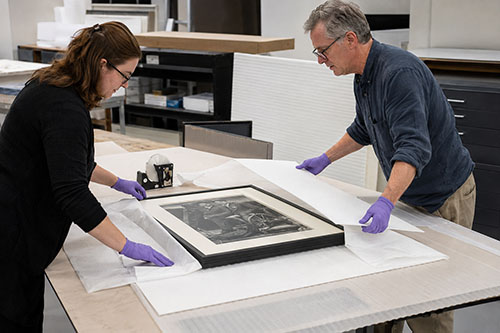
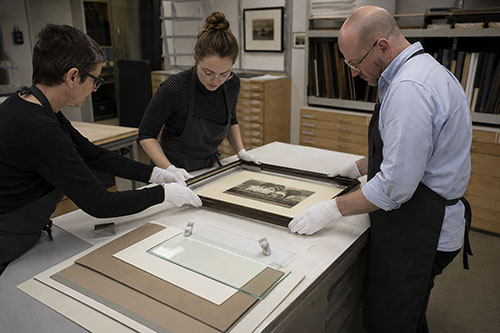
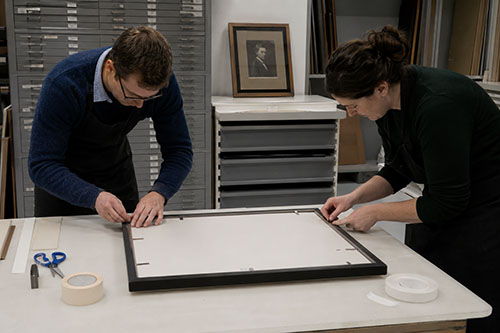
We offer wood and metal frames, custom cut & joined to order. Each framed print includes hanging hardware and foamcore backer.
Matting
We use conservation grade 100% virgin alpha-cellulose 2 ply mats with white core. Acid-free and lignin-free, these are both face resistant and meet all conservation quality standards set by the Fine Art Trade Guild. Mats are digitally cut for ultimate precision. The window will be 1/8″ smaller than the print dimensions.
Glazing (Acrylic Glass)
We offer custom cut panes of shatter-proof, acrylic glass, to protect your valuable artwork and prints.
Premium Clear
Framing grade clear acrylic is shatter resistant and lightweight.
Reflection Control
With its matte finish, Tru Vue Reflection Control® Acrylic scatters light to diminish unwanted glare.
Conservation Clear
Tru Vue Conservation Clear® Acrylic is a framing industry staple, blocking up to 99% of UV rays for ultimate protection.
Conservation Reflection Control
Tru Vue Conservation Reflection Control® Acrylic scatters and diffuses light to reduce unwanted glare. Blocks up to 99% of UV rays.
Related products
-

Fay Wray – King Kong (1933) Ann Darrow Torn Dress Skull Island Publicity Photo
$38.00 -
Boris Karloff – The Haunted Strangler (1958) James Rankin Facial Transformation Photo
$30.00 -
Klaus Kinski – Fitzcarraldo (1982) Brian Sweeney Fitzgerald Leopard Tapestry Publicity Photo
$25.00 -
Catherine Deneuve – Repulsion (1965) Carol Ledoux Profile Close-Up Photo
$30.00


