
Boris Karloff – The Haunted Strangler (1958) James Rankin Facial Transformation Photo
Limited Edition Photograph (learn more)
In stock
Boris Karloff is captured as James Rankin during his terrifying transformation into the Strangler in this stark black-and-white photograph from The Haunted Strangler (1958). Photographed in an exceptionally tight close-up, Karloff dominates the frame with his face violently distorted, his hair disheveled and his eyes fixed in an intense stare. A dark-gloved hand curls upward near his chest while the rough stone surface immediately beside him contributes to the image’s claustrophobic, threatening atmosphere.
Harsh directional lighting is one of the photograph’s strongest features. Illumination strikes Karloff from the side, carving deep shadows across his face and emphasizing every change in expression. The light catches the strands of his tousled hair, the folds of his costume and the contours of his cheek and mouth, while much of the opposite side of the composition disappears into near-black shadow. The result is an image built around contrast and physical performance rather than elaborate surroundings.
Boris Karloff The Haunted Strangler 1958 imagery is particularly fascinating because James Rankin’s transformation depended heavily on Karloff himself. Production accounts record that while director Robert Day and the makeup department considered how to create the altered appearance, Karloff demonstrated that he could achieve much of the effect simply by removing his dentures and manipulating his facial muscles. The resulting asymmetry, combined with his contorted mouth, narrowed eye, hunched posture and disordered hair, created a startling physical transformation with comparatively little reliance on elaborate prosthetic makeup.
Directed by Robert Day, The Haunted Strangler stars Karloff as nineteenth-century writer and social reformer James Rankin, who becomes convinced that the wrong man was executed two decades earlier for the crimes of the Haymarket Strangler. Rankin’s investigation takes him into the buried evidence surrounding the murders and ultimately exposes a horrific connection between himself and the long-dead killer. The film was also released under the title Grip of the Strangler.
The photograph concentrates on the moment when Rankin’s civilized appearance gives way to something visibly monstrous. Karloff’s transformation is not presented as a conventional creature effect; instead, the horror comes from seeing a familiar human face physically reorganized through expression, posture and shadow. His mouth is pulled sharply to one side, one eye appears more exposed than the other, and the raised gloved hand adds a predatory quality to the pose.
That reliance on performance gives the image special importance within Karloff’s later horror work. The actor had spent decades associated with elaborate screen monsters, yet here the effect is created largely through his own face and body. Criterion describes the film as the story of Rankin’s investigation into an old murder case that leads him toward an inescapable secret, making this distorted close-up a powerful visual encapsulation of the character’s collapse.
For collectors of classic horror photography, the photograph offers an unusually concentrated study of Boris Karloff’s physical acting, stripped of distracting scenery and focused almost entirely on transformation, expression, light and texture. The rough wall, dark glove, rumpled costume and severe monochrome lighting frame Karloff at one of the most extreme moments of his performance.
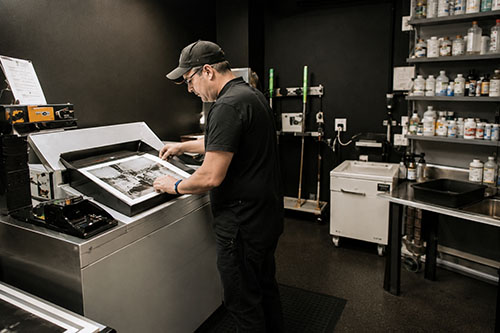
Carefully restored from historic photographic source material and professionally lab-developed, this museum-quality photograph is presented uncropped, preserving the complete image area contained in the source. Restoration recovers facial texture, disheveled hair, gloved-hand detail, costume folds and rough stone-wall texture while maintaining the natural tonal gradation and character of the historic black-and-white photograph. The finished photograph contains no AI-generated image content.
Product Enquiry
Kodak Professional Endura Paper
Kodak Endura papers provide an incredible amount of detail and smooth transition of tones. Designed for the professional photographer in mind, looking for a more traditional photo print style, Kodak Endura provides an extended print life and color gamut almost at the level of a high end fine art paper print.
Archival Matte Paper
Archival Matte Paper, also known as Moab Lasal Photo Matte, is our house stock fine art paper and is an economical favorite for fine art reproductions and photo prints. It features a smooth surface, heavy weight (230 g, 9.5-mil), neutral white, matte paper engineered for accurate color reproduction that provides high contrast and high-resolution output. This paper is acid-free, making it the perfect choice for both photography & fine art reproductions.
Giclee William Turner Paper by Hahnemühle
The William Turner by Hahnemühle is one of the most popular papers used in the Giclee printing industry. This is a 310g natural white mould made natural line paper with 100% rag content making it highly archival. It has a slight coarse texture which gives photos and artwork an elegant look. These fine art paper prints (also known as Giclee) are ordered by galleries, individual artists and photographers. The papers and inks are not only archival but use some of the most accurate print technology for full color prints.
- Giclee prints use very expensive archival pigmented inks.
- Highest level of color gamut available in printing (12 color printing).
- Exceptional black & white printing.
- Fade resistant, pigmented inks which provide a superior color range compared to other types of inks. Widely preferred in fine art and photography circles.
- We ONLY use professional grade fine art and photo paper that resist yellowing and aging.
Framing
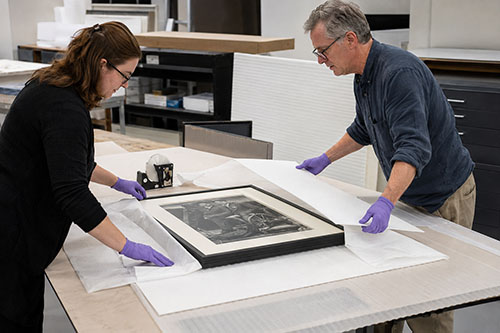
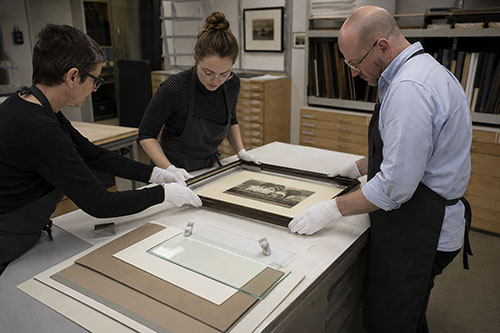
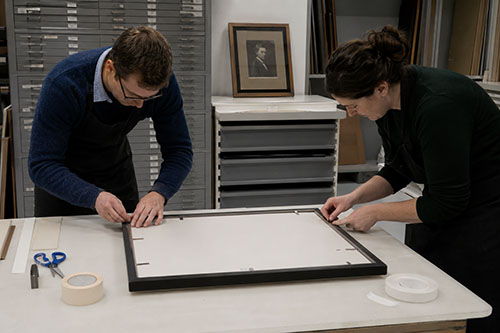
We offer wood and metal frames, custom cut & joined to order. Each framed print includes hanging hardware and foamcore backer.
Matting
We use conservation grade 100% virgin alpha-cellulose 2 ply mats with white core. Acid-free and lignin-free, these are both face resistant and meet all conservation quality standards set by the Fine Art Trade Guild. Mats are digitally cut for ultimate precision. The window will be 1/8″ smaller than the print dimensions.
Glazing (Acrylic Glass)
We offer custom cut panes of shatter-proof, acrylic glass, to protect your valuable artwork and prints.
Premium Clear
Framing grade clear acrylic is shatter resistant and lightweight.
Reflection Control
With its matte finish, Tru Vue Reflection Control® Acrylic scatters light to diminish unwanted glare.
Conservation Clear
Tru Vue Conservation Clear® Acrylic is a framing industry staple, blocking up to 99% of UV rays for ultimate protection.
Conservation Reflection Control
Tru Vue Conservation Reflection Control® Acrylic scatters and diffuses light to reduce unwanted glare. Blocks up to 99% of UV rays.
Related products
-

King Kong (1933) New York Exhibition Escape Pre-Production Concept Artwork
$38.00 -
Colin Clive & Dwight Frye – Frankenstein (1931) Bandaged Monster in Laboratory Universal Horror Photo
$38.00 -
King Kong Escapes (1967) Mechani-Kong Battle Toho Kaiju Promotional Artwork
$25.00 -
King Kong Escapes (1967) Gorosaurus & Mechani-Kong Toho Kaiju Battle Artwork
$25.00


