

Peter Cushing in the Laboratory – Frankenstein Created Woman (1967) Publicity Photo
Limited Edition Photograph (learn more)
In stock
Peter Cushing leans over a laboratory table as Baron Victor Frankenstein in this black-and-white publicity photograph from Hammer’s Frankenstein Created Woman (1967). His gloved hands are braced on either side of a cloth-covered form, and he looks straight ahead with a fixed, unsmiling expression. The white cuffs at his wrists stand out against his dark suit, while shelves of bottles and jars place him firmly in his working environment. For collectors of Peter Cushing photographs, it is a concentrated image of the actor in one of his defining roles.
The camera is positioned across the table, close enough for the folds of the cloth to fill the foreground. Your eye moves from the fabric to Cushing’s gloves, then up along his arms to his face. That forward lean gives the still its force. The Baron appears to have paused over his work and looked up, and the placement of the table makes it feel as though the viewer is standing directly across from him. The photograph leaves the form beneath the cloth concealed, giving the scene a tension that depends as much on what we can see of Cushing as on what he is examining.
Directed by Terence Fisher, Frankenstein Created Woman was the fourth entry in Hammer’s Frankenstein series. Cushing returns as the Baron, joined by Susan Denberg as Christina, Robert Morris as Hans, and Thorley Walters as Dr. Hertz. The story follows Frankenstein’s attempt to preserve the human soul after death. When Hans is wrongly executed and Christina dies, the Baron restores her body and transfers Hans’s soul into it, setting in motion a revenge story that reaches beyond the laboratory.
Cushing’s posture suits the way the Baron approaches that experiment. He stands with his arms straight and his weight forward, as though he expects to resume work at any moment. His clothes are equally precise. The patterned cravat is visible against the white collar, and the narrow band of each cuff divides the dark sleeve from the glove. These are small details, but they give the character a sense of order. Cushing holds that composure even as the cloth and the crowded shelves suggest how much is going on around him.
The laboratory setting also rewards a closer look. Pale bottles are grouped on the shelves at right, their different heights breaking up the straight lines of the shelving. At left, the rough surface behind the table catches the light in irregular patches. Those textures are typical of what collectors can enjoy in a well-defined black-and-white production photograph. Here, they give the background enough character to establish the room while leaving the clearest contrast around the Baron’s face and hands.
For a Hammer Horror photography collection, this image pairs naturally with a portrait of Denberg as Christina or with a theatrical poster for the film. It captures the Baron in the place where his decisions set the story in motion, with the laboratory and covered table immediately identifiable. Displayed on its own, the photograph has a strong silhouette and a direct gaze that carries across a room. Up close, the folds of the cloth, the rows of bottles, and the pattern of Cushing’s cravat offer more to discover.
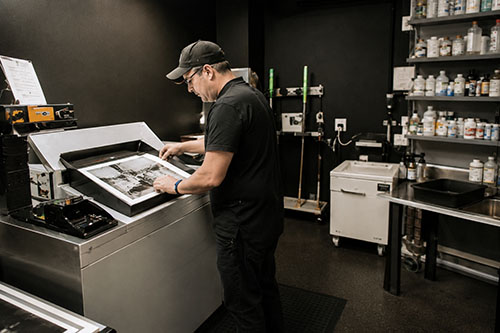
Carefully restored from historic photographic source material and professionally lab-developed, this museum-quality photograph is presented uncropped, preserving the complete image area contained in the source. Restoration recovers facial detail, cravat pattern, folds in the table covering and tonal separation among the laboratory shelves and bottles while maintaining the natural tonal gradation and authentic character of the historic black-and-white photograph. The finished photograph contains no AI-generated image content.
Product Enquiry
Kodak Professional Endura Paper
Kodak Endura papers provide an incredible amount of detail and smooth transition of tones. Designed for the professional photographer in mind, looking for a more traditional photo print style, Kodak Endura provides an extended print life and color gamut almost at the level of a high end fine art paper print.
Archival Matte Paper
Archival Matte Paper, also known as Moab Lasal Photo Matte, is our house stock fine art paper and is an economical favorite for fine art reproductions and photo prints. It features a smooth surface, heavy weight (230 g, 9.5-mil), neutral white, matte paper engineered for accurate color reproduction that provides high contrast and high-resolution output. This paper is acid-free, making it the perfect choice for both photography & fine art reproductions.
Giclee William Turner Paper by Hahnemühle
The William Turner by Hahnemühle is one of the most popular papers used in the Giclee printing industry. This is a 310g natural white mould made natural line paper with 100% rag content making it highly archival. It has a slight coarse texture which gives photos and artwork an elegant look. These fine art paper prints (also known as Giclee) are ordered by galleries, individual artists and photographers. The papers and inks are not only archival but use some of the most accurate print technology for full color prints.
- Giclee prints use very expensive archival pigmented inks.
- Highest level of color gamut available in printing (12 color printing).
- Exceptional black & white printing.
- Fade resistant, pigmented inks which provide a superior color range compared to other types of inks. Widely preferred in fine art and photography circles.
- We ONLY use professional grade fine art and photo paper that resist yellowing and aging.
Framing
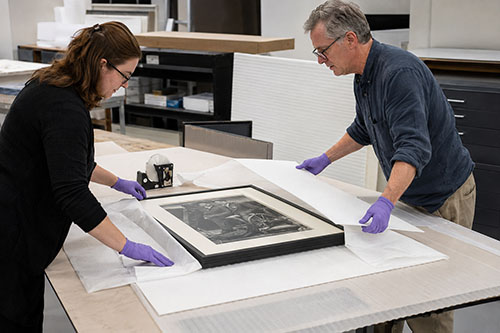
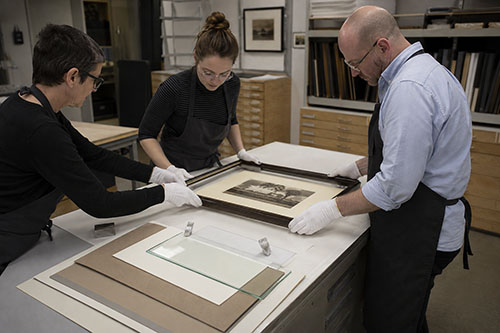
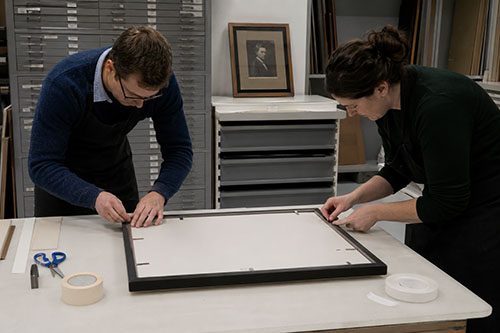
We offer wood and metal frames, custom cut & joined to order. Each framed print includes hanging hardware and foamcore backer.
Matting
We use conservation grade 100% virgin alpha-cellulose 2 ply mats with white core. Acid-free and lignin-free, these are both face resistant and meet all conservation quality standards set by the Fine Art Trade Guild. Mats are digitally cut for ultimate precision. The window will be 1/8″ smaller than the print dimensions.
Glazing (Acrylic Glass)
We offer custom cut panes of shatter-proof, acrylic glass, to protect your valuable artwork and prints.
Premium Clear
Framing grade clear acrylic is shatter resistant and lightweight.
Reflection Control
With its matte finish, Tru Vue Reflection Control® Acrylic scatters light to diminish unwanted glare.
Conservation Clear
Tru Vue Conservation Clear® Acrylic is a framing industry staple, blocking up to 99% of UV rays for ultimate protection.
Conservation Reflection Control
Tru Vue Conservation Reflection Control® Acrylic scatters and diffuses light to reduce unwanted glare. Blocks up to 99% of UV rays.
Related products
-

Peter Cushing & Susan Denberg – Frankenstein Created Woman (1967) Bandage Bikini Laboratory Hammer Publicity Photo
$25.00 -
Susan Denberg – Frankenstein Created Woman (1967) White Bed Publicity Photo
$30.00 -
Susan Denberg Behind the White Metal Bed – Frankenstein Created Woman (1967) Publicity Photo
$30.00 -
Susan Denberg Beside the White Scroll Headboard – Frankenstein Created Woman (1967) Publicity Photo
$30.00


