

Terence Young & Ursula Andress – Dr. No (1962) Director Briefing James Bond 007 BTS Photo
Limited Edition Photograph (learn more)
In stock
TERENCE YOUNG briefs URSULA ANDRESS during production of Dr. No (1962) in this revealing black-and-white behind-the-scenes photograph from the creation of the first Eon Productions James Bond film. Young sits directly in front of Andress, gesturing toward himself as he discusses the forthcoming scene, while Andress stands listening in costume with her hands at her hips. Her patterned sleeveless top and light trousers contrast sharply with Young’s dark jacket, drawing attention immediately to the director-performer interaction. Studio lighting, equipment and portions of the working set remain visible around them, removing the illusion of the finished movie and preserving an unusually direct view of filmmaking in progress.
What distinguishes the photograph is the concentration between director and actress. Young is not posing for a production portrait, and Andress is not being presented simply as Honey Ryder; instead, the image records the practical communication required before a take. Their close positioning and Young’s animated gesture give the photograph a strong documentary quality, while the exposed lamp above them reinforces its behind-the-scenes character. For collectors seeking Terence Young Ursula Andress Dr. No 1962 material, it provides something substantially different from the familiar beach and publicity imagery associated with the film.
The surviving original caption accompanying this photograph is particularly useful, identifying Terence Young briefing Ursula Andress on how to perform her next scene and carrying the agency reference 7294-5. That contemporary identification gives the image an unusually specific production context and supports what is visibly taking place in the photograph without requiring speculation about the exact scene being prepared.
Directed by Terence Young and produced by Albert R. Broccoli and Harry Saltzman, Dr. No introduced Sean Connery as James Bond 007 and Andress as Honey Ryder, alongside Joseph Wiseman as Dr. No, Jack Lord as Felix Leiter, John Kitzmiller as Quarrel and Bernard Lee as M. The official James Bond archive confirms Young as director, Broccoli and Saltzman as producers, and Jamaica and Pinewood Studios as the principal production locations.
Young played an important role in establishing the screen personality of the new cinematic Bond world. Official 007 production history notes that the producers selected him because his sense of elegance, style and panache suited Ian Fleming’s character, while filming began in Jamaica on January 16, 1962 before moving to Pinewood for interiors. Andress joined the production as Honey Ryder, whose celebrated introduction on the Jamaican shoreline became one of the defining visual moments not only of Dr. No but of the developing Bond series.
For the collector, this photograph reveals the human process behind that polished screen result. Instead of Honey Ryder emerging from the sea or Bond confronting Dr. No, we see a director explaining, an actress listening and the technical environment surrounding them. It is a compact but highly evocative record of director and performer actively shaping a scene during the production that established cinematic James Bond.
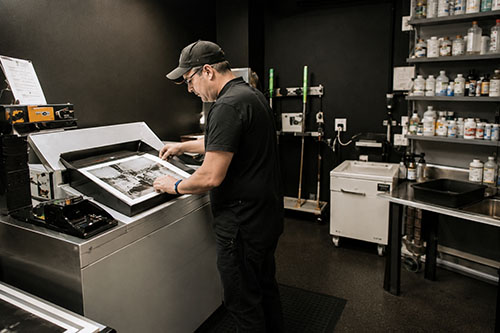
Carefully restored from historic photographic source material and professionally lab-developed, this museum-quality photograph is presented uncropped, preserving the complete image area contained in the source. Restoration recovers facial detail, clothing texture, studio lighting, set equipment and subtle shadow detail while maintaining the natural tonal gradation and character of the historic black-and-white photograph. The finished photograph contains no AI-generated image content.
A particularly strong choice for collectors of James Bond 007, Ursula Andress, Terence Young and behind-the-scenes film photography, this image preserves the creative process behind one of cinema’s most influential franchise beginnings.
Product Enquiry
Kodak Professional Endura Paper
Kodak Endura papers provide an incredible amount of detail and smooth transition of tones. Designed for the professional photographer in mind, looking for a more traditional photo print style, Kodak Endura provides an extended print life and color gamut almost at the level of a high end fine art paper print.
Archival Matte Paper
Archival Matte Paper, also known as Moab Lasal Photo Matte, is our house stock fine art paper and is an economical favorite for fine art reproductions and photo prints. It features a smooth surface, heavy weight (230 g, 9.5-mil), neutral white, matte paper engineered for accurate color reproduction that provides high contrast and high-resolution output. This paper is acid-free, making it the perfect choice for both photography & fine art reproductions.
Giclee William Turner Paper by Hahnemühle
The William Turner by Hahnemühle is one of the most popular papers used in the Giclee printing industry. This is a 310g natural white mould made natural line paper with 100% rag content making it highly archival. It has a slight coarse texture which gives photos and artwork an elegant look. These fine art paper prints (also known as Giclee) are ordered by galleries, individual artists and photographers. The papers and inks are not only archival but use some of the most accurate print technology for full color prints.
- Giclee prints use very expensive archival pigmented inks.
- Highest level of color gamut available in printing (12 color printing).
- Exceptional black & white printing.
- Fade resistant, pigmented inks which provide a superior color range compared to other types of inks. Widely preferred in fine art and photography circles.
- We ONLY use professional grade fine art and photo paper that resist yellowing and aging.
Framing
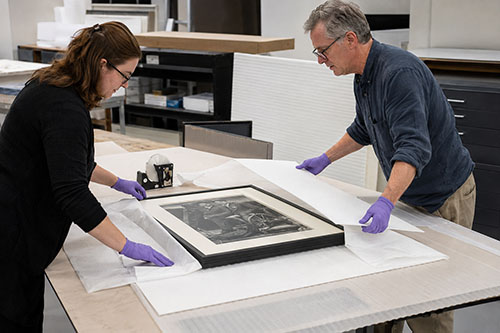
We offer wood and metal frames, custom cut & joined to order. Each framed print includes hanging hardware and foamcore backer.
Matting
We use conservation grade 100% virgin alpha-cellulose 2 ply mats with white core. Acid-free and lignin-free, these are both face resistant and meet all conservation quality standards set by the Fine Art Trade Guild. Mats are digitally cut for ultimate precision. The window will be 1/8″ smaller than the print dimensions.
Glazing (Acrylic Glass)
We offer custom cut panes of shatter-proof, acrylic glass, to protect your valuable artwork and prints.
Premium Clear
Framing grade clear acrylic is shatter resistant and lightweight.
Reflection Control
With its matte finish, Tru Vue Reflection Control® Acrylic scatters light to diminish unwanted glare.
Conservation Clear
Tru Vue Conservation Clear® Acrylic is a framing industry staple, blocking up to 99% of UV rays for ultimate protection.
Conservation Reflection Control
Tru Vue Conservation Reflection Control® Acrylic scatters and diffuses light to reduce unwanted glare. Blocks up to 99% of UV rays.
Related products
-

Peter Cushing & Susan Denberg – Frankenstein Created Woman (1967) Bandage Bikini Laboratory Hammer Publicity Photo
$25.00 -
Robert Hossein – Le Vampire de Düsseldorf (1965) Peter Kürten Night Street Crime Thriller Photo
$25.00 -
Katya Wyeth & Damien Thomas – Twins of Evil (1971) Mircalla Vampire Bite Photo
$30.00 -
Yutte Stensgaard – Lust for a Vampire (1971) Mircalla Carmilla Karnstein White Nightgown Hammer Horror Photo
$30.00


