

Barbara Shelley – Dracula: Prince of Darkness (1966) Vampire Helen Kent Garden Negligee Hammer Horror Publicity Photo
Limited Edition Photograph (learn more)
In stock
Barbara Shelley appears as Helen Kent in this elegant black-and-white publicity photograph from Dracula: Prince of Darkness (1966), standing beneath dense foliage in the flowing low-cut negligee associated with Helen’s transformed appearance. Her long dark hair falls smoothly over her shoulders as she looks directly toward the camera, while delicate wildflowers rise across the foreground and leafy branches frame her from above. The combination of Shelley’s serene expression, pale gown and natural surroundings gives the image an unexpectedly romantic quality while retaining the subtle sensuality and menace associated with Vampire Helen Kent.
The photograph is particularly beautiful for its softer composition. Unlike the preceding close portrait in the same costume, Shelley is shown more upright and surrounded by vegetation, allowing the folds of the negligee and the natural textures of the foliage to become important parts of the image. The small flowers crossing her gown introduce an almost pastoral quality, creating a striking visual contrast with Helen’s supernatural transformation.
Released in 1966, Dracula: Prince of Darkness was directed by Terence Fisher for Hammer Film Productions. Christopher Lee returned as Count Dracula, with Barbara Shelley as Helen, Andrew Keir as Father Sandor, Francis Matthews as Charles, Suzan Farmer as Diana and Charles Tingwell as Alan.
Helen begins the film as the most anxious and cautious of the travelers who find themselves at Dracula’s castle. Her fears prove justified, but after she falls victim to the Count her personality changes dramatically. Shelley transforms the restrained and apprehensive Helen into a confident, predatory vampire, creating one of the most memorable character reversals in Hammer’s classic Dracula cycle.
That transformation became a showcase for Barbara Shelley’s ability to move between vulnerability and menace. The elegant, nervous woman seen early in the story gives way to a far more sensual and dangerous figure, and Shelley’s performance helped make Helen one of Hammer Horror’s best-remembered female vampires.
Dracula: Prince of Darkness was particularly important because it marked Christopher Lee’s first sequel appearance as Count Dracula following Hammer’s Dracula (1958). Lee’s Dracula has no spoken dialogue in the film, relying instead on physical movement, expression and commanding screen presence. The production became one of the defining entries in Hammer’s mid-1960s Gothic period.
For Shelley, the film arrived during an extraordinary run of genre performances. Her work included The Gorgon (1964), Dracula: Prince of Darkness (1966), Rasputin the Mad Monk (1966) and Quatermass and the Pit (1967), following her earlier success in Village of the Damned (1960). These roles established her as one of the most important women in British Gothic cinema and earned her an enduring reputation among collectors as the Queen of Hammer.
This publicity photograph captures the visual duality that makes Helen’s transformation so effective. There are no visible fangs, wounds or blood; instead, Shelley appears composed and almost serene amid the foliage. Yet her flowing negligee, direct gaze and transformed appearance connect the portrait unmistakably with the more dangerous Helen who emerges after Dracula claims her.
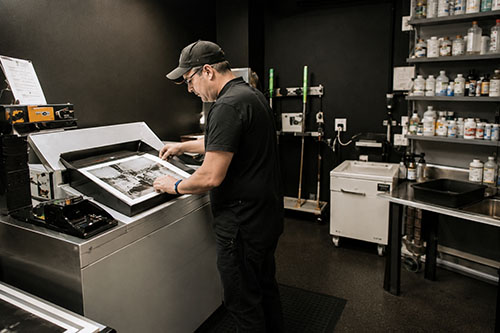
Carefully restored from historic photographic source material and professionally lab-developed, this museum-quality photograph is presented uncropped, preserving the complete image area contained in the source. Meticulous restoration recovers facial detail, hair texture, fabric folds, wildflowers, foliage, tonal range and photographic clarity while retaining the atmospheric character of the original black-and-white publicity photograph.
For collectors of Barbara Shelley, Dracula: Prince of Darkness and Hammer Horror, this is an especially elegant portrait of Vampire Helen Kent—Shelley framed by dense foliage and delicate flowers in her flowing negligee, preserving a softer but unmistakably sensual image from one of the defining vampire performances of her celebrated Hammer career.
Product Enquiry
Kodak Professional Endura Paper
Kodak Endura papers provide an incredible amount of detail and smooth transition of tones. Designed for the professional photographer in mind, looking for a more traditional photo print style, Kodak Endura provides an extended print life and color gamut almost at the level of a high end fine art paper print.
Archival Matte Paper
Archival Matte Paper, also known as Moab Lasal Photo Matte, is our house stock fine art paper and is an economical favorite for fine art reproductions and photo prints. It features a smooth surface, heavy weight (230 g, 9.5-mil), neutral white, matte paper engineered for accurate color reproduction that provides high contrast and high-resolution output. This paper is acid-free, making it the perfect choice for both photography & fine art reproductions.
Giclee William Turner Paper by Hahnemühle
The William Turner by Hahnemühle is one of the most popular papers used in the Giclee printing industry. This is a 310g natural white mould made natural line paper with 100% rag content making it highly archival. It has a slight coarse texture which gives photos and artwork an elegant look. These fine art paper prints (also known as Giclee) are ordered by galleries, individual artists and photographers. The papers and inks are not only archival but use some of the most accurate print technology for full color prints.
- Giclee prints use very expensive archival pigmented inks.
- Highest level of color gamut available in printing (12 color printing).
- Exceptional black & white printing.
- Fade resistant, pigmented inks which provide a superior color range compared to other types of inks. Widely preferred in fine art and photography circles.
- We ONLY use professional grade fine art and photo paper that resist yellowing and aging.
Framing
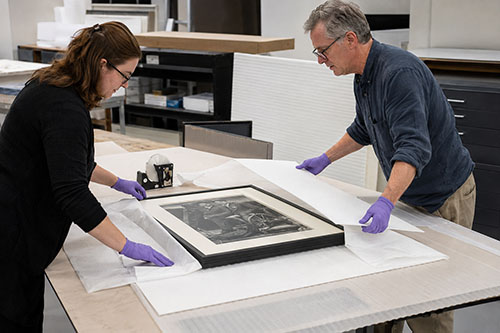
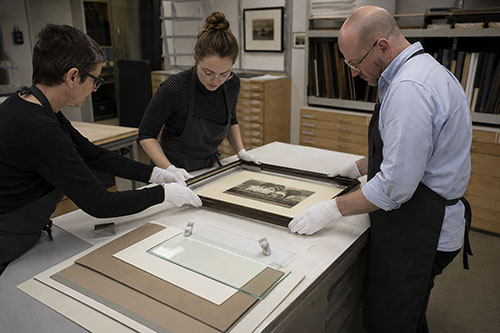
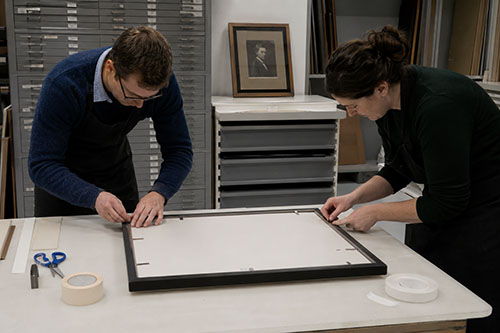
We offer wood and metal frames, custom cut & joined to order. Each framed print includes hanging hardware and foamcore backer.
Matting
We use conservation grade 100% virgin alpha-cellulose 2 ply mats with white core. Acid-free and lignin-free, these are both face resistant and meet all conservation quality standards set by the Fine Art Trade Guild. Mats are digitally cut for ultimate precision. The window will be 1/8″ smaller than the print dimensions.
Glazing (Acrylic Glass)
We offer custom cut panes of shatter-proof, acrylic glass, to protect your valuable artwork and prints.
Premium Clear
Framing grade clear acrylic is shatter resistant and lightweight.
Reflection Control
With its matte finish, Tru Vue Reflection Control® Acrylic scatters light to diminish unwanted glare.
Conservation Clear
Tru Vue Conservation Clear® Acrylic is a framing industry staple, blocking up to 99% of UV rays for ultimate protection.
Conservation Reflection Control
Tru Vue Conservation Reflection Control® Acrylic scatters and diffuses light to reduce unwanted glare. Blocks up to 99% of UV rays.
Related products
-

Peter Cushing – The Curse of Frankenstein (1957) Baron Victor Frankenstein Top Hat Publicity Photo
$30.00 -
The Howling (1981) Werewolf Venetian Blind Shadows Rob Bottin Creature Photo
$25.00 -
King Kong Escapes (1967) Gorosaurus & Mechani-Kong Toho Kaiju Battle Artwork
$25.00 -
Barbara Steele – The Long Hair of Death (1964) Helen Karnstein Gothic Close-Up Photo
$38.00


