

Boris Karloff – Bride of Frankenstein (1935) Classic Monster Portrait Universal Horror Photo
Limited Edition Photograph (learn more)
In stock
Released in 1935, Bride of Frankenstein was produced by Universal Pictures and directed by James Whale. The celebrated sequel to Frankenstein (1931) stars Boris Karloff as Frankenstein's Monster, alongside Colin Clive as Henry Frankenstein, Elsa Lanchester as the Bride, Ernest Thesiger as Dr. Septimus Pretorius and Valerie Hobson as Elizabeth. Inspired by Mary Shelley's literary creation, the film became one of the defining achievements of Universal's classic horror era.
This extraordinary black-and-white portrait captures Boris Karloff in his legendary portrayal of Frankenstein's Monster, presenting one of the most recognizable and emotionally compelling faces in motion-picture history. Photographed against a restrained background, Karloff appears in a striking close-up that concentrates attention on the character's distinctive facial features, elaborate makeup and haunting expression.
The Monster's broad forehead, visible scars, heavy brow and carefully sculpted facial contours immediately identify the extraordinary makeup artistry of Jack Pierce. Yet what makes this photograph particularly fascinating is Karloff's expression. Beneath the imposing exterior, his solemn gaze suggests loneliness, suffering and an unmistakable trace of humanity.
The appearance of the Monster in Bride of Frankenstein differed from his original 1931 incarnation. Makeup artist Jack Pierce modified the character's familiar design to reflect injuries suffered during the burning windmill climax of the preceding film. The altered hairline, visible scars and damaged facial details reinforce the continuity between the two productions while giving the Monster a more weathered appearance.
Pierce's work was exceptionally demanding. Using the sophisticated makeup materials and techniques available during Hollywood's early sound era, he transformed Karloff into a character whose appearance has become inseparable from the history of cinematic horror.
But the achievement extended far beyond makeup. Karloff brought remarkable sensitivity to the role, combining his imposing physical presence with gestures and expressions that communicated the Monster's isolation and longing for companionship.
In Bride of Frankenstein, the creature survives the events of the first film and continues his search for understanding in a world that regards him with terror. His encounters include a deeply moving friendship with a blind hermit, played by O. P. Heggie, who welcomes him without prejudice and briefly provides the kindness he has never known.
Meanwhile, the sinister Dr. Pretorius persuades Henry Frankenstein to help create a female companion for the Monster. When the newly animated Bride, portrayed by Elsa Lanchester, recoils from him in horror, the creature experiences yet another devastating rejection.
These themes of loneliness, prejudice and the desire for human connection give Bride of Frankenstein an emotional richness that distinguishes it from conventional monster films.
This portrait is particularly appealing because it isolates the expressive qualities that made Karloff's interpretation so extraordinary. Without the distraction of elaborate laboratory machinery or supporting performers, the photograph directs attention entirely toward the character's face, revealing the craftsmanship of Pierce's makeup and the subtlety of Karloff's performance.
The powerful contrast between illuminated facial details and darker clothing emphasizes the Monster's unusual features while preserving the atmosphere of classic Universal black-and-white cinematography.
For collectors, this image is a striking representation of a character whose influence extends far beyond the original film series. Karloff's Frankenstein Monster helped establish the visual vocabulary of screen horror and remains among the most enduring figures in popular culture.
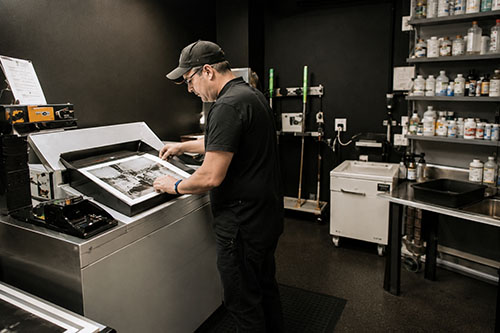
Carefully restored from historic photographic source material and professionally lab-developed, this museum-quality photograph is presented uncropped, preserving the complete image area contained in the source. Restoration recovers facial detail, costume texture, background information, tonal balance and original photographic clarity while maintaining the authentic character of the historic black-and-white image. The finished photograph contains no AI-generated image content.
An exceptional addition for collectors of Boris Karloff, Bride of Frankenstein, James Whale, Jack Pierce, Universal Monsters, Frankenstein memorabilia, classic Hollywood horror, vintage monster portraits, Gothic cinema and historic motion-picture photography, this haunting portrait preserves the extraordinary artistry behind one of cinema's most unforgettable screen creations.
Product Enquiry
Kodak Professional Endura Paper
Kodak Endura papers provide an incredible amount of detail and smooth transition of tones. Designed for the professional photographer in mind, looking for a more traditional photo print style, Kodak Endura provides an extended print life and color gamut almost at the level of a high end fine art paper print.
Archival Matte Paper
Archival Matte Paper, also known as Moab Lasal Photo Matte, is our house stock fine art paper and is an economical favorite for fine art reproductions and photo prints. It features a smooth surface, heavy weight (230 g, 9.5-mil), neutral white, matte paper engineered for accurate color reproduction that provides high contrast and high-resolution output. This paper is acid-free, making it the perfect choice for both photography & fine art reproductions.
Giclee William Turner Paper by Hahnemühle
The William Turner by Hahnemühle is one of the most popular papers used in the Giclee printing industry. This is a 310g natural white mould made natural line paper with 100% rag content making it highly archival. It has a slight coarse texture which gives photos and artwork an elegant look. These fine art paper prints (also known as Giclee) are ordered by galleries, individual artists and photographers. The papers and inks are not only archival but use some of the most accurate print technology for full color prints.
- Giclee prints use very expensive archival pigmented inks.
- Highest level of color gamut available in printing (12 color printing).
- Exceptional black & white printing.
- Fade resistant, pigmented inks which provide a superior color range compared to other types of inks. Widely preferred in fine art and photography circles.
- We ONLY use professional grade fine art and photo paper that resist yellowing and aging.
Framing
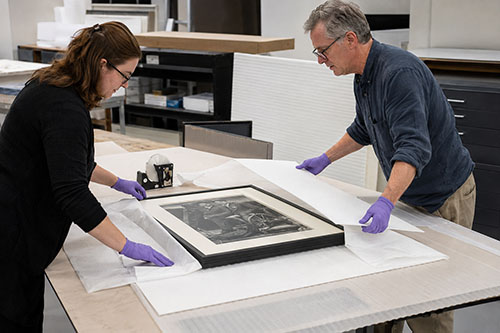
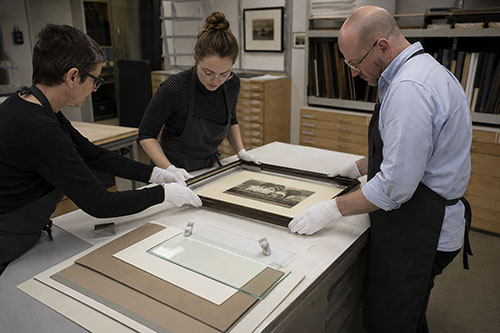
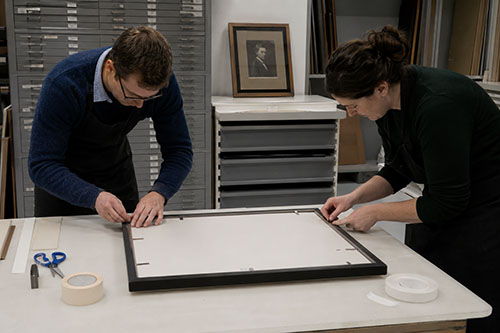
We offer wood and metal frames, custom cut & joined to order. Each framed print includes hanging hardware and foamcore backer.
Matting
We use conservation grade 100% virgin alpha-cellulose 2 ply mats with white core. Acid-free and lignin-free, these are both face resistant and meet all conservation quality standards set by the Fine Art Trade Guild. Mats are digitally cut for ultimate precision. The window will be 1/8″ smaller than the print dimensions.
Glazing (Acrylic Glass)
We offer custom cut panes of shatter-proof, acrylic glass, to protect your valuable artwork and prints.
Premium Clear
Framing grade clear acrylic is shatter resistant and lightweight.
Reflection Control
With its matte finish, Tru Vue Reflection Control® Acrylic scatters light to diminish unwanted glare.
Conservation Clear
Tru Vue Conservation Clear® Acrylic is a framing industry staple, blocking up to 99% of UV rays for ultimate protection.
Conservation Reflection Control
Tru Vue Conservation Reflection Control® Acrylic scatters and diffuses light to reduce unwanted glare. Blocks up to 99% of UV rays.
Related products
-

Leonard Whiting – Frankenstein: The True Story (1973) Victor Assembling the Creature Scene Photo
$25.00 -
Boris Karloff – Frankenstein (1931) Monster Reaching for Sunlight Universal Horror Photo
$38.00 -
Fay Wray – King Kong (1933) Ann Darrow Glamour Close-Up Publicity Photo
$38.00 -
Klaus Kinski – Fitzcarraldo (1982) Brian Sweeney Fitzgerald Leopard Tapestry Publicity Photo
$25.00


