

Christopher Lee, Barbara Shelley & Andrew Keir – Dracula: Prince of Darkness (1966) Bray Studios Stage 2 Hammer Cast & Executives Photo
Limited Edition Photograph (learn more)
In stock
Christopher Lee, Barbara Shelley and Andrew Keir stand among Hammer Film Productions personnel and senior British film-industry executives outside Stage 2 at Bray Studios in this extraordinary black-and-white publicity photograph associated with Dracula: Prince of Darkness (1966). Shelley’s long light-colored dress forms the visual center of the predominantly dark-suited lineup, while Lee’s unmistakable height and Keir’s distinctive presence immediately identify three of the film’s principal stars. The corrugated studio exterior and vast Stage 2 doorway give the photograph an unusually direct sense of place, preserving Hammer’s celebrated Bray Studios operation at the height of its classic Gothic period.
The photograph is particularly important because it brings performers, Hammer management, production personnel and executives from the wider British film industry together in a single formal lineup. Rather than depicting a scene from the film, the image documents the business and production infrastructure surrounding Hammer’s success—an exceptional record of the people involved in bringing its Gothic productions from Bray Studios to cinemas.
A surviving published caption identifies the lineup outside Stage Two at Bray Studios as including Macgregor Scott, managing director of Warner-Pathé; Christopher Lee; Andrew Keir; C. J. Latta, managing director of Associated British Pictures; D. J. Goodlatte, managing director of Associated British Cinemas; Barbara Shelley; Hammer chairman and co-founder James Carreras; Francis Matthews; J. H. MacDonald; J. R. Wallis, responsible for ABPC studio operations; Anthony Hinds; Hammer director Brian Lawrence; and producer and Bray Studios general manager Anthony Nelson Keys. The original published identification also records one additional man in the lineup without a name.
Released in 1966, Dracula: Prince of Darkness was directed by Terence Fisher and produced by Anthony Nelson Keys for Hammer Film Productions. Christopher Lee returned as Count Dracula, with Barbara Shelley as Helen Kent, Andrew Keir as Father Sandor and Francis Matthews as Charles Kent. The principal cast also includes Suzan Farmer as Diana Kent, Charles Tingwell as Alan Kent and Philip Latham as Klove.
The production marked Christopher Lee’s first sequel appearance as Count Dracula following Hammer’s Dracula (1958). Lee had not appeared in The Brides of Dracula (1960), making his return an important publicity event for Hammer. BFI records that Dracula: Prince of Darkness began shooting at Bray Studios under Fisher on 26 April 1965 and wrapped in early June.
For Barbara Shelley, Helen Kent became one of her defining Hammer performances. The character begins as the most restrained and apprehensive of the travelers arriving at Dracula’s castle before undergoing a dramatic transformation into a vampire. Shelley’s shift from fearful respectability to predatory menace created one of the film’s most memorable character arcs and strengthened her reputation as one of Hammer’s essential female stars.
Andrew Keir’s Father Sandor provides the principal opposition to Dracula, while Francis Matthews’ Charles Kent becomes central to the effort to rescue Diana and confront the resurrected Count. Their presence alongside Lee and Shelley in this formal Bray Studios gathering makes the photograph especially attractive to collectors because it combines several key performers with the executives responsible for Hammer’s production and distribution network.
The photograph also captures Hammer at a particularly ambitious moment. Producer Anthony Nelson Keys had devised a plan to shoot four films in rapid succession—Dracula: Prince of Darkness, Rasputin the Mad Monk, The Plague of the Zombies and The Reptile—allowing sets, costumes and production resources to be shared. BFI records that the four productions followed one another almost continuously at Bray during 1965.
Bray Studios, at Down Place near Windsor, had become synonymous with Hammer’s Gothic identity. Its stages, grounds and adaptable sets provided the production base for many of the films that established Hammer internationally. The Hammer Graveyard production record confirms Bray Studios as the studio base for Dracula: Prince of Darkness, with filming running from April through June 1965.
That context gives this photograph exceptional historical value. It is not merely a cast portrait: it records Hammer stars, company leadership, cinema executives and distribution figures standing together outside the actual stage where the studio’s filmmaking operation was taking place. The plain industrial architecture behind them provides a fascinating contrast with the lavish Gothic castles and interiors audiences ultimately saw on screen.
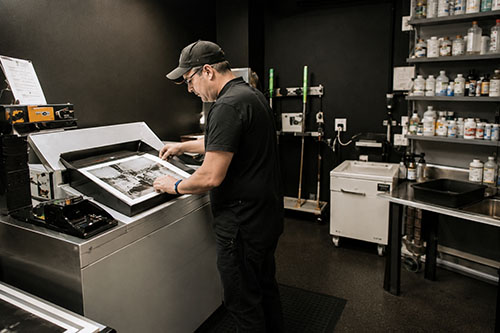
Carefully restored from historic photographic source material and professionally lab-developed, this museum-quality photograph is presented uncropped, preserving the complete image area contained in the source. Meticulous restoration recovers facial detail, clothing texture, studio architecture, tonal range and photographic clarity while retaining the documentary character of the original black-and-white publicity photograph.
For collectors of Christopher Lee, Barbara Shelley, Andrew Keir, Dracula: Prince of Darkness and Hammer Film Productions, this is an exceptional piece of Bray Studios history—cast members and leading Hammer and British film-industry figures assembled outside Stage 2, preserving a remarkable photographic record of the people and studio infrastructure behind one of Hammer Horror’s defining mid-1960s productions.
Product Enquiry
Kodak Professional Endura Paper
Kodak Endura papers provide an incredible amount of detail and smooth transition of tones. Designed for the professional photographer in mind, looking for a more traditional photo print style, Kodak Endura provides an extended print life and color gamut almost at the level of a high end fine art paper print.
Archival Matte Paper
Archival Matte Paper, also known as Moab Lasal Photo Matte, is our house stock fine art paper and is an economical favorite for fine art reproductions and photo prints. It features a smooth surface, heavy weight (230 g, 9.5-mil), neutral white, matte paper engineered for accurate color reproduction that provides high contrast and high-resolution output. This paper is acid-free, making it the perfect choice for both photography & fine art reproductions.
Giclee William Turner Paper by Hahnemühle
The William Turner by Hahnemühle is one of the most popular papers used in the Giclee printing industry. This is a 310g natural white mould made natural line paper with 100% rag content making it highly archival. It has a slight coarse texture which gives photos and artwork an elegant look. These fine art paper prints (also known as Giclee) are ordered by galleries, individual artists and photographers. The papers and inks are not only archival but use some of the most accurate print technology for full color prints.
- Giclee prints use very expensive archival pigmented inks.
- Highest level of color gamut available in printing (12 color printing).
- Exceptional black & white printing.
- Fade resistant, pigmented inks which provide a superior color range compared to other types of inks. Widely preferred in fine art and photography circles.
- We ONLY use professional grade fine art and photo paper that resist yellowing and aging.
Framing
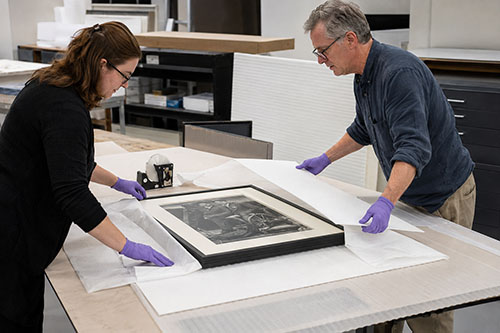
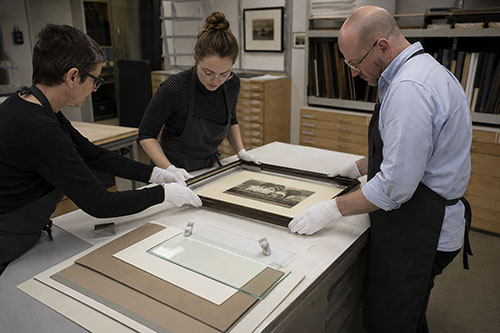
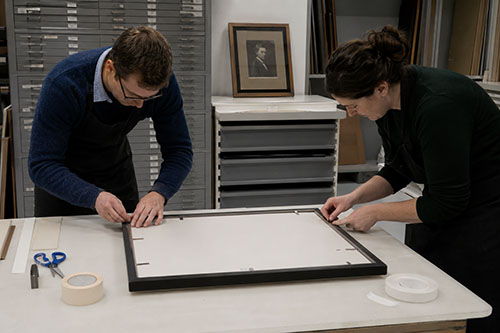
We offer wood and metal frames, custom cut & joined to order. Each framed print includes hanging hardware and foamcore backer.
Matting
We use conservation grade 100% virgin alpha-cellulose 2 ply mats with white core. Acid-free and lignin-free, these are both face resistant and meet all conservation quality standards set by the Fine Art Trade Guild. Mats are digitally cut for ultimate precision. The window will be 1/8″ smaller than the print dimensions.
Glazing (Acrylic Glass)
We offer custom cut panes of shatter-proof, acrylic glass, to protect your valuable artwork and prints.
Premium Clear
Framing grade clear acrylic is shatter resistant and lightweight.
Reflection Control
With its matte finish, Tru Vue Reflection Control® Acrylic scatters light to diminish unwanted glare.
Conservation Clear
Tru Vue Conservation Clear® Acrylic is a framing industry staple, blocking up to 99% of UV rays for ultimate protection.
Conservation Reflection Control
Tru Vue Conservation Reflection Control® Acrylic scatters and diffuses light to reduce unwanted glare. Blocks up to 99% of UV rays.
Related products
-

Christopher Lee & Heinz Drache – The Brides of Fu Manchu (1966) Big Ben Westminster Bridge Cast Publicity Photo
$25.00 -
Christopher Lee & Ewan Hooper – Dracula Has Risen from the Grave (1968) Black Park Hearse Behind-the-Scenes Hammer Horror Photo
$30.00 -
Christopher Lee & Ewan Hooper – Dracula Has Risen from the Grave (1968) Count Dracula & Priest Black Park Hearse Hammer Horror Photo
$30.00 -
CHRISTOPHER LEE – HORROR OF DRACULA (1958) Count Dracula with Stone Eagle Publicity Photo
$30.00