

Christopher Lee & Ewan Hooper – Dracula Has Risen from the Grave (1968) Count Dracula & Priest Black Park Hearse Hammer Horror Photo
Limited Edition Photograph (learn more)
In stock
Christopher Lee as Count Dracula and Ewan Hooper as the Priest are captured aboard Dracula’s horse-drawn hearse in this remarkable color photograph from Dracula Has Risen from the Grave (1968), photographed during the Black Park sequence in Buckinghamshire. Lee sits commandingly at the front of the vehicle with the reins in hand and a long driving whip held upright, while Hooper sits beside him in the Priest’s black clothing and broad-brimmed hat. The brilliant red lining of Dracula’s cape spills dramatically across the seat, creating a vivid slash of color against the dark costumes and wooded landscape.
The photograph is especially striking because it places Dracula outside the familiar castle interiors normally associated with the character. Lee’s tall, rigid posture and control of the reins make him physically dominant within the composition, while the Priest’s position beside him reinforces the character’s submission to Dracula’s influence. The hearse, horses and wooded surroundings give the image a strong sense of movement and location while preserving the unmistakable Gothic identity of Hammer’s Count.
Released in 1968, Dracula Has Risen from the Grave was directed by Freddie Francis and stars Christopher Lee as Count Dracula alongside Ewan Hooper as the Priest, Veronica Carlson as Maria, Rupert Davies as Monsignor Ernst Mueller, Barry Andrews as Paul and Barbara Ewing as Zena. Produced by Aida Young for Hammer Film Productions, the film continued the studio’s celebrated Dracula cycle following Dracula: Prince of Darkness (1966).
The story begins after the Monsignor travels to the village below Dracula’s castle and attempts to exorcise the Count’s domain. The terrified local Priest accompanies him only part of the way, but an accident ultimately contributes to Dracula’s resurrection. Once revived, the Count brings the Priest under his control and uses him as an unwilling servant in his campaign of revenge.
That relationship gives this photograph particular dramatic interest. Ewan Hooper’s Priest is not simply accompanying Dracula voluntarily; he has become trapped within the vampire’s supernatural influence. Sitting beside Lee on the hearse, the two characters create a striking pairing of master and servant, with Dracula visibly controlling both the vehicle and the direction of their journey.
The hearse becomes especially memorable during the Black Park exterior material. The wooded Buckinghamshire landscape provided Hammer with a convincing outdoor setting close to the Pinewood production base, allowing the horse-drawn vehicle and pursuing characters to move through a broader natural environment than the studio interiors could provide.
For Christopher Lee, Dracula Has Risen from the Grave continued the intensely physical interpretation of the Count he had established for Hammer. His Dracula dominates through stature, movement, expression and costume, and this photograph demonstrates how effectively Lee could project authority even while seated. The raised whip, tightly held reins and black cape with its vivid red lining turn a simple driving pose into an exceptionally commanding Dracula image.
Ewan Hooper’s Priest provides a contrasting presence. His subdued posture and dark clerical clothing reinforce the character’s compromised position, while the broad hat and black costume visually complement Lee’s Dracula. Together they create one of the film’s more unusual pairings, moving the vampire mythology away from the castle and directly into the surrounding countryside.
The film was photographed by Arthur Grant, whose color cinematography contributed significantly to Hammer’s late-1960s Gothic style. Dracula Has Risen from the Grave is particularly remembered for its strong use of color, and the intense red of Dracula’s cape lining seen in this photograph demonstrates how effectively costume color could stand out against muted natural backgrounds.
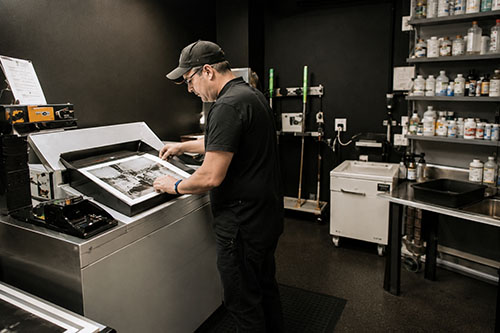
Carefully restored from historic photographic source material and professionally lab-developed, this museum-quality photograph is presented uncropped, preserving the complete image area contained in the source. Meticulous restoration recovers facial detail, cape texture, costume definition, hearse detail, natural foliage, tonal range and color balance while retaining the authentic character of the original color photograph.
For collectors of Christopher Lee, Ewan Hooper, Dracula Has Risen from the Grave and Hammer Horror, this is an exceptional outdoor image—Count Dracula driving the horse-drawn hearse through Black Park with the enslaved Priest seated beside him, the raised whip, reins and brilliant red-lined cape preserving an unusually commanding view of Lee during one of Hammer’s defining late-1960s Dracula productions.
Product Enquiry
Kodak Professional Endura Paper
Kodak Endura papers provide an incredible amount of detail and smooth transition of tones. Designed for the professional photographer in mind, looking for a more traditional photo print style, Kodak Endura provides an extended print life and color gamut almost at the level of a high end fine art paper print.
Archival Matte Paper
Archival Matte Paper, also known as Moab Lasal Photo Matte, is our house stock fine art paper and is an economical favorite for fine art reproductions and photo prints. It features a smooth surface, heavy weight (230 g, 9.5-mil), neutral white, matte paper engineered for accurate color reproduction that provides high contrast and high-resolution output. This paper is acid-free, making it the perfect choice for both photography & fine art reproductions.
Giclee William Turner Paper by Hahnemühle
The William Turner by Hahnemühle is one of the most popular papers used in the Giclee printing industry. This is a 310g natural white mould made natural line paper with 100% rag content making it highly archival. It has a slight coarse texture which gives photos and artwork an elegant look. These fine art paper prints (also known as Giclee) are ordered by galleries, individual artists and photographers. The papers and inks are not only archival but use some of the most accurate print technology for full color prints.
- Giclee prints use very expensive archival pigmented inks.
- Highest level of color gamut available in printing (12 color printing).
- Exceptional black & white printing.
- Fade resistant, pigmented inks which provide a superior color range compared to other types of inks. Widely preferred in fine art and photography circles.
- We ONLY use professional grade fine art and photo paper that resist yellowing and aging.
Framing
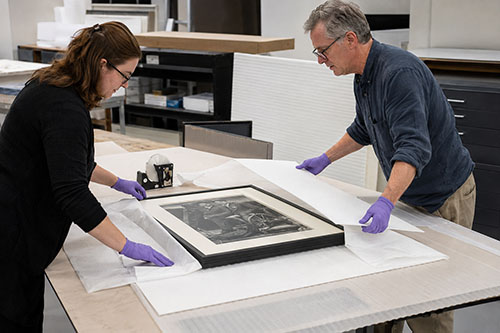
We offer wood and metal frames, custom cut & joined to order. Each framed print includes hanging hardware and foamcore backer.
Matting
We use conservation grade 100% virgin alpha-cellulose 2 ply mats with white core. Acid-free and lignin-free, these are both face resistant and meet all conservation quality standards set by the Fine Art Trade Guild. Mats are digitally cut for ultimate precision. The window will be 1/8″ smaller than the print dimensions.
Glazing (Acrylic Glass)
We offer custom cut panes of shatter-proof, acrylic glass, to protect your valuable artwork and prints.
Premium Clear
Framing grade clear acrylic is shatter resistant and lightweight.
Reflection Control
With its matte finish, Tru Vue Reflection Control® Acrylic scatters light to diminish unwanted glare.
Conservation Clear
Tru Vue Conservation Clear® Acrylic is a framing industry staple, blocking up to 99% of UV rays for ultimate protection.
Conservation Reflection Control
Tru Vue Conservation Reflection Control® Acrylic scatters and diffuses light to reduce unwanted glare. Blocks up to 99% of UV rays.
Related products
-

Martine Beswick – Thunderball (1965) Paula Caplan 007 Bond Girl Reclining Tiger-Stripe Swimsuit Boat Bahamas Publicity Photo
$30.00 -
Martine Beswick – Thunderball (1965) Paula Caplan 007 Bond Girl Tiger-Stripe Swimsuit on Boat Bahamas Publicity Photo
$30.00 -
Clint Eastwood – Dirty Harry (1971) Seated Candid on Sidewalk Behind-the-Scenes Photo
$38.00 -
Clint Eastwood & Don Siegel – Dirty Harry (1971) Rooftop Behind-the-Scenes Photo
$38.00


