

Christopher Lee & Fred Williams – Count Dracula (1970) Castle Dinner with Jonathan Harker Jess Franco Gothic Horror Photo
Limited Edition Photograph (learn more)
In stock
Christopher Lee as Count Dracula and Fred Williams as Jonathan Harker face one another across an imposing castle dinner table in this richly atmospheric color photograph from Count Dracula (1970), surrounded by towering candles, deep crimson fabric and austere Gothic stonework. Lee’s rigid black-clad presence contrasts with Harker’s position at the laden table, creating a restrained but ominous image of classic European Gothic vampire cinema in which aristocratic hospitality conceals mortal danger.
The photograph captures one of the defining early encounters in Bram Stoker’s story: Jonathan Harker’s arrival at Dracula’s remote Transylvanian castle and his gradual realization that his seemingly courteous host is something far more sinister. The formal dinner setting gives the scene an almost ceremonial quality, while the surrounding darkness and heavy architecture quietly undermine any sense of safety.
Christopher Lee’s Dracula is especially effective in this composition because he does so little physically. Seated apart from Harker, the Count appears controlled, remote and almost unnaturally still. His severe black costume seems to merge with the surrounding shadows, allowing Lee’s face and posture to communicate authority without requiring overt violence.
Fred Williams’ Jonathan Harker provides the essential human counterpoint. Positioned at the table amid food, silverware and elaborate candlelight, Harker appears to occupy the role of guest, yet the visual balance of the photograph makes it clear that Dracula dominates the environment. The hospitality is formal, but the atmosphere is unmistakably threatening.
Released in 1970, Count Dracula was directed by Jess Franco and produced by Harry Alan Towers as an international adaptation of Bram Stoker’s famous vampire novel. Unlike Christopher Lee’s Hammer Dracula films, this production offered a separate interpretation of the character and deliberately restored several elements associated more closely with Stoker’s original narrative.
One of those elements was Dracula’s initially older appearance. Rather than presenting the Count immediately as the sleek Gothic figure familiar from Hammer, the film allows Lee’s Dracula to appear more aged and severe during the Transylvanian sequences, reinforcing the sense that Harker has entered the home of an ancient and deeply unnatural being.
The film stars Christopher Lee as Count Dracula and Fred Williams as Jonathan Harker, alongside Herbert Lom as Van Helsing, Klaus Kinski as Renfield, Maria Rohm as Mina and Soledad Miranda as Lucy. The cast places several major figures of European cult and horror cinema within a more literary interpretation of the Dracula mythology.
The visual design is particularly effective in this photograph. The towering candles, crimson table covering, carved furnishings and heavy stone walls create a richly textured Gothic environment, while the restrained arrangement of the two actors emphasizes psychological tension rather than physical action. The result is a scene built almost entirely around silence, ritual and menace.
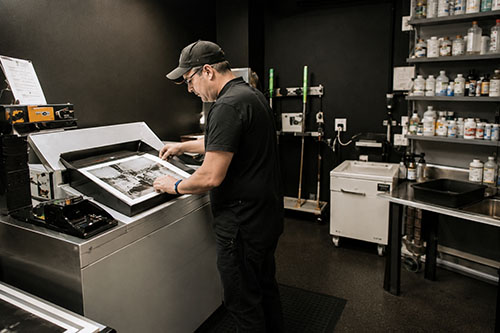
Carefully restored from archival source material and professionally lab-developed, this museum-quality photograph is presented uncropped, preserving the complete image area contained in the archival source. Meticulous restoration recovers natural color balance, facial clarity, candlelight detail, fabric texture and Gothic architectural depth while retaining the authentic atmosphere of the original color image.
For collectors of Christopher Lee, Fred Williams and Count Dracula, this is an especially evocative piece of Jess Franco Gothic horror imagery—a classic castle encounter in which Dracula’s severe black costume, Jonathan Harker’s formal dinner setting, towering candles, crimson table covering and ancient stone interior transform apparent hospitality into quiet supernatural menace, making it particularly desirable for collectors of Bram Stoker adaptations, European vampire cinema, Christopher Lee photography and classic Gothic horror.
Product Enquiry
Kodak Professional Endura Paper
Kodak Endura papers provide an incredible amount of detail and smooth transition of tones. Designed for the professional photographer in mind, looking for a more traditional photo print style, Kodak Endura provides an extended print life and color gamut almost at the level of a high end fine art paper print.
Archival Matte Paper
Archival Matte Paper, also known as Moab Lasal Photo Matte, is our house stock fine art paper and is an economical favorite for fine art reproductions and photo prints. It features a smooth surface, heavy weight (230 g, 9.5-mil), neutral white, matte paper engineered for accurate color reproduction that provides high contrast and high-resolution output. This paper is acid-free, making it the perfect choice for both photography & fine art reproductions.
Giclee William Turner Paper by Hahnemühle
The William Turner by Hahnemühle is one of the most popular papers used in the Giclee printing industry. This is a 310g natural white mould made natural line paper with 100% rag content making it highly archival. It has a slight coarse texture which gives photos and artwork an elegant look. These fine art paper prints (also known as Giclee) are ordered by galleries, individual artists and photographers. The papers and inks are not only archival but use some of the most accurate print technology for full color prints.
- Giclee prints use very expensive archival pigmented inks.
- Highest level of color gamut available in printing (12 color printing).
- Exceptional black & white printing.
- Fade resistant, pigmented inks which provide a superior color range compared to other types of inks. Widely preferred in fine art and photography circles.
- We ONLY use professional grade fine art and photo paper that resist yellowing and aging.
Framing
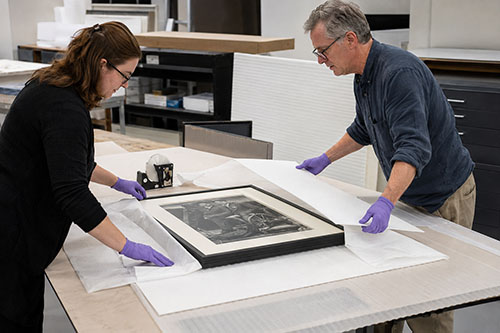
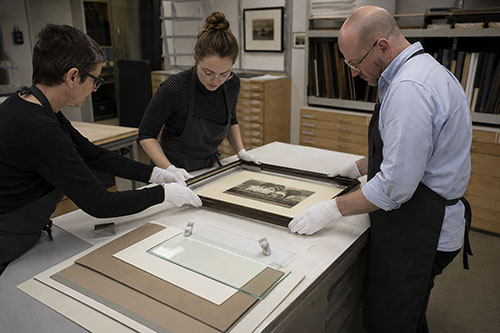
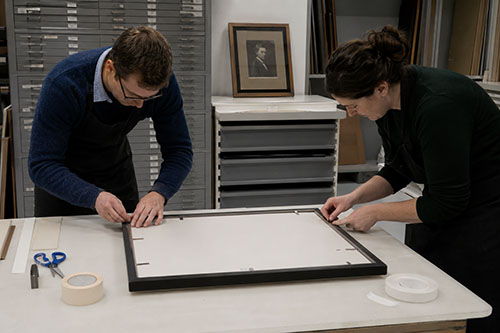
We offer wood and metal frames, custom cut & joined to order. Each framed print includes hanging hardware and foamcore backer.
Matting
We use conservation grade 100% virgin alpha-cellulose 2 ply mats with white core. Acid-free and lignin-free, these are both face resistant and meet all conservation quality standards set by the Fine Art Trade Guild. Mats are digitally cut for ultimate precision. The window will be 1/8″ smaller than the print dimensions.
Glazing (Acrylic Glass)
We offer custom cut panes of shatter-proof, acrylic glass, to protect your valuable artwork and prints.
Premium Clear
Framing grade clear acrylic is shatter resistant and lightweight.
Reflection Control
With its matte finish, Tru Vue Reflection Control® Acrylic scatters light to diminish unwanted glare.
Conservation Clear
Tru Vue Conservation Clear® Acrylic is a framing industry staple, blocking up to 99% of UV rays for ultimate protection.
Conservation Reflection Control
Tru Vue Conservation Reflection Control® Acrylic scatters and diffuses light to reduce unwanted glare. Blocks up to 99% of UV rays.
Related products
-

Dracula Has Risen from the Grave (1968) Christopher Lee Japanese Theatrical Design Hammer Horror 18×24 Fine Art Poster
$149.85 -
Christopher Lee & Heinz Drache – The Brides of Fu Manchu (1966) Big Ben Westminster Bridge Cast Publicity Photo
$25.00 -
Christopher Lee – Scars of Dracula (1970) Shadowed Count Dracula Atmospheric Hammer Horror Photo
$30.00 -
Christopher Lee & Ewan Hooper – Dracula Has Risen from the Grave (1968) Count Dracula & Priest Black Park Hearse Hammer Horror Photo
$30.00


