

Dieter Eppler & Graziella Granata – Slaughter of the Vampires (1962) Vampire Bites Louise Bedroom Italian Gothic Horror Photo
Limited Edition Photograph (learn more)
In stock
Dieter Eppler as the Vampire and Graziella Granata as Louise are captured in this charged bedroom scene from Slaughter of the Vampires (1962), as Eppler leans commandingly over Granata on an ornate bed. Dressed in formal black evening clothes, the Vampire closes in upon Louise while she lies pressed against the pillows, one hand raised against his chest. The elaborate bedding, decorative furnishings and intimate framing create a striking combination of aristocratic elegance, supernatural danger and classic Italian Gothic vampire imagery.
The photograph is particularly effective because the threat is communicated almost entirely through proximity. Eppler’s dark figure cuts diagonally across the composition while Granata’s lighter clothing and exposed face remain framed against the bedding beneath him. There are no elaborate effects competing for attention; the tension comes from the Vampire’s physical dominance and Louise’s vulnerable position within the richly appointed bedroom.
Released in 1962 under its original Italian title La strage dei vampiri, the film was written and directed by Roberto Mauri. Dieter Eppler plays the unnamed Vampire, Graziella Granata appears as Louise, Walter Brandi as her husband Marquis Wolfgang, and Luigi Batzella—credited as Paolo Solvay—as the doctor who eventually recognizes the supernatural nature of Louise’s illness. Cinematography was by Ugo Brunelli, with music by Aldo Piga.
The story follows newlyweds Wolfgang and Louise after they settle into a castle in nineteenth-century Austria. During a celebration, Louise encounters a mysterious stranger who is actually a vampire secretly hiding within the castle. After withdrawing to her bedroom, she is visited by the creature and bitten, beginning the physical and psychological decline that drives the film’s central conflict.
That encounter makes this photograph one of the film’s key character images. The Vampire does not simply attack Louise as an anonymous victim; his influence gradually draws her toward him, introducing the mixture of attraction and supernatural corruption characteristic of European vampire cinema during the period. Granata’s Louise becomes the emotional center of the story as Wolfgang struggles to understand what is happening to his wife.
For Dieter Eppler, the unnamed Vampire is a classic example of the aristocratic Gothic blood-drinker. Formal evening clothes, controlled physical presence and a cultivated appearance replace grotesque monster makeup, allowing the threat to emerge through charm, proximity and predatory confidence. Contemporary genre references consistently identify Eppler as the vampire who infiltrates Wolfgang and Louise’s castle.
Slaughter of the Vampires belongs to the important wave of Italian Gothic horror that followed the international success of films such as Mario Bava’s Black Sunday (1960). Mauri’s production embraces castles, shadowed interiors, aristocratic characters, vampire seduction and black-and-white atmosphere, giving the film a distinctly European variation on the vampire mythology popularized internationally during the late 1950s and early 1960s.
The production used the historic castle at Monte San Giovanni Campano as Wolfgang’s residence, lending authentic stone architecture and period atmosphere to the film’s interiors and exterior imagery. Location research specifically identifies the castle as the setting invaded by Eppler’s vampire.
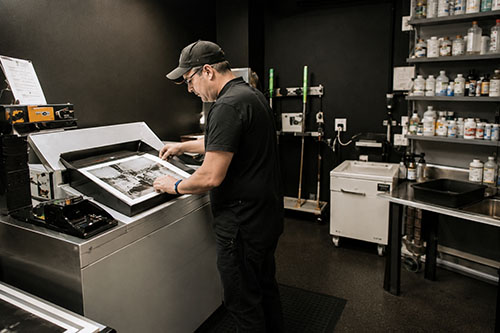
Carefully restored from historic photographic source material and professionally lab-developed, this museum-quality photograph is presented uncropped, preserving the complete image area contained in the source. Meticulous restoration recovers facial detail, costume texture, bedding, furniture, tonal range and shadow separation while retaining the intimate Gothic atmosphere of the original black-and-white image.
For collectors of Dieter Eppler, Graziella Granata, Slaughter of the Vampires and Italian Gothic horror, this is an exceptional bedroom image—the Vampire closing in upon Louise at the beginning of the supernatural corruption that drives the film’s dark and romantic vampire story.
Product Enquiry
Kodak Professional Endura Paper
Kodak Endura papers provide an incredible amount of detail and smooth transition of tones. Designed for the professional photographer in mind, looking for a more traditional photo print style, Kodak Endura provides an extended print life and color gamut almost at the level of a high end fine art paper print.
Archival Matte Paper
Archival Matte Paper, also known as Moab Lasal Photo Matte, is our house stock fine art paper and is an economical favorite for fine art reproductions and photo prints. It features a smooth surface, heavy weight (230 g, 9.5-mil), neutral white, matte paper engineered for accurate color reproduction that provides high contrast and high-resolution output. This paper is acid-free, making it the perfect choice for both photography & fine art reproductions.
Giclee William Turner Paper by Hahnemühle
The William Turner by Hahnemühle is one of the most popular papers used in the Giclee printing industry. This is a 310g natural white mould made natural line paper with 100% rag content making it highly archival. It has a slight coarse texture which gives photos and artwork an elegant look. These fine art paper prints (also known as Giclee) are ordered by galleries, individual artists and photographers. The papers and inks are not only archival but use some of the most accurate print technology for full color prints.
- Giclee prints use very expensive archival pigmented inks.
- Highest level of color gamut available in printing (12 color printing).
- Exceptional black & white printing.
- Fade resistant, pigmented inks which provide a superior color range compared to other types of inks. Widely preferred in fine art and photography circles.
- We ONLY use professional grade fine art and photo paper that resist yellowing and aging.
Framing
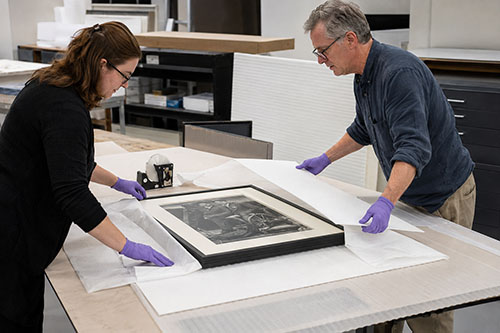
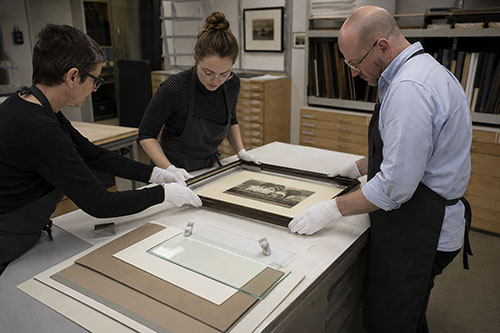
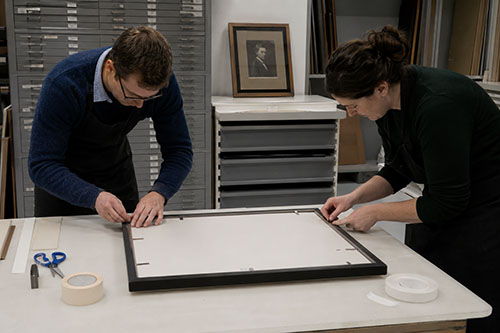
We offer wood and metal frames, custom cut & joined to order. Each framed print includes hanging hardware and foamcore backer.
Matting
We use conservation grade 100% virgin alpha-cellulose 2 ply mats with white core. Acid-free and lignin-free, these are both face resistant and meet all conservation quality standards set by the Fine Art Trade Guild. Mats are digitally cut for ultimate precision. The window will be 1/8″ smaller than the print dimensions.
Glazing (Acrylic Glass)
We offer custom cut panes of shatter-proof, acrylic glass, to protect your valuable artwork and prints.
Premium Clear
Framing grade clear acrylic is shatter resistant and lightweight.
Reflection Control
With its matte finish, Tru Vue Reflection Control® Acrylic scatters light to diminish unwanted glare.
Conservation Clear
Tru Vue Conservation Clear® Acrylic is a framing industry staple, blocking up to 99% of UV rays for ultimate protection.
Conservation Reflection Control
Tru Vue Conservation Reflection Control® Acrylic scatters and diffuses light to reduce unwanted glare. Blocks up to 99% of UV rays.
Related products
-

TERENCE FISHER, JANINA FAYE & ROBERT LYNN – HORROR OF DRACULA (1958) Relaxed Behind-the-Scenes Hammer Production Photo
$30.00 -
ANTHONY HIGGINS, LAURENCE PAYNE & ROBERT TAYMAN – VAMPIRE CIRCUS (1972) Climactic Crypt Battle Photo
$25.00 -
Sean Connery & Ursula Andress – Dr. No (1962) Crab Key Water Scene Jamaica Behind-the-Scenes Photo
$38.00 -
Sean Connery & Ursula Andress – Dr. No (1962) Relaxing Between Takes in Jamaica James Bond 007 Behind-the-Scenes Photo
$30.00