

Edwige Fenech & Alberto de Mendoza – The Strange Vice of Mrs. Wardh (1971) Julie & Neil Wardh Dark House Lighter Italian Giallo Photo
Limited Edition Photograph (learn more)
In stock
Edwige Fenech and Alberto de Mendoza appear as Julie and Neil Wardh in this exceptionally atmospheric black-and-white photograph from The Strange Vice of Mrs. Wardh (1971), cautiously moving through a darkened interior with Neil holding a small lighter ahead of them. Julie remains pressed closely beside her husband as both look into the surrounding darkness, while the tiny flame and illuminated floor provide almost the only relief from the deep blackness engulfing the room. The stripped-down composition creates a beautifully concentrated image of giallo suspense, uncertainty and approaching danger.
The photograph is especially effective because the darkness itself becomes the dominant visual element. Fenech’s patterned mini dress and de Mendoza’s suit emerge only where the limited light reaches them, while the surrounding interior disappears almost completely. Neil’s lighter becomes both a practical source of illumination and the focal point of the scene, emphasizing how little the characters can see and how vulnerable they are to whatever may be waiting beyond the frame.
Released in 1971, The Strange Vice of Mrs. Wardh—originally Lo strano vizio della signora Wardh—was directed by Sergio Martino. Edwige Fenech stars as Julie Wardh alongside Alberto de Mendoza as Neil Wardh, George Hilton as George Corro, Ivan Rassimov as Jean and Conchita Airoldi as Carol Brandt. The screenplay credits include Ernesto Gastaldi, Eduardo Manzanos and Vittorio Caronia, with cinematography by Emilio Foriscot and music by Nora Orlandi.
This image relates to a particularly tense section of the story. After Julie becomes increasingly frightened by the apparent return of her former lover Jean, Neil goes to confront him at his residence. Julie accompanies him, and the pair explore the darkened house before discovering Jean apparently dead in a blood-filled bathtub. Contemporary plot summaries specifically describe Neil and Julie searching the dark house together before making the disturbing discovery.
That sequence demonstrates Martino’s skill at creating suspense through restricted information. The audience sees only what Julie and Neil can illuminate, turning darkness, silence and limited visibility into sources of tension. The modest flame held by Neil becomes far more unsettling than an elaborate effect because every unexplored part of the room remains potentially threatening.
For Edwige Fenech, Julie Wardh became one of her defining giallo roles. Julie is surrounded by murder, blackmail and conflicting relationships, while her memories of Jean make it increasingly difficult to distinguish genuine danger from psychological manipulation. Fenech’s combination of glamour and vulnerability gives the film its emotional center.
The picture marked an important early collaboration between Sergio Martino and Fenech, helping establish a partnership closely associated with Italian giallo cinema during the early 1970s. The film’s visual vocabulary—elegant interiors, psychological uncertainty, black-gloved menace, erotic tension and sudden violence—would become central to Martino’s subsequent work in the genre.
Internationally, the film circulated under alternate titles including Blade of the Ripper, Next! and The Next Victim, reflecting the extensive international release history typical of Italian genre cinema.
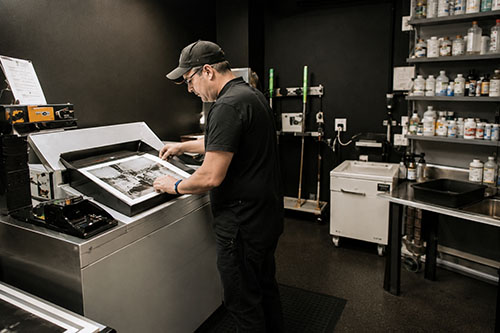
Carefully restored from historic photographic source material and professionally lab-developed, this museum-quality photograph is presented uncropped, preserving the complete image area contained in the source. Meticulous restoration recovers facial detail, clothing texture, lighter definition, floor detail, tonal gradation and shadow separation while retaining the suspenseful character of the original black-and-white image.
For collectors of Edwige Fenech, Alberto de Mendoza, The Strange Vice of Mrs. Wardh and Italian giallo, this is an exceptional suspense image—Julie and Neil advancing together through near-total darkness with only a small lighter to guide them, moments before one of the film’s most disturbing discoveries.
Product Enquiry
Kodak Professional Endura Paper
Kodak Endura papers provide an incredible amount of detail and smooth transition of tones. Designed for the professional photographer in mind, looking for a more traditional photo print style, Kodak Endura provides an extended print life and color gamut almost at the level of a high end fine art paper print.
Archival Matte Paper
Archival Matte Paper, also known as Moab Lasal Photo Matte, is our house stock fine art paper and is an economical favorite for fine art reproductions and photo prints. It features a smooth surface, heavy weight (230 g, 9.5-mil), neutral white, matte paper engineered for accurate color reproduction that provides high contrast and high-resolution output. This paper is acid-free, making it the perfect choice for both photography & fine art reproductions.
Giclee William Turner Paper by Hahnemühle
The William Turner by Hahnemühle is one of the most popular papers used in the Giclee printing industry. This is a 310g natural white mould made natural line paper with 100% rag content making it highly archival. It has a slight coarse texture which gives photos and artwork an elegant look. These fine art paper prints (also known as Giclee) are ordered by galleries, individual artists and photographers. The papers and inks are not only archival but use some of the most accurate print technology for full color prints.
- Giclee prints use very expensive archival pigmented inks.
- Highest level of color gamut available in printing (12 color printing).
- Exceptional black & white printing.
- Fade resistant, pigmented inks which provide a superior color range compared to other types of inks. Widely preferred in fine art and photography circles.
- We ONLY use professional grade fine art and photo paper that resist yellowing and aging.
Framing
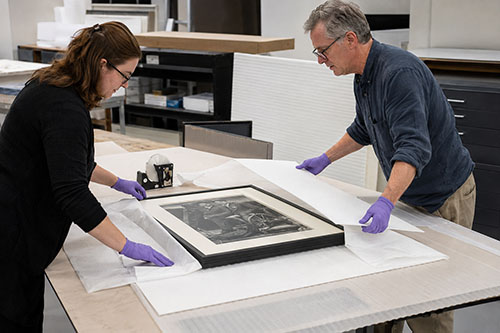
We offer wood and metal frames, custom cut & joined to order. Each framed print includes hanging hardware and foamcore backer.
Matting
We use conservation grade 100% virgin alpha-cellulose 2 ply mats with white core. Acid-free and lignin-free, these are both face resistant and meet all conservation quality standards set by the Fine Art Trade Guild. Mats are digitally cut for ultimate precision. The window will be 1/8″ smaller than the print dimensions.
Glazing (Acrylic Glass)
We offer custom cut panes of shatter-proof, acrylic glass, to protect your valuable artwork and prints.
Premium Clear
Framing grade clear acrylic is shatter resistant and lightweight.
Reflection Control
With its matte finish, Tru Vue Reflection Control® Acrylic scatters light to diminish unwanted glare.
Conservation Clear
Tru Vue Conservation Clear® Acrylic is a framing industry staple, blocking up to 99% of UV rays for ultimate protection.
Conservation Reflection Control
Tru Vue Conservation Reflection Control® Acrylic scatters and diffuses light to reduce unwanted glare. Blocks up to 99% of UV rays.
Related products
-

Rosalba Neri – Lady Frankenstein (1971) Dr. Tania Crimson Gown Gothic Interior Photo
$30.00 -
Klaus Kinski – Fitzcarraldo (1982) Brian Sweeney Fitzgerald Leopard Tapestry Publicity Photo
$25.00 -
The Howling (1981) Werewolf Venetian Blind Shadows Rob Bottin Creature Photo
$25.00 -
Yutte Stensgaard – Lust for a Vampire (1971) Mircalla White Nightgown Stone Steps Publicity Photo
$38.00


