

Jack Nicholson – The Shining (1980) “Here’s Johnny!” Bathroom Door Scene Photo
Limited Edition Photograph (learn more)
In stock
Jack Nicholson is captured as Jack Torrance in the unforgettable bathroom-door sequence from The Shining (1980), his face appearing through the jagged opening he has smashed into the wooden door while pursuing Wendy through the Overlook Hotel. Nicholson’s widened eyes, clenched grin and sweat-dampened hair fill the narrow space between the splintered panels, creating one of the most instantly recognizable close-ups in modern horror cinema. The damaged doorway becomes a frame within the frame, concentrating the entire image on Jack Torrance’s complete psychological collapse.
The photograph’s extraordinary power comes from its almost unbearable closeness. Nicholson’s face is compressed between the broken vertical sections of the bathroom door, leaving virtually no space between performer and viewer. His eyes turn sharply to the side, his teeth are fully exposed in a manic grin and a single lock of dark hair falls across his forehead. The raw wood surrounding his head remains visibly cracked and torn, preserving the physical violence that has just created the opening.
This Jack Nicholson The Shining 1980 image captures the climax of Jack Torrance’s transformation from frustrated writer and winter caretaker into a murderous figure stalking his own family through the isolated Overlook Hotel. By this stage, any remaining trace of his earlier restraint has disappeared. The close-up does not need blood, elaborate makeup or supernatural effects to communicate horror—the terror comes almost entirely from Nicholson’s performance.
Directed by Stanley Kubrick, The Shining stars Jack Nicholson as Jack Torrance, Shelley Duvall as Wendy Torrance, Danny Lloyd as Danny Torrance and Scatman Crothers as Dick Hallorann. Jack accepts a position as winter caretaker at the remote Overlook Hotel, bringing Wendy and Danny with him as the property closes for the season. Isolation, supernatural influence and Jack’s own instability gradually combine until the hotel becomes the setting for the family’s desperate struggle to survive.
The bathroom-door sequence comes during that final breakdown. Wendy retreats into the bathroom while Jack attacks the door from the other side, forcing his way through the wood until he can thrust his face into the opening. Nicholson then delivers the now-famous line “Here’s Johnny!”, turning a brief piece of dialogue into one of the most enduring moments associated with both the actor and the film.
What makes the image so effective is the way Kubrick’s carefully controlled visual world suddenly becomes brutally simple. Much of The Shining is defined by the Overlook’s enormous corridors, elaborate carpets and precisely arranged interiors, yet this photograph reduces everything to a face trapped between two splintered pieces of wood. The architectural grandeur disappears and the horror becomes immediate, physical and intensely personal.
Nicholson’s performance is crucial to that effect. The fixed grin, shifting eyes and strained facial muscles create a grotesque parody of cheerfulness, making Jack simultaneously recognizable and completely transformed. The narrow opening also exaggerates the expression by preventing the viewer from seeing anything beyond his face, forcing attention onto every detail of the performance.
For collectors of classic horror and Stanley Kubrick photography, this is one of the defining images from The Shining. The combination of Nicholson’s face, the broken bathroom door and the unmistakable “Here’s Johnny!” moment gives the photograph an identity that extends far beyond the individual scene. It preserves one of cinema’s most famous portrayals of madness at the exact point where character, performance and visual composition become inseparable.
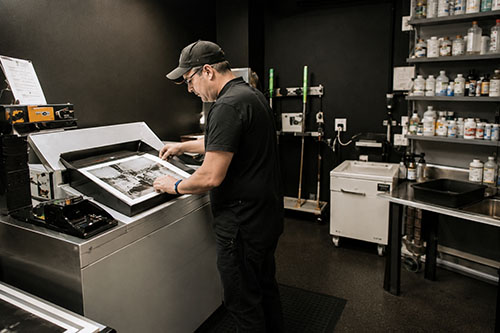
Carefully restored from historic photographic source material and professionally lab-developed, this museum-quality photograph is presented uncropped, preserving the complete image area contained in the source. Restoration recovers facial detail, eye definition, individual hair strands, skin texture and splintered wood grain while maintaining the natural color balance and authentic character of the historic photograph. The finished photograph contains no AI-generated image content.
Product Enquiry
Kodak Professional Endura Paper
Kodak Endura papers provide an incredible amount of detail and smooth transition of tones. Designed for the professional photographer in mind, looking for a more traditional photo print style, Kodak Endura provides an extended print life and color gamut almost at the level of a high end fine art paper print.
Archival Matte Paper
Archival Matte Paper, also known as Moab Lasal Photo Matte, is our house stock fine art paper and is an economical favorite for fine art reproductions and photo prints. It features a smooth surface, heavy weight (230 g, 9.5-mil), neutral white, matte paper engineered for accurate color reproduction that provides high contrast and high-resolution output. This paper is acid-free, making it the perfect choice for both photography & fine art reproductions.
Giclee William Turner Paper by Hahnemühle
The William Turner by Hahnemühle is one of the most popular papers used in the Giclee printing industry. This is a 310g natural white mould made natural line paper with 100% rag content making it highly archival. It has a slight coarse texture which gives photos and artwork an elegant look. These fine art paper prints (also known as Giclee) are ordered by galleries, individual artists and photographers. The papers and inks are not only archival but use some of the most accurate print technology for full color prints.
- Giclee prints use very expensive archival pigmented inks.
- Highest level of color gamut available in printing (12 color printing).
- Exceptional black & white printing.
- Fade resistant, pigmented inks which provide a superior color range compared to other types of inks. Widely preferred in fine art and photography circles.
- We ONLY use professional grade fine art and photo paper that resist yellowing and aging.
Framing
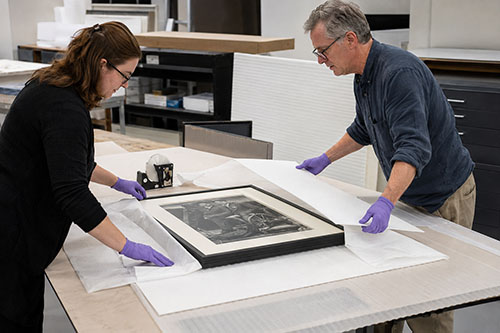
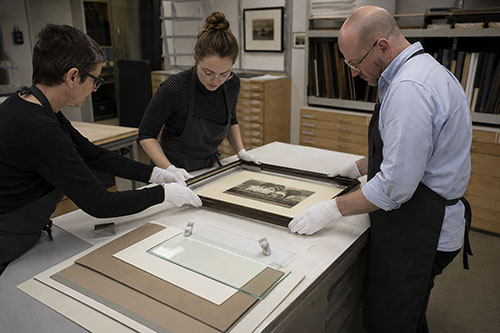
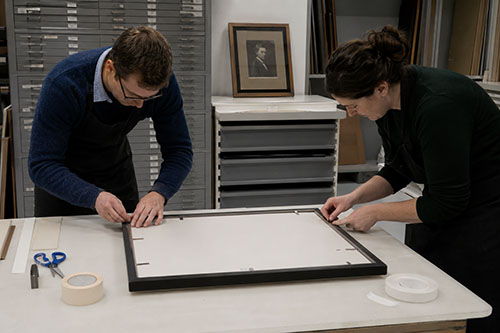
We offer wood and metal frames, custom cut & joined to order. Each framed print includes hanging hardware and foamcore backer.
Matting
We use conservation grade 100% virgin alpha-cellulose 2 ply mats with white core. Acid-free and lignin-free, these are both face resistant and meet all conservation quality standards set by the Fine Art Trade Guild. Mats are digitally cut for ultimate precision. The window will be 1/8″ smaller than the print dimensions.
Glazing (Acrylic Glass)
We offer custom cut panes of shatter-proof, acrylic glass, to protect your valuable artwork and prints.
Premium Clear
Framing grade clear acrylic is shatter resistant and lightweight.
Reflection Control
With its matte finish, Tru Vue Reflection Control® Acrylic scatters light to diminish unwanted glare.
Conservation Clear
Tru Vue Conservation Clear® Acrylic is a framing industry staple, blocking up to 99% of UV rays for ultimate protection.
Conservation Reflection Control
Tru Vue Conservation Reflection Control® Acrylic scatters and diffuses light to reduce unwanted glare. Blocks up to 99% of UV rays.
Related products
-

Christopher Lee – Scars of Dracula (1970) Shadowed Count Dracula Atmospheric Hammer Horror Photo
$30.00 -
Christopher Lee – Scars of Dracula (1970) Count Dracula Crest Ring Behind-the-Scenes Hammer Horror Photo
$30.00 -
Robert Hossein & Marie-France Pisier – Le Vampire de Düsseldorf (1965) Peter Kürten & Anna Death Scene High-Angle Crime Thriller Photo
$30.00 -
Ingrid Pitt – The Vampire Lovers (1970) Marcilla Red Gown Moor Park Mansion Photo
$25.00