

Klaus Kinski & Isabelle Adjani – Nosferatu the Vampyre (1979) Dracula & Lucy Bedside Scene Photo
Limited Edition Photograph (learn more)
In stock
Klaus Kinski and Isabelle Adjani are captured as Count Dracula and Lucy Harker in this haunting color photograph from Nosferatu the Vampyre (1979), with Dracula leaning over Lucy as she lies motionless upon the bed. Kinski’s pale, skull-like head and sunken features dominate the dark composition, while Adjani’s luminous face and black hair create a striking contrast against the surrounding bedding. The intimacy of the framing turns the encounter into an image of vulnerability, obsession and supernatural menace.
The photograph is especially powerful because the two performers occupy almost the entire frame. Dracula’s face is positioned only inches from Lucy, his bald head, elongated ears and deeply shadowed eyes giving him an unmistakably cadaverous appearance. Adjani lies beneath him with her head turned to the side, her pale complexion and red lips standing out against the darkened room. A hand entering from the upper right adds further tension to the tightly compressed scene.
Kinski’s interpretation of Dracula deliberately rejects aristocratic glamour. His vampire is emaciated, almost corpse-like, with a rigid physical presence that recalls the visual tradition established by Max Schreck in F. W. Murnau’s Nosferatu (1922). Yet Kinski gives the character an additional quality of loneliness and yearning, making the vampire seem both horrifying and tragically isolated.
That duality is central to this Klaus Kinski Isabelle Adjani Nosferatu the Vampyre 1979 image. Dracula is physically threatening, but the stillness of the composition creates something more complex than a conventional attack photograph. His proximity to Lucy feels invasive and predatory, yet the scene also carries the mournful, romantic atmosphere that runs throughout Werner Herzog’s interpretation of the story.
Written and directed by Werner Herzog, Nosferatu the Vampyre stars Klaus Kinski as Count Dracula, Isabelle Adjani as Lucy Harker and Bruno Ganz as Jonathan Harker. Herzog conceived the film as both a tribute to and a reinterpretation of Murnau’s silent classic, retaining the gaunt vampire design while expanding the story through atmospheric landscapes, death imagery and a strong sense of fatalism.
Adjani provides the crucial human contrast to Kinski’s decaying vampire. Her delicate features and controlled stillness give Lucy an almost spectral beauty of her own, allowing scenes between the two characters to operate visually as confrontations between life and death. In this photograph, that contrast is concentrated into their faces: Kinski’s deeply aged, corpse-like features against Adjani’s smooth, pale complexion.
The muted colors and low lighting further strengthen the Gothic mood. Dark surrounding areas absorb much of the background detail, forcing attention toward the performers and the immediate physical proximity between them. The bedding and clothing create soft folds around the figures while Dracula’s head becomes the starkest object in the composition.
For collectors of European horror, Klaus Kinski, Isabelle Adjani and vampire cinema, this photograph captures one of the defining visual relationships in Herzog’s film. The intimate bedside setting, distinctive Dracula makeup and remarkable contrast between the two performers make it an immediately recognizable image from one of the most important vampire films of the 1970s.
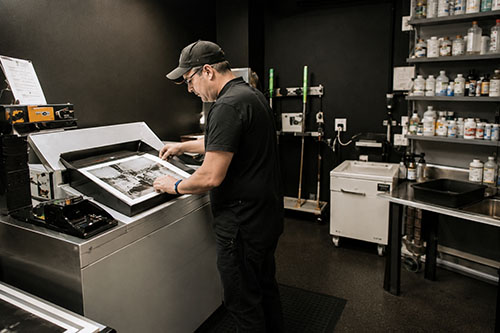
Carefully restored from historic photographic source material and professionally lab-developed, this museum-quality photograph is presented uncropped, preserving the complete image area contained in the source. Restoration recovers facial detail, Dracula makeup texture, hair definition, bedding folds and subtle low-light color gradation while maintaining the natural color balance and authentic character of the historic photograph. The finished photograph contains no AI-generated image content.
Product Enquiry
Kodak Professional Endura Paper
Kodak Endura papers provide an incredible amount of detail and smooth transition of tones. Designed for the professional photographer in mind, looking for a more traditional photo print style, Kodak Endura provides an extended print life and color gamut almost at the level of a high end fine art paper print.
Archival Matte Paper
Archival Matte Paper, also known as Moab Lasal Photo Matte, is our house stock fine art paper and is an economical favorite for fine art reproductions and photo prints. It features a smooth surface, heavy weight (230 g, 9.5-mil), neutral white, matte paper engineered for accurate color reproduction that provides high contrast and high-resolution output. This paper is acid-free, making it the perfect choice for both photography & fine art reproductions.
Giclee William Turner Paper by Hahnemühle
The William Turner by Hahnemühle is one of the most popular papers used in the Giclee printing industry. This is a 310g natural white mould made natural line paper with 100% rag content making it highly archival. It has a slight coarse texture which gives photos and artwork an elegant look. These fine art paper prints (also known as Giclee) are ordered by galleries, individual artists and photographers. The papers and inks are not only archival but use some of the most accurate print technology for full color prints.
- Giclee prints use very expensive archival pigmented inks.
- Highest level of color gamut available in printing (12 color printing).
- Exceptional black & white printing.
- Fade resistant, pigmented inks which provide a superior color range compared to other types of inks. Widely preferred in fine art and photography circles.
- We ONLY use professional grade fine art and photo paper that resist yellowing and aging.
Framing
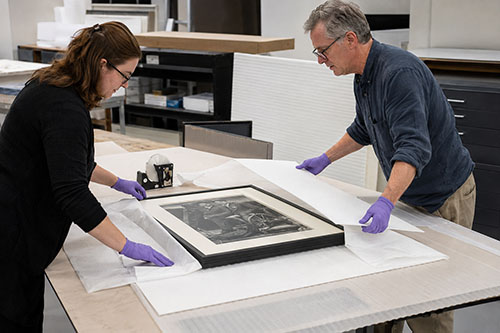
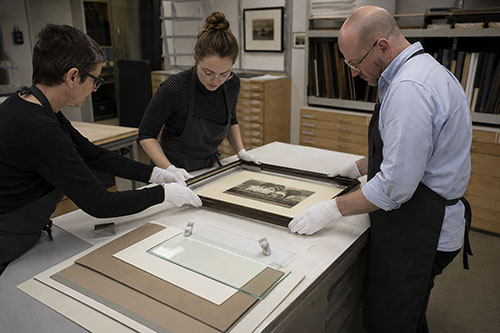
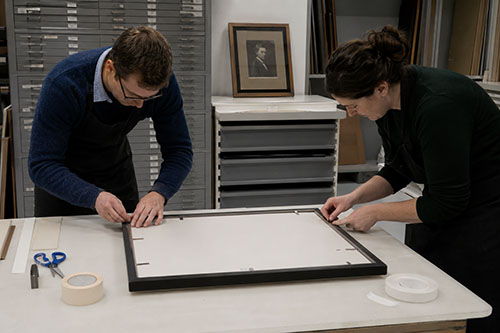
We offer wood and metal frames, custom cut & joined to order. Each framed print includes hanging hardware and foamcore backer.
Matting
We use conservation grade 100% virgin alpha-cellulose 2 ply mats with white core. Acid-free and lignin-free, these are both face resistant and meet all conservation quality standards set by the Fine Art Trade Guild. Mats are digitally cut for ultimate precision. The window will be 1/8″ smaller than the print dimensions.
Glazing (Acrylic Glass)
We offer custom cut panes of shatter-proof, acrylic glass, to protect your valuable artwork and prints.
Premium Clear
Framing grade clear acrylic is shatter resistant and lightweight.
Reflection Control
With its matte finish, Tru Vue Reflection Control® Acrylic scatters light to diminish unwanted glare.
Conservation Clear
Tru Vue Conservation Clear® Acrylic is a framing industry staple, blocking up to 99% of UV rays for ultimate protection.
Conservation Reflection Control
Tru Vue Conservation Reflection Control® Acrylic scatters and diffuses light to reduce unwanted glare. Blocks up to 99% of UV rays.
Related products
-

KLAUS KINSKI – NOSFERATU THE VAMPYRE (1979) Count Dracula Coffin Scene Gothic Horror Photo
$38.00 -
Robert Hossein – Le Vampire de Düsseldorf (1965) Peter Kürten Night Street Crime Thriller Photo
$25.00 -
Terence Young & Ursula Andress – Dr. No (1962) Director Briefing James Bond 007 BTS Photo
$38.00 -
Yutte Stensgaard – Lust for a Vampire (1971) Mircalla Carmilla Karnstein White Nightgown Hammer Horror Photo
$30.00


