

Peter Cushing & Christopher Lee – The Curse of Frankenstein (1957) Baron Frankenstein & Suspended Creature Laboratory Hammer Horror Photo
Limited Edition Photograph (learn more)
In stock
Peter Cushing as Baron Victor Frankenstein and Christopher Lee as the Creature are captured in this extraordinary color photograph from The Curse of Frankenstein (1957), with Cushing calmly pulling on a glove while Lee’s apparently lifeless body hangs suspended behind him in the laboratory. Frankenstein’s precise, almost clinical concentration contrasts dramatically with the Creature’s rigid black-clad figure, bandaged and scarred face and unnatural suspension from above. The composition perfectly expresses the cold determination of a scientist who refuses to accept death as the end of his experiment.
The photograph is particularly powerful because Cushing appears almost detached from the disturbing sight behind him. His tailored clothing and deliberate hand movement suggest method and control, while Lee’s enormous suspended figure dominates the upper right of the image. The stone walls, heavy beams and laboratory surroundings reinforce the Gothic atmosphere without overwhelming the two performers.
Released in 1957, The Curse of Frankenstein was directed by Terence Fisher for Hammer Film Productions and stars Peter Cushing as Baron Victor Frankenstein, Christopher Lee as the Creature, Hazel Court as Elizabeth and Robert Urquhart as Paul Krempe. Jimmy Sangster wrote the screenplay, Anthony Hinds produced, and Jack Asher photographed the film in Eastmancolor.
The image relates to one of Victor Frankenstein’s most revealing acts of obsession. After the Creature escapes and kills a blind man, Paul shoots it in the head and the two men bury the body. Frankenstein, however, secretly exhumes the Creature and resumes his experiments, eventually restoring it to life. AFI confirms that Victor unearths the body after its burial and continues his work until the Creature is revived.
That refusal to abandon his creation is central to Cushing’s interpretation of Frankenstein. Hammer shifts much of the moral focus away from the Creature and toward the Baron himself: intelligent, cultured and relentlessly determined, yet increasingly willing to sacrifice human life in pursuit of scientific achievement. Cushing’s controlled performance became the foundation of Hammer’s long-running Frankenstein series.
Christopher Lee’s Creature was deliberately unlike the familiar Universal monster. His patchwork face, damaged flesh and asymmetrical appearance emphasized the fact that Frankenstein had assembled him from human remains. Lee’s height and physical presence made the Creature formidable, while his largely wordless performance gave the character an unpredictable, wounded quality.
The Curse of Frankenstein was a landmark for Hammer. BFI describes it as the film that brought Gothic horror vividly into the color era, combining graphic physical detail with Peter Cushing and Christopher Lee in star-making roles. It also marked the first film in which Cushing and Lee worked together directly, beginning one of horror cinema’s most celebrated screen partnerships.
The production became the first entry in Hammer’s Frankenstein cycle and established many of the qualities that would define the studio internationally: intense color, elaborate Gothic environments, stronger violence, psychological complexity and charismatic stars. Its enormous success helped make Hammer one of the dominant names in horror cinema for the next two decades.
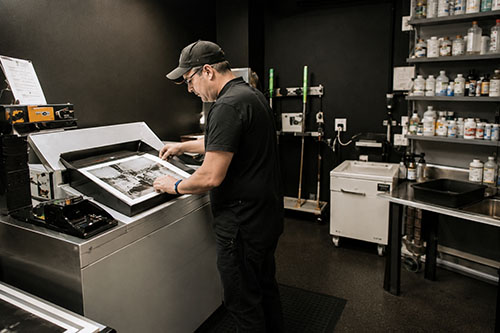
Carefully restored from historic photographic source material and professionally lab-developed, this museum-quality photograph is presented uncropped, preserving the complete image area contained in the source. Meticulous restoration recovers facial detail, Creature makeup, costume texture, laboratory architecture, shadow definition, tonal range and natural color balance while retaining the dramatic atmosphere of the original image.
For collectors of Peter Cushing, Christopher Lee, The Curse of Frankenstein and Hammer Horror, this is an exceptional laboratory image—Baron Frankenstein preparing to continue his work while the suspended Creature hangs behind him, preserving the obsessive scientific determination and macabre Gothic imagery that helped launch Hammer’s legendary horror era.
Product Enquiry
Kodak Professional Endura Paper
Kodak Endura papers provide an incredible amount of detail and smooth transition of tones. Designed for the professional photographer in mind, looking for a more traditional photo print style, Kodak Endura provides an extended print life and color gamut almost at the level of a high end fine art paper print.
Archival Matte Paper
Archival Matte Paper, also known as Moab Lasal Photo Matte, is our house stock fine art paper and is an economical favorite for fine art reproductions and photo prints. It features a smooth surface, heavy weight (230 g, 9.5-mil), neutral white, matte paper engineered for accurate color reproduction that provides high contrast and high-resolution output. This paper is acid-free, making it the perfect choice for both photography & fine art reproductions.
Giclee William Turner Paper by Hahnemühle
The William Turner by Hahnemühle is one of the most popular papers used in the Giclee printing industry. This is a 310g natural white mould made natural line paper with 100% rag content making it highly archival. It has a slight coarse texture which gives photos and artwork an elegant look. These fine art paper prints (also known as Giclee) are ordered by galleries, individual artists and photographers. The papers and inks are not only archival but use some of the most accurate print technology for full color prints.
- Giclee prints use very expensive archival pigmented inks.
- Highest level of color gamut available in printing (12 color printing).
- Exceptional black & white printing.
- Fade resistant, pigmented inks which provide a superior color range compared to other types of inks. Widely preferred in fine art and photography circles.
- We ONLY use professional grade fine art and photo paper that resist yellowing and aging.
Framing
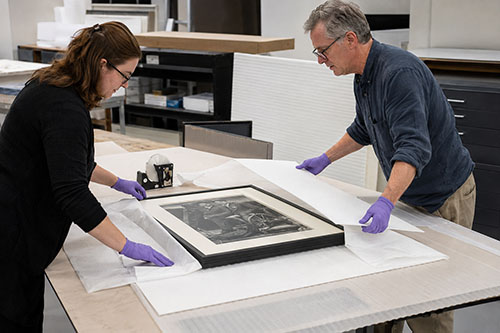
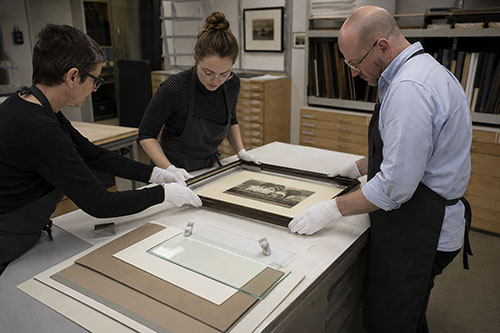
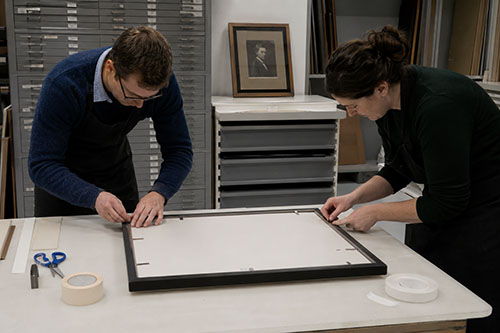
We offer wood and metal frames, custom cut & joined to order. Each framed print includes hanging hardware and foamcore backer.
Matting
We use conservation grade 100% virgin alpha-cellulose 2 ply mats with white core. Acid-free and lignin-free, these are both face resistant and meet all conservation quality standards set by the Fine Art Trade Guild. Mats are digitally cut for ultimate precision. The window will be 1/8″ smaller than the print dimensions.
Glazing (Acrylic Glass)
We offer custom cut panes of shatter-proof, acrylic glass, to protect your valuable artwork and prints.
Premium Clear
Framing grade clear acrylic is shatter resistant and lightweight.
Reflection Control
With its matte finish, Tru Vue Reflection Control® Acrylic scatters light to diminish unwanted glare.
Conservation Clear
Tru Vue Conservation Clear® Acrylic is a framing industry staple, blocking up to 99% of UV rays for ultimate protection.
Conservation Reflection Control
Tru Vue Conservation Reflection Control® Acrylic scatters and diffuses light to reduce unwanted glare. Blocks up to 99% of UV rays.
Related products
-

Dracula: Prince of Darkness (1966) Christopher Lee Original French Theatrical Design Hammer Horror 18×22 Fine Art Poster
$149.85 -
Christopher Lee – Taste the Blood of Dracula (1970) Red-Eyed Fanged Count Dracula Extreme Close-Up Hammer Horror Photo
$30.00 -
PETER CUSHING – THE CURSE OF FRANKENSTEIN (1957) Baron Victor Frankenstein Top Hat Publicity Photo
$30.00 -
Dracula Has Risen from the Grave (1968) Christopher Lee Japanese Theatrical Design Hammer Horror 18×24 Fine Art Poster
$149.85