

Peter Cushing – The Evil of Frankenstein (1964) Back-Projection Wagon Setup Behind-the-Scenes Photo
Limited Edition Photograph (learn more)
In stock
PETER CUSHING is photographed in costume as Baron Victor Frankenstein during a studio effects setup for The Evil of Frankenstein (1964), seated high on a practical wagon section positioned directly in front of a large projection screen. The finished illusion is absent here: instead, the photograph exposes the mechanics around the performance, including studio lighting units, support stands, curtains, floor space and crew silhouettes in the foreground. Cushing sits centered above the wagon with his legs braced apart and hands resting near his knees, maintaining the Baron’s controlled, purposeful appearance even while the surrounding soundstage remains completely visible. The contrast between costumed actor and exposed technical environment gives the image its particular appeal, turning a brief screen effect into a revealing record of Hammer production practice.
The wide composition makes the photographic setup unusually easy to read. The wagon occupies the center of the frame, while the large pale screen behind Cushing creates a clean background for the projected moving scenery used in the completed sequence. Lighting and masking equipment flank the screen, and the open studio floor shows how carefully the foreground performance had to be separated from the background image. For collectors of Peter Cushing The Evil of Frankenstein 1964 material, this is a strong behind-the-scenes photograph because it documents not simply the actor in costume but the practical filmmaking method being prepared around him.
Directed by Freddie Francis for Hammer Film Productions, The Evil of Frankenstein was released in 1964 and stars Cushing as Baron Frankenstein, with Peter Woodthorpe as Zoltan, Sandor Elès as Hans and Kiwi Kingston as the Creature. MoMA identifies the film as a 1964 British production directed by Francis and lists Cushing, Woodthorpe and Kingston among its principal performers. Hammer’s own retrospective on Francis also discusses his direction of the film and his close working relationship with Cushing.
The story finds Frankenstein returning to Karlstaad, where he discovers his earlier Creature preserved in ice and attempts to restore it. When the Creature’s mind fails to respond, the Baron turns to hypnotist Zoltan, whose intervention creates a new danger. The film continued Hammer’s Frankenstein cycle while again placing Cushing’s Baron at the center of the story, driven by his determination to revive and control life despite the consequences surrounding his experiments.
Production records place filming from 14 October to 16 November 1963, principally at Bray Studios, Down Place, Oakley Green, Berkshire, with location work at nearby Oakley Court. The same records credit John Wilcox as director of photography, Don Mingaye as art director, Anthony Hinds as producer and screenwriter under the name John Elder, and Les Bowie with special effects.
The behind-the-scenes value of this image lies in the removal of cinematic illusion. On screen, back projection could combine a stationary foreground performance with separately photographed moving scenery to suggest travel; here, the stationary wagon section, screen and surrounding technical apparatus are all visible at once. The photograph therefore offers both a Peter Cushing character study and a compact lesson in practical screen-effects photography from Hammer’s Bray Studios period.
Carefully restored from historic photographic source material and professionally lab-developed, this museum-quality photograph is presented uncropped, preserving the complete image area contained in the source. Restoration recovers fine detail in Cushing’s costume and expression, the wagon construction, projection screen, lighting equipment, stands, curtains and shadowed crew areas while preserving the tonal range and natural character of the original black-and-white photography. The finished photograph contains no AI-generated image content.
For collectors of Hammer Horror, Peter Cushing, Frankenstein cinema and behind-the-scenes production photography, this image offers a particularly revealing view of how a familiar screen illusion was assembled before the camera.
Product Enquiry
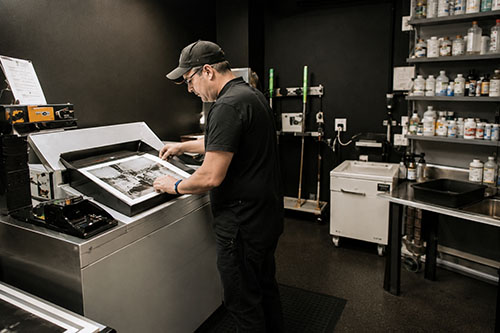
Kodak Professional Endura Paper
Kodak Endura papers provide an incredible amount of detail and smooth transition of tones. Designed for the professional photographer in mind, looking for a more traditional photo print style, Kodak Endura provides an extended print life and color gamut almost at the level of a high end fine art paper print.
Archival Matte Paper
Archival Matte Paper, also known as Moab Lasal Photo Matte, is our house stock fine art paper and is an economical favorite for fine art reproductions and photo prints. It features a smooth surface, heavy weight (230 g, 9.5-mil), neutral white, matte paper engineered for accurate color reproduction that provides high contrast and high-resolution output. This paper is acid-free, making it the perfect choice for both photography & fine art reproductions.
Giclee William Turner Paper by Hahnemühle
The William Turner by Hahnemühle is one of the most popular papers used in the Giclee printing industry. This is a 310g natural white mould made natural line paper with 100% rag content making it highly archival. It has a slight coarse texture which gives photos and artwork an elegant look. These fine art paper prints (also known as Giclee) are ordered by galleries, individual artists and photographers. The papers and inks are not only archival but use some of the most accurate print technology for full color prints.
- Giclee prints use very expensive archival pigmented inks.
- Highest level of color gamut available in printing (12 color printing).
- Exceptional black & white printing.
- Fade resistant, pigmented inks which provide a superior color range compared to other types of inks. Widely preferred in fine art and photography circles.
- We ONLY use professional grade fine art and photo paper that resist yellowing and aging.
Framing
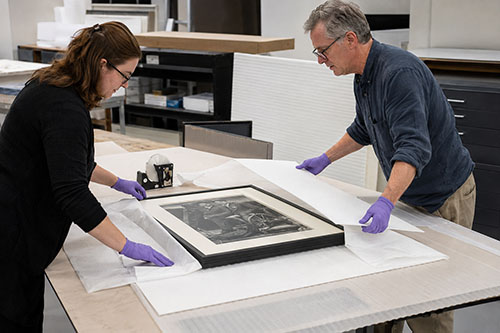
We offer wood and metal frames, custom cut & joined to order. Each framed print includes hanging hardware and foamcore backer.
Matting
We use conservation grade 100% virgin alpha-cellulose 2 ply mats with white core. Acid-free and lignin-free, these are both face resistant and meet all conservation quality standards set by the Fine Art Trade Guild. Mats are digitally cut for ultimate precision. The window will be 1/8″ smaller than the print dimensions.
Glazing (Acrylic Glass)
We offer custom cut panes of shatter-proof, acrylic glass, to protect your valuable artwork and prints.
Premium Clear
Framing grade clear acrylic is shatter resistant and lightweight.
Reflection Control
With its matte finish, Tru Vue Reflection Control® Acrylic scatters light to diminish unwanted glare.
Conservation Clear
Tru Vue Conservation Clear® Acrylic is a framing industry staple, blocking up to 99% of UV rays for ultimate protection.
Conservation Reflection Control
Tru Vue Conservation Reflection Control® Acrylic scatters and diffuses light to reduce unwanted glare. Blocks up to 99% of UV rays.
Related products
-

Peter Cushing & Neil Binney – Frankenstein Must Be Destroyed (1969) Sickle Scene Behind-the-Scenes Photo
$38.00 -
Akiko Wakabayashi – You Only Live Twice (1967) Aki Powder-Blue Dress 007 Photo
$38.00 -
Peter Cushing & Simon Ward – Frankenstein Must Be Destroyed (1969) Professor Richter Skull-Drilling Brain Surgery Photo
$30.00 -
Sean Connery & Luciana Paluzzi – Thunderball (1965) Fiona Volpe Bedroom Scene Pinewood Studios James Bond 007 Photo
$38.00


