

Sean Connery & Luciana Paluzzi – Thunderball (1965) Fiona Volpe Bedroom Scene Pinewood Studios James Bond 007 Photo
Limited Edition Photograph (learn more)
In stock
SEAN CONNERY and LUCIANA PALUZZI are photographed together during Fiona Volpe’s bedroom sequence for Thunderball (1965), filmed at Pinewood Studios in England. Connery’s James Bond rests at the front of the bed while Paluzzi leans closely behind him, their faces framed through the sweeping curved metal bars of the distinctive bedstead. Photographed from an unusually low viewpoint, the repeating metal framework crosses the foreground and creates a striking geometric pattern around the two performers. Connery’s relaxed expression and Paluzzi’s close positioning give the photograph an intimacy that contrasts with the calculated danger surrounding their characters in the finished film. The bedding, dark background and polished metal frame keep the composition concentrated almost entirely on Bond and Fiona, making this one of the more visually distinctive character studies from the production.
The unusual camera position is what gives the image much of its power. Rather than photographing the actors conventionally from the side of the bed, the lens looks directly through its decorative framework, making the bars an essential part of the composition. Connery’s face anchors the foreground while Paluzzi appears immediately above his shoulder, visually binding the two characters together. For collectors seeking Sean Connery Luciana Paluzzi Thunderball 1965 photography, the combination of both performers, the recognizable Fiona Volpe sequence and the documented Pinewood Studios setting makes this a particularly strong image from Bond’s fourth cinematic adventure.
Directed by Terence Young, Thunderball stars Connery as James Bond 007 and Paluzzi as Fiona Volpe, the formidable SPECTRE operative working alongside Emilio Largo. Claudine Auger appears as Domino Derval and Adolfo Celi as Largo. Kevin McClory produced the film, with Albert R. Broccoli and Harry Saltzman serving as executive producers. AFI credits Ted Moore as cinematographer and Ken Adam as production designer, with Eon Productions and Danjaq among the production companies.
The Pinewood attribution for this bedroom material is firmly documented. The official James Bond production timeline records that on February 25, 1965, production was working at Pinewood Studios and specifically identifies a love scene between Bond and SPECTRE assassin Fiona Volpe among the material filmed there. Although the sequence represents Nassau within the story, the bedroom itself was therefore created and photographed in England rather than on the Bahamas location shoot.
Fiona is one of Thunderball’s most memorable adversaries because she never becomes merely another romantic conquest for Bond. Their encounter is part seduction and part strategic contest, with Fiona remaining fully committed to SPECTRE. That tension gives the bedroom sequence a different character from many of Bond’s romantic scenes. The decorative metal bed frame becomes an especially memorable visual element, almost enclosing the two characters within the composition and reinforcing the sense that Bond’s apparent intimacy with Fiona exists inside a much more dangerous situation.
Thunderball greatly expanded the scale of the Bond series through its Bahamas locations, underwater action and increasingly elaborate production design. The official 007 archive notes that approximately a quarter of the completed film takes place underwater and identifies Pinewood Studios, Nassau, France and Miami among the production locations. This quieter interior photograph offers an effective counterpoint to that spectacle by concentrating on two performers and the controlled visual design of a single scene.
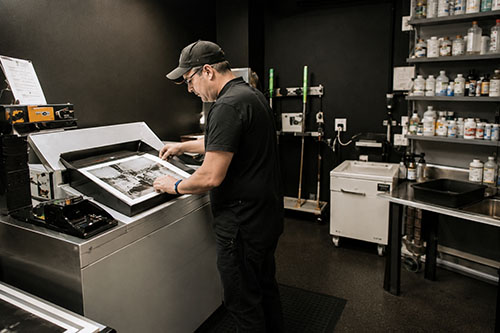
Carefully restored from historic photographic source material and professionally lab-developed, this museum-quality photograph is presented uncropped, preserving the complete image area contained in the source. Restoration recovers facial detail, hair texture, bedding, costume detail and the polished curves of the distinctive metal bed frame while maintaining the natural tonal gradation and character of the historic black-and-white photograph. The finished photograph contains no AI-generated image content.
A sophisticated and visually unusual image of Sean Connery and Luciana Paluzzi, this Pinewood Studios photograph offers collectors a direct connection to one of Thunderball’s most memorable Bond-and-Fiona encounters.
Product Enquiry
Kodak Professional Endura Paper
Kodak Endura papers provide an incredible amount of detail and smooth transition of tones. Designed for the professional photographer in mind, looking for a more traditional photo print style, Kodak Endura provides an extended print life and color gamut almost at the level of a high end fine art paper print.
Archival Matte Paper
Archival Matte Paper, also known as Moab Lasal Photo Matte, is our house stock fine art paper and is an economical favorite for fine art reproductions and photo prints. It features a smooth surface, heavy weight (230 g, 9.5-mil), neutral white, matte paper engineered for accurate color reproduction that provides high contrast and high-resolution output. This paper is acid-free, making it the perfect choice for both photography & fine art reproductions.
Giclee William Turner Paper by Hahnemühle
The William Turner by Hahnemühle is one of the most popular papers used in the Giclee printing industry. This is a 310g natural white mould made natural line paper with 100% rag content making it highly archival. It has a slight coarse texture which gives photos and artwork an elegant look. These fine art paper prints (also known as Giclee) are ordered by galleries, individual artists and photographers. The papers and inks are not only archival but use some of the most accurate print technology for full color prints.
- Giclee prints use very expensive archival pigmented inks.
- Highest level of color gamut available in printing (12 color printing).
- Exceptional black & white printing.
- Fade resistant, pigmented inks which provide a superior color range compared to other types of inks. Widely preferred in fine art and photography circles.
- We ONLY use professional grade fine art and photo paper that resist yellowing and aging.
Framing
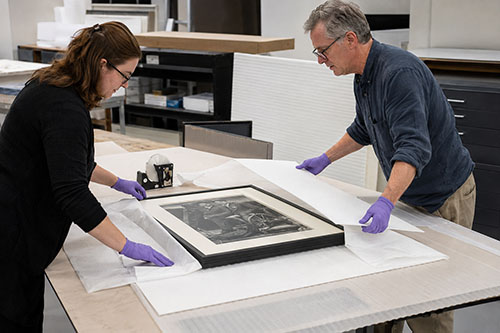
We offer wood and metal frames, custom cut & joined to order. Each framed print includes hanging hardware and foamcore backer.
Matting
We use conservation grade 100% virgin alpha-cellulose 2 ply mats with white core. Acid-free and lignin-free, these are both face resistant and meet all conservation quality standards set by the Fine Art Trade Guild. Mats are digitally cut for ultimate precision. The window will be 1/8″ smaller than the print dimensions.
Glazing (Acrylic Glass)
We offer custom cut panes of shatter-proof, acrylic glass, to protect your valuable artwork and prints.
Premium Clear
Framing grade clear acrylic is shatter resistant and lightweight.
Reflection Control
With its matte finish, Tru Vue Reflection Control® Acrylic scatters light to diminish unwanted glare.
Conservation Clear
Tru Vue Conservation Clear® Acrylic is a framing industry staple, blocking up to 99% of UV rays for ultimate protection.
Conservation Reflection Control
Tru Vue Conservation Reflection Control® Acrylic scatters and diffuses light to reduce unwanted glare. Blocks up to 99% of UV rays.
Related products
-

Christopher Lee – Dracula Has Risen from the Grave (1968) Count Dracula Bloody Lips Coffin Photo
$30.00 -
Clint Eastwood – Dirty Harry (1971) Seated Candid on Sidewalk Behind-the-Scenes Photo
$38.00 -
Veronica Carlson – Dracula Has Risen from the Grave (1968) Maria Bedroom Window Color Photo
$25.00 -
Sean Connery – Thunderball (1965) Shirtless Nassau Beach Location Behind-the-Scenes James Bond 007 Photo
$38.00


