

Peter Cushing & Simon Ward – Frankenstein Must Be Destroyed (1969) Professor Richter Skull-Drilling Brain Surgery Photo
Limited Edition Photograph (learn more)
In stock
Peter Cushing as Baron Frankenstein and Simon Ward as Dr. Karl Holst perform a disturbing surgical procedure on the heavily bandaged Professor Richter in this vivid color scene photograph from Frankenstein Must Be Destroyed (1969). Richter is strapped upright in a chair while Karl braces his head between both hands and Frankenstein positions a hand drill over the exposed opening at the crown of the skull. The close grouping of the three figures, stark surgical whites and Frankenstein’s conspicuously blood-marked apron concentrate the composition on the calculated physical horror of the operation.
The Frankenstein Must Be Destroyed brain surgery sequence is especially memorable because Hammer presents its medical grotesquerie with an almost matter-of-fact precision. Cushing’s Frankenstein is not shown recoiling from his work or displaying uncertainty; his attention is fixed completely on the procedure. Wearing a dark waistcoat beneath a heavily stained protective apron, he stands behind the seated patient with the drill held vertically in his hands. Simon Ward’s Karl, dressed more formally in waistcoat and white shirt, leans forward from the opposite side, gripping Richter’s bandaged head to prevent movement.
Professor Richter, portrayed by Freddie Jones, occupies the visual center of the photograph. Broad white bandages cover his head and much of his face, leaving only portions of the features visible, while a wide restraint secures his torso to the chair. His pale medical clothing, bandages and rigid seated position contrast strongly with the darker costumes of Frankenstein and Karl. Around them, the warm brown tones of the improvised laboratory, work surfaces, shelves and equipment create a convincingly functional setting rather than a fanciful Gothic dungeon.
Directed by Terence Fisher for Hammer Film Productions, Frankenstein Must Be Destroyed follows Baron Frankenstein’s obsessive attempt to recover the experimental knowledge of his former colleague Dr. Frederick Brandt, played by George Pravda. Frankenstein blackmails young asylum doctor Karl Holst into helping him abduct Brandt, but when Brandt suffers a serious heart attack, the Baron resorts to an even more extreme solution: transferring Brandt’s brain into the healthier body of asylum administrator Professor Richter.
This photograph represents a later skull-drilling procedure rather than the brain transplant itself. After Brandt’s brain has been placed inside Richter’s body, Frankenstein undertakes further surgery, drilling into the skull as he attempts to deal with the cerebral condition he believes responsible for Brandt’s mental collapse. That narrative distinction makes the image particularly useful as a record of one of the film’s separate surgical set pieces. The bandaging, restraints, drill and concentrated physical interaction between Cushing and Ward give the photograph an unusually clear view of Hammer’s combination of clinical procedure and graphic horror.
Released in 1969, the film brought together Peter Cushing, Simon Ward, Veronica Carlson, Freddie Jones and George Pravda under Fisher’s direction. Cushing’s increasingly ruthless Baron dominates the story, while Karl becomes trapped in Frankenstein’s schemes through coercion and blackmail. This image captures that relationship visually: Frankenstein controls the procedure while Karl is compelled to assist at extraordinarily close quarters.
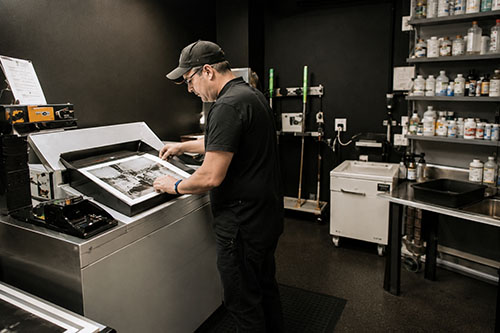
Carefully restored from historic photographic source material and professionally lab-developed, this museum-quality photograph is presented uncropped, preserving the complete image area contained in the source. Restoration recovers facial detail, bandage texture, surgical whites, the blood-marked apron, warm interior tones and surrounding laboratory detail while maintaining the natural color balance and authentic character of the historic photograph. The finished photograph contains no AI-generated image content.
Product Enquiry
Kodak Professional Endura Paper
Kodak Endura papers provide an incredible amount of detail and smooth transition of tones. Designed for the professional photographer in mind, looking for a more traditional photo print style, Kodak Endura provides an extended print life and color gamut almost at the level of a high end fine art paper print.
Archival Matte Paper
Archival Matte Paper, also known as Moab Lasal Photo Matte, is our house stock fine art paper and is an economical favorite for fine art reproductions and photo prints. It features a smooth surface, heavy weight (230 g, 9.5-mil), neutral white, matte paper engineered for accurate color reproduction that provides high contrast and high-resolution output. This paper is acid-free, making it the perfect choice for both photography & fine art reproductions.
Giclee William Turner Paper by Hahnemühle
The William Turner by Hahnemühle is one of the most popular papers used in the Giclee printing industry. This is a 310g natural white mould made natural line paper with 100% rag content making it highly archival. It has a slight coarse texture which gives photos and artwork an elegant look. These fine art paper prints (also known as Giclee) are ordered by galleries, individual artists and photographers. The papers and inks are not only archival but use some of the most accurate print technology for full color prints.
- Giclee prints use very expensive archival pigmented inks.
- Highest level of color gamut available in printing (12 color printing).
- Exceptional black & white printing.
- Fade resistant, pigmented inks which provide a superior color range compared to other types of inks. Widely preferred in fine art and photography circles.
- We ONLY use professional grade fine art and photo paper that resist yellowing and aging.
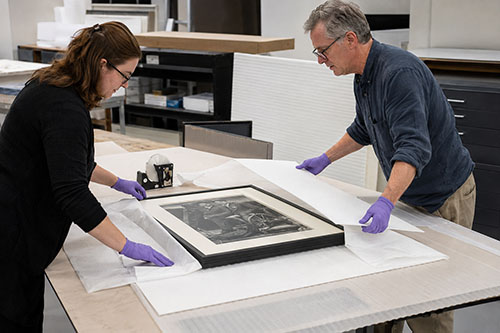
Framing
We offer wood and metal frames, custom cut & joined to order. Each framed print includes hanging hardware and foamcore backer.
Matting
We use conservation grade 100% virgin alpha-cellulose 2 ply mats with white core. Acid-free and lignin-free, these are both face resistant and meet all conservation quality standards set by the Fine Art Trade Guild. Mats are digitally cut for ultimate precision. The window will be 1/8″ smaller than the print dimensions.
Glazing (Acrylic Glass)
We offer custom cut panes of shatter-proof, acrylic glass, to protect your valuable artwork and prints.
Premium Clear
Framing grade clear acrylic is shatter resistant and lightweight.
Reflection Control
With its matte finish, Tru Vue Reflection Control® Acrylic scatters light to diminish unwanted glare.
Conservation Clear
Tru Vue Conservation Clear® Acrylic is a framing industry staple, blocking up to 99% of UV rays for ultimate protection.
Conservation Reflection Control
Tru Vue Conservation Reflection Control® Acrylic scatters and diffuses light to reduce unwanted glare. Blocks up to 99% of UV rays.
Related products
-

Martine Beswick – Thunderball (1965) Paula Caplan 007 Bond Girl Reclining Tiger-Stripe Swimsuit Boat Bahamas Publicity Photo
$30.00 -
Susan Denberg – Frankenstein Created Woman (1967) Bray Studios Dressing Room Behind-the-Scenes Photo
$38.00 -
Martine Beswick – Thunderball (1965) Paula Caplan 007 Bond Girl Tiger-Stripe Swimsuit on Boat Bahamas Publicity Photo
$30.00 -
Sean Connery & Luciana Paluzzi – Thunderball (1965) Fiona Volpe Bedroom Set Behind-the-Scenes James Bond 007 Photo
$38.00


