

Peter Cushing – Frankenstein and the Monster from Hell (1974) Baron Frankenstein Top Hat Publicity Photo
Limited Edition Photograph (learn more)
In stock
Peter Cushing confronts the camera as Baron Frankenstein in this austere black-and-white character photograph from Frankenstein and the Monster from Hell (1974). Framed tightly in his tall black top hat, dark coat and cravat, Cushing’s pale face and unwavering gaze dominate the composition while the shadowed asylum interior recedes behind him. With no Creature or laboratory apparatus competing for attention, the photograph concentrates entirely on Cushing’s severe characterization of the Baron in his final Hammer appearance.
The image is constructed around Cushing’s extraordinary ability to communicate authority through stillness. His shoulders are squared almost directly toward the camera, while the high collar, tightly wrapped neckwear and formal top hat create a rigid vertical silhouette. Deep black fabric surrounds the lighter tones of his face, immediately drawing attention to his eyes and sharply defined features. The expression is controlled rather than theatrical: cool, watchful and faintly intimidating, perfectly suited to the increasingly hardened Frankenstein of Hammer’s later films.
Behind him, the environment is deliberately subdued. A patterned wall or grille occupies part of the background, while surrounding architectural details disappear into heavy shadow. That limited depth gives the portrait an enclosed, oppressive quality consistent with the institutional setting of the film. The strong contrast between Cushing’s illuminated face and the dark interior also allows the costume to become part of the characterization. His formal Victorian appearance suggests dignity and professional authority, yet the severity of the clothing and expression makes that respectability feel distinctly ominous.
Directed by Terence Fisher for Hammer Film Productions, Frankenstein and the Monster from Hell places the Baron inside an asylum, where he has established a new identity as Dr. Carl Victor and continues his experiments largely beyond outside scrutiny. When the young surgeon Simon Helder, played by Shane Briant, is committed to the institution after being caught conducting forbidden experiments, Frankenstein recognizes both his ability and his usefulness. Helder gradually becomes the Baron’s assistant as another attempt to construct a viable human being takes shape within the asylum.
This Peter Cushing Frankenstein and the Monster from Hell portrait is particularly effective because it removes the spectacle of experimentation and presents the character almost as a psychological study. There is no operating table, surgical instrument or monstrous body visible to explain who he is. Instead, the image depends entirely upon Cushing’s presence. His direct gaze, immaculate clothing and restrained expression communicate the intelligence, self-possession and moral detachment that defined his interpretation of Frankenstein across Hammer’s long-running series.
The film occupies an important place in Hammer history. Principal photography took place in 1972 at EMI-MGM Elstree Studios, although the picture did not receive its general release until 1974. It became Peter Cushing’s sixth and final portrayal of Hammer’s Baron Frankenstein, completing a character arc that had begun with The Curse of Frankenstein in 1957. It was also the final feature directed by Terence Fisher, whose work with Hammer had played a central role in defining the studio’s Gothic horror style.
For collectors of Cushing and Hammer Frankenstein imagery, the photograph has unusual strength precisely because of its simplicity. The top hat, severe Victorian costume, penetrating expression and near-monochromatic darkness reduce the character to his essential visual qualities. Rather than depicting Frankenstein in the act of creation, it presents the man himself: controlled, intelligent, isolated and still utterly committed to the work that has consumed his life.
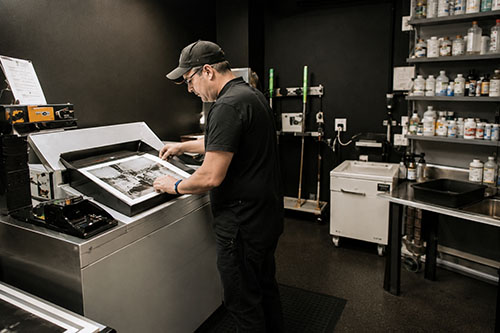
Carefully restored from historic photographic source material and professionally lab-developed, this museum-quality photograph is presented uncropped, preserving the complete image area contained in the source. Restoration recovers Cushing’s facial detail, top-hat texture, dark costume definition, cravat detail and the shadowed asylum background while maintaining the natural tonal gradation and character of the historic black-and-white photograph. The finished photograph contains no AI-generated image content.
Product Enquiry
Kodak Professional Endura Paper
Kodak Endura papers provide an incredible amount of detail and smooth transition of tones. Designed for the professional photographer in mind, looking for a more traditional photo print style, Kodak Endura provides an extended print life and color gamut almost at the level of a high end fine art paper print.
Archival Matte Paper
Archival Matte Paper, also known as Moab Lasal Photo Matte, is our house stock fine art paper and is an economical favorite for fine art reproductions and photo prints. It features a smooth surface, heavy weight (230 g, 9.5-mil), neutral white, matte paper engineered for accurate color reproduction that provides high contrast and high-resolution output. This paper is acid-free, making it the perfect choice for both photography & fine art reproductions.
Giclee William Turner Paper by Hahnemühle
The William Turner by Hahnemühle is one of the most popular papers used in the Giclee printing industry. This is a 310g natural white mould made natural line paper with 100% rag content making it highly archival. It has a slight coarse texture which gives photos and artwork an elegant look. These fine art paper prints (also known as Giclee) are ordered by galleries, individual artists and photographers. The papers and inks are not only archival but use some of the most accurate print technology for full color prints.
- Giclee prints use very expensive archival pigmented inks.
- Highest level of color gamut available in printing (12 color printing).
- Exceptional black & white printing.
- Fade resistant, pigmented inks which provide a superior color range compared to other types of inks. Widely preferred in fine art and photography circles.
- We ONLY use professional grade fine art and photo paper that resist yellowing and aging.
Framing
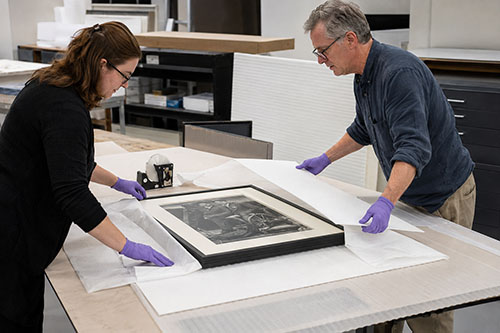
We offer wood and metal frames, custom cut & joined to order. Each framed print includes hanging hardware and foamcore backer.
Matting
We use conservation grade 100% virgin alpha-cellulose 2 ply mats with white core. Acid-free and lignin-free, these are both face resistant and meet all conservation quality standards set by the Fine Art Trade Guild. Mats are digitally cut for ultimate precision. The window will be 1/8″ smaller than the print dimensions.
Glazing (Acrylic Glass)
We offer custom cut panes of shatter-proof, acrylic glass, to protect your valuable artwork and prints.
Premium Clear
Framing grade clear acrylic is shatter resistant and lightweight.
Reflection Control
With its matte finish, Tru Vue Reflection Control® Acrylic scatters light to diminish unwanted glare.
Conservation Clear
Tru Vue Conservation Clear® Acrylic is a framing industry staple, blocking up to 99% of UV rays for ultimate protection.
Conservation Reflection Control
Tru Vue Conservation Reflection Control® Acrylic scatters and diffuses light to reduce unwanted glare. Blocks up to 99% of UV rays.
Related products
-

Peter Cushing & Christopher Lee – The Curse of Frankenstein (1957) Baron Frankenstein & Bandaged Creature Awakening Hammer Horror Photo
$25.00 -
Peter Cushing & Susan Denberg – Frankenstein Created Woman (1967) Christina on Laboratory Table Publicity Photo
$38.00 -
Peter Cushing – The Curse of Frankenstein (1957) Baron Victor Frankenstein Publicity Photo
$30.00 -
The Brides of Dracula (1960) Peter Cushing Van Helsing Original Belgian Theatrical Design Hammer Horror 15×22 Fine Art Poster
$149.85


