

Roman Polanski & Sven Nykvist – The Tenant (1976) Trelkovsky Camera Rig & Boom Microphone Behind-the-Scenes Photo
Limited Edition Photograph (learn more)
In stock
Roman Polanski and cinematographer Sven Nykvist are documented at work during production of The Tenant (1976) in this dense black-and-white behind-the-scenes photograph, with a massive motion-picture camera rig dominating the center of the composition. Polanski, in costume as Trelkovsky, sits immediately beneath the equipment holding production pages while looking upward toward the crew, as Nykvist remains partially visible at the left. A suspended boom microphone enters the working space above them, creating an unusually revealing image of the camera, sound equipment, technicians and performer compressed into a single active production setup.
The photograph is particularly valuable because it shows how physically crowded professional filmmaking could become inside a confined interior. The large camera body, support system, cabling and microphone occupy much of the available space, while Polanski remains positioned directly beneath the equipment. Rather than hiding the machinery of filmmaking, the image makes that machinery the subject, preserving the close coordination required between direction, cinematography, sound and performance before a shot could be recorded.
Released in 1976, The Tenant was directed by Roman Polanski, who also portrays Trelkovsky, alongside Isabelle Adjani as Stella, Melvyn Douglas, Jo Van Fleet, Shelley Winters, Bernard Fresson and Lila Kedrova. Sven Nykvist served as director of photography, bringing his celebrated precision with light, composition and interior space to one of Polanski’s most psychologically claustrophobic films.
The film’s camera department included Jean Harnois as camera operator, with François Catonne and Bruno De Keyser as camera assistants. AFI also credits Jean-Pierre Ruh as sound mixer and Louis Gimel as boom operator, making the visible interaction between camera and suspended microphone in this photograph especially representative of the collaboration between the image and sound departments.
That production structure is part of what makes the photograph so compelling. The boom microphone had to be positioned close enough to capture usable dialogue while remaining outside the camera frame, and the camera crew simultaneously had to manage composition, focus and movement within the same restricted space. The resulting image preserves the technical negotiation occurring just beyond what audiences ultimately see and hear.
The Tenant was adapted by Roman Polanski and Gérard Brach from Roland Topor’s novel Le Locataire chimérique. The story follows Trelkovsky, a withdrawn Paris tenant whose growing obsession with the previous occupant of his apartment develops into paranoia, psychological fragmentation and an increasingly unstable perception of identity and space.
The production is also important in the history of camera technology. AFI credits Louma for special photography, and La Cinémathèque française identifies The Tenant as the first feature film to use the Louma crane, which enabled the celebrated extended opening movement through and around the apartment building. The Festival de Cannes likewise notes the Louma’s use on the film and its importance in expanding the possibilities of controlled camera movement.
That technological ambition is consistent with the working environment seen here. Whether the particular rig in this photograph is associated with the Louma setup or a conventional camera configuration, the image clearly reveals a production built around substantial mechanical equipment and carefully coordinated technical departments. It offers collectors an unusually immediate view of the physical realities behind the film’s polished visual precision.
For Sven Nykvist, the project extended a career already internationally celebrated through his collaborations with Ingmar Bergman. His restrained approach to lighting and composition helped give The Tenant a credible, almost naturalistic surface even as Polanski gradually distorted architecture, scale and perspective around Trelkovsky.
Polanski’s dual position as both director and leading actor adds another layer of interest. In this photograph he is not simply observing the technical process from behind the camera; he is positioned within the scene as Trelkovsky while simultaneously participating in the decision-making surrounding the shot. That overlapping role gives the image particular value as a document of filmmaking practice.
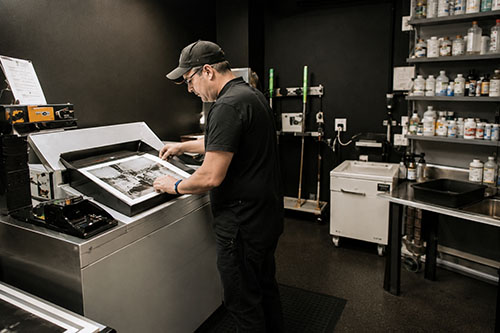
Carefully restored from historic photographic source material and professionally lab-developed, this museum-quality photograph is presented uncropped, preserving the complete image area contained in the source. Meticulous restoration recovers facial detail, camera-equipment definition, cabling, microphone detail, clothing texture, tonal range and photographic clarity while retaining the documentary character of the original black-and-white behind-the-scenes photograph.
For collectors of Roman Polanski, Sven Nykvist, The Tenant and motion-picture production history, this is an exceptional technical image—Polanski seated as Trelkovsky beneath the imposing camera rig while Nykvist and the crew work around him and a boom microphone hangs overhead, preserving a rare visual record of the tightly coordinated camera-and-sound environment behind one of the defining psychological films of the 1970s.
Product Enquiry
Kodak Professional Endura Paper
Kodak Endura papers provide an incredible amount of detail and smooth transition of tones. Designed for the professional photographer in mind, looking for a more traditional photo print style, Kodak Endura provides an extended print life and color gamut almost at the level of a high end fine art paper print.
Archival Matte Paper
Archival Matte Paper, also known as Moab Lasal Photo Matte, is our house stock fine art paper and is an economical favorite for fine art reproductions and photo prints. It features a smooth surface, heavy weight (230 g, 9.5-mil), neutral white, matte paper engineered for accurate color reproduction that provides high contrast and high-resolution output. This paper is acid-free, making it the perfect choice for both photography & fine art reproductions.
Giclee William Turner Paper by Hahnemühle
The William Turner by Hahnemühle is one of the most popular papers used in the Giclee printing industry. This is a 310g natural white mould made natural line paper with 100% rag content making it highly archival. It has a slight coarse texture which gives photos and artwork an elegant look. These fine art paper prints (also known as Giclee) are ordered by galleries, individual artists and photographers. The papers and inks are not only archival but use some of the most accurate print technology for full color prints.
- Giclee prints use very expensive archival pigmented inks.
- Highest level of color gamut available in printing (12 color printing).
- Exceptional black & white printing.
- Fade resistant, pigmented inks which provide a superior color range compared to other types of inks. Widely preferred in fine art and photography circles.
- We ONLY use professional grade fine art and photo paper that resist yellowing and aging.
Framing
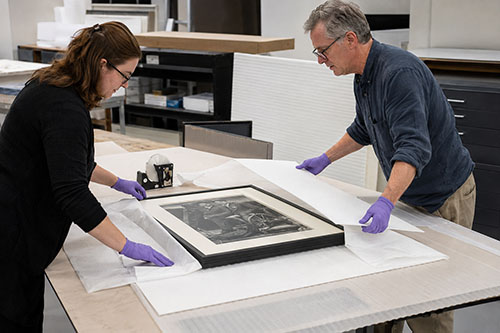
We offer wood and metal frames, custom cut & joined to order. Each framed print includes hanging hardware and foamcore backer.
Matting
We use conservation grade 100% virgin alpha-cellulose 2 ply mats with white core. Acid-free and lignin-free, these are both face resistant and meet all conservation quality standards set by the Fine Art Trade Guild. Mats are digitally cut for ultimate precision. The window will be 1/8″ smaller than the print dimensions.
Glazing (Acrylic Glass)
We offer custom cut panes of shatter-proof, acrylic glass, to protect your valuable artwork and prints.
Premium Clear
Framing grade clear acrylic is shatter resistant and lightweight.
Reflection Control
With its matte finish, Tru Vue Reflection Control® Acrylic scatters light to diminish unwanted glare.
Conservation Clear
Tru Vue Conservation Clear® Acrylic is a framing industry staple, blocking up to 99% of UV rays for ultimate protection.
Conservation Reflection Control
Tru Vue Conservation Reflection Control® Acrylic scatters and diffuses light to reduce unwanted glare. Blocks up to 99% of UV rays.
Related products
-

Colin Clive, Boris Karloff & Dwight Frye – Frankenstein (1931) Monster Creation Laboratory Wide View
$38.00 -
Barbara Steele – The Horrible Dr. Hichcock (1962) Coffin Confinement Scene Photo
$30.00 -
Sean Connery & Ursula Andress – Dr. No (1962) Crab Key Water Scene Jamaica Behind-the-Scenes Photo
$38.00 -
Klaus Kinski – Fitzcarraldo (1982) Brian Sweeney Fitzgerald Jungle Location Publicity Photo
$25.00