

Sean Connery, Claudine Auger & Terence Young – Thunderball (1965) Nassau Beach Behind-the-Scenes Photo
Limited Edition Photograph (learn more)
In stock
SEAN CONNERY and CLAUDINE AUGER are photographed during beach filming for Thunderball (1965) in Nassau, Bahamas, while director TERENCE YOUNG and a substantial section of the location crew remain fully visible around them. Connery and Auger sit together on the sand at the left of the composition as technicians, assistants and production personnel occupy virtually every other part of the beach. Large studio lamps, reflectors, flags, stands, cables and camera-related equipment dominate the right side of the frame, while Young sits nearby beneath a broad-brimmed hat observing the setup. Rather than disguising the mechanics of filmmaking, this unusually wide photograph makes the production apparatus itself part of the subject, offering a remarkable view of the scale required to create what would appear on screen as an effortless tropical Bond sequence.
The depth of the composition makes it particularly rewarding for collectors. Connery and Auger are relatively small within the frame, allowing the eye to move from the performers across the lighting equipment, seated crew members and working beach environment. The photograph therefore functions as much as a document of 1960s location filmmaking as a portrait of the stars. For collectors searching for Sean Connery Claudine Auger Thunderball 1965 material, it provides something considerably rarer than a conventional Bond publicity still: an expansive view of the people and equipment surrounding the actors during production.
Directed by Terence Young, Thunderball was the fourth Eon Productions James Bond adventure and Young’s third and final Bond film after Dr. No and From Russia with Love. Sean Connery returned as James Bond, while French actress Claudine Auger played Domino Derval opposite Adolfo Celi as SPECTRE operative Emilio Largo. The supporting cast includes Luciana Paluzzi as Fiona Volpe, Rik Van Nutter as Felix Leiter and Martine Beswick as Paula. Kevin McClory produced the film, with Albert R. Broccoli and Harry Saltzman serving as executive producers.
The production was the most ambitious Bond undertaking to that point. The official 007 production history records that the company left for Nassau on March 22, 1965, with Bahamian filming beginning on March 24. AFI likewise documents the move to Nassau and records that numerous scenes were filmed there and on surrounding islands. Extensive underwater work, large crews and specialized photographic equipment dramatically expanded the visual scale of the developing series.
The Bahamas are integral to the story itself. Bond travels to Nassau while pursuing two stolen NATO nuclear weapons and investigates Largo, eventually persuading Domino to turn against him after revealing the truth about her brother’s death. Official Bond records identify Love Beach in Nassau as the setting for an important Bond-and-Domino scene, while the film’s celebrated underwater sequences and climactic battle further established Thunderball as one of the most visually ambitious entries of the Connery era.
For the collector, this photograph is especially valuable because it shows how carefully that apparent tropical ease was manufactured. The beach may look natural on screen, but here the concentration of lights, stands, crew and technical equipment reveals the substantial operation positioned just outside the camera’s finished frame.
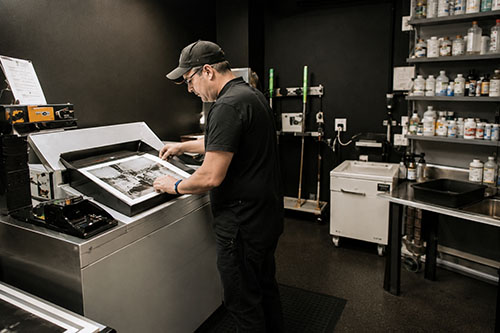
Carefully restored from historic photographic source material and professionally lab-developed, this museum-quality photograph is presented uncropped, preserving the complete image area contained in the source. Restoration recovers facial detail, beach textures, production equipment, lighting units, cables and crew figures while maintaining the natural tonal gradation and character of the historic black-and-white photograph. The finished photograph contains no AI-generated image content.
A superb production document from Thunderball, this image combines Sean Connery, Claudine Auger, Terence Young and the visible mechanics of location filmmaking in one exceptional piece of James Bond history.
Product Enquiry
Kodak Professional Endura Paper
Kodak Endura papers provide an incredible amount of detail and smooth transition of tones. Designed for the professional photographer in mind, looking for a more traditional photo print style, Kodak Endura provides an extended print life and color gamut almost at the level of a high end fine art paper print.
Archival Matte Paper
Archival Matte Paper, also known as Moab Lasal Photo Matte, is our house stock fine art paper and is an economical favorite for fine art reproductions and photo prints. It features a smooth surface, heavy weight (230 g, 9.5-mil), neutral white, matte paper engineered for accurate color reproduction that provides high contrast and high-resolution output. This paper is acid-free, making it the perfect choice for both photography & fine art reproductions.
Giclee William Turner Paper by Hahnemühle
The William Turner by Hahnemühle is one of the most popular papers used in the Giclee printing industry. This is a 310g natural white mould made natural line paper with 100% rag content making it highly archival. It has a slight coarse texture which gives photos and artwork an elegant look. These fine art paper prints (also known as Giclee) are ordered by galleries, individual artists and photographers. The papers and inks are not only archival but use some of the most accurate print technology for full color prints.
- Giclee prints use very expensive archival pigmented inks.
- Highest level of color gamut available in printing (12 color printing).
- Exceptional black & white printing.
- Fade resistant, pigmented inks which provide a superior color range compared to other types of inks. Widely preferred in fine art and photography circles.
- We ONLY use professional grade fine art and photo paper that resist yellowing and aging.
Framing
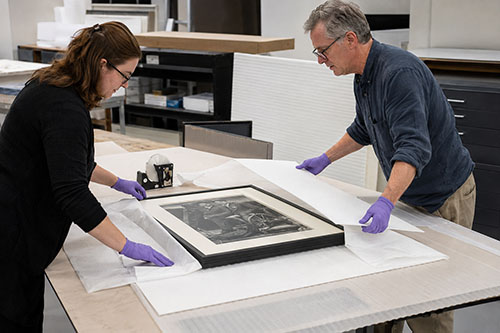
We offer wood and metal frames, custom cut & joined to order. Each framed print includes hanging hardware and foamcore backer.
Matting
We use conservation grade 100% virgin alpha-cellulose 2 ply mats with white core. Acid-free and lignin-free, these are both face resistant and meet all conservation quality standards set by the Fine Art Trade Guild. Mats are digitally cut for ultimate precision. The window will be 1/8″ smaller than the print dimensions.
Glazing (Acrylic Glass)
We offer custom cut panes of shatter-proof, acrylic glass, to protect your valuable artwork and prints.
Premium Clear
Framing grade clear acrylic is shatter resistant and lightweight.
Reflection Control
With its matte finish, Tru Vue Reflection Control® Acrylic scatters light to diminish unwanted glare.
Conservation Clear
Tru Vue Conservation Clear® Acrylic is a framing industry staple, blocking up to 99% of UV rays for ultimate protection.
Conservation Reflection Control
Tru Vue Conservation Reflection Control® Acrylic scatters and diffuses light to reduce unwanted glare. Blocks up to 99% of UV rays.
Related products
-

Sean Connery – Thunderball (1965) Shirtless in Frogman Gear James Bond 007 BTS Photo
$30.00 -
Clint Eastwood – Dirty Harry (1971) Panavision Camera Behind-the-Scenes Photo
$38.00 -
Sean Connery & Luciana Paluzzi – Thunderball (1965) Fiona Volpe Bedroom Scene Pinewood Studios James Bond 007 Photo
$38.00 -
Sean Connery – Dr. No (1962) “Bond, James Bond” Le Cercle Casino Photo
$38.00


