

Sean Connery – Dr. No (1962) “Bond, James Bond” Le Cercle Casino Photo
Limited Edition Photograph (learn more)
In stock
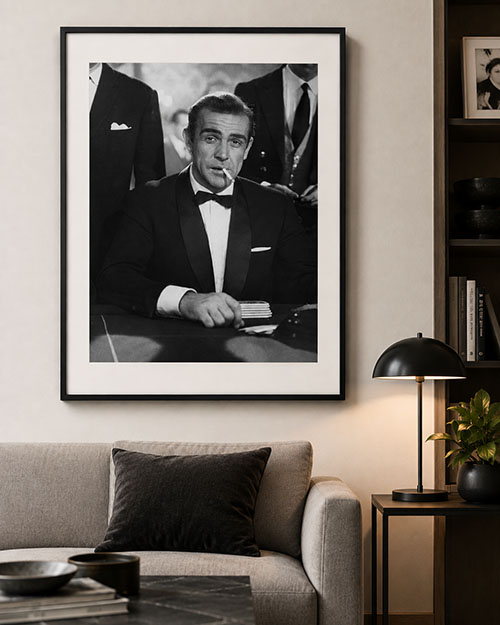
SEAN CONNERY appears as James Bond at the chemin de fer table in this commanding black-and-white photograph from the legendary Le Cercle casino sequence in Dr. No (1962), the scene that gives cinema audiences their defining introduction to Agent 007. Dressed impeccably in a black dinner jacket, white shirt and bow tie, Connery sits at the gaming table with a cigarette held casually between his lips and a neat stack of cards before him. His controlled expression, direct gaze and relaxed posture immediately establish the combination of elegance, confidence and danger that would become inseparable from the cinematic Bond character. With other formally dressed patrons remaining softly visible behind him, the photograph concentrates firmly on Connery and the composed self-assurance of his first screen appearance.
For collectors seeking Sean Connery Dr. No 1962 photography, the significance of this image is difficult to overstate. The scene takes place at Le Cercle, Les Ambassadeurs Club in London, where Bond plays chemin de fer opposite Sylvia Trench, portrayed by Eunice Gayson. The official James Bond archive confirms that Sylvia introduces herself as “Trench, Sylvia Trench,” prompting Connery’s famous reply: “Bond, James Bond.” It was the first cinematic delivery of the line that became the character’s enduring verbal signature.
The casino setting is equally important to Bond history. Official 007 material identifies chemin de fer as the game being played and notes that Sylvia holds a strong hand before Bond ultimately wins. Casinos would become a recurring element throughout the series, but this is where the association begins: formal evening wear, high-stakes gambling, cigarettes, confidence and the calculated introduction of Bond’s name.
Although the story places the sequence inside the real Les Ambassadeurs Club, the casino interior seen in Dr. No was recreated as a studio set at Pinewood Studios, modeled on the actual Le Cercle room and designed by celebrated production designer Ken Adam. Specialist Bond documentation confirms that the club itself was not used for the interior filming. That distinction makes the photograph as interesting from a production standpoint as it is historically important to the Bond character.
Directed by Terence Young and produced by Albert R. Broccoli and Harry Saltzman, Dr. No was the first film in the Eon Productions James Bond series. The official 007 archive records its October 1962 British release and identifies Pinewood Studios and Jamaica as the principal production bases, with the James Bond Theme by Monty Norman accompanying the film’s creation of a new screen icon. The BFI likewise describes Dr. No as the picture that introduced Bond to cinema audiences and made Connery an international star.
The strength of this photograph lies in how completely Connery already appears to inhabit the role. There is no action, weapon or exotic location required. The tuxedo, cigarette, cards and unwavering expression are sufficient to establish the character. This example is also part of the newly offered group of historic photographs now becoming available to collectors for the first time.
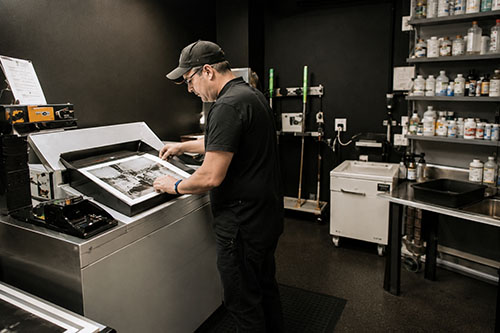
Carefully restored from historic photographic source material and professionally lab-developed, this museum-quality photograph is presented uncropped, preserving the complete image area contained in the source. Restoration recovers facial detail, tuxedo fabric, cigarette, playing cards and subtle tonal detail throughout the casino setting while maintaining the natural tonal gradation and character of the historic black-and-white photograph. The finished photograph contains no AI-generated image content.
A foundational image of Sean Connery as James Bond, this photograph preserves the moment when the tuxedoed gambler at Le Cercle became 007 and one of cinema’s most enduring characters.
Product Enquiry
Kodak Professional Endura Paper
Kodak Endura papers provide an incredible amount of detail and smooth transition of tones. Designed for the professional photographer in mind, looking for a more traditional photo print style, Kodak Endura provides an extended print life and color gamut almost at the level of a high end fine art paper print.
Archival Matte Paper
Archival Matte Paper, also known as Moab Lasal Photo Matte, is our house stock fine art paper and is an economical favorite for fine art reproductions and photo prints. It features a smooth surface, heavy weight (230 g, 9.5-mil), neutral white, matte paper engineered for accurate color reproduction that provides high contrast and high-resolution output. This paper is acid-free, making it the perfect choice for both photography & fine art reproductions.
Giclee William Turner Paper by Hahnemühle
The William Turner by Hahnemühle is one of the most popular papers used in the Giclee printing industry. This is a 310g natural white mould made natural line paper with 100% rag content making it highly archival. It has a slight coarse texture which gives photos and artwork an elegant look. These fine art paper prints (also known as Giclee) are ordered by galleries, individual artists and photographers. The papers and inks are not only archival but use some of the most accurate print technology for full color prints.
- Giclee prints use very expensive archival pigmented inks.
- Highest level of color gamut available in printing (12 color printing).
- Exceptional black & white printing.
- Fade resistant, pigmented inks which provide a superior color range compared to other types of inks. Widely preferred in fine art and photography circles.
- We ONLY use professional grade fine art and photo paper that resist yellowing and aging.
Framing
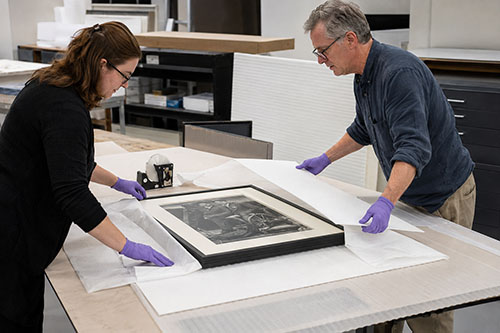
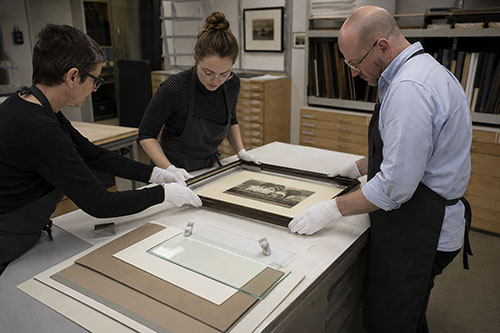
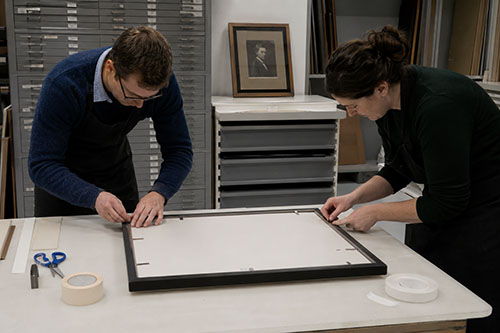
We offer wood and metal frames, custom cut & joined to order. Each framed print includes hanging hardware and foamcore backer.
Matting
We use conservation grade 100% virgin alpha-cellulose 2 ply mats with white core. Acid-free and lignin-free, these are both face resistant and meet all conservation quality standards set by the Fine Art Trade Guild. Mats are digitally cut for ultimate precision. The window will be 1/8″ smaller than the print dimensions.
Glazing (Acrylic Glass)
We offer custom cut panes of shatter-proof, acrylic glass, to protect your valuable artwork and prints.
Premium Clear
Framing grade clear acrylic is shatter resistant and lightweight.
Reflection Control
With its matte finish, Tru Vue Reflection Control® Acrylic scatters light to diminish unwanted glare.
Conservation Clear
Tru Vue Conservation Clear® Acrylic is a framing industry staple, blocking up to 99% of UV rays for ultimate protection.
Conservation Reflection Control
Tru Vue Conservation Reflection Control® Acrylic scatters and diffuses light to reduce unwanted glare. Blocks up to 99% of UV rays.
Related products
-

Sean Connery & Ursula Andress – Dr. No (1962) Relaxing Between Takes in Jamaica James Bond 007 Behind-the-Scenes Photo
$30.00 -
Sean Connery – Dr. No (1962) James Bond M’s Office Walther PPK Introduction Photo
$30.00 -
Sean Connery & Luciana Paluzzi – Thunderball (1965) Fiona Volpe Bedroom Set Behind-the-Scenes James Bond 007 Photo
$38.00 -
Sean Connery & Ursula Andress – Dr. No (1962) Torn-Shirt Finale Behind-the-Scenes Jamaica Photo
$30.00


