

Sean Connery – Dr. No (1962) James Bond M’s Office Walther PPK Introduction Photo
Limited Edition Photograph (learn more)
In stock
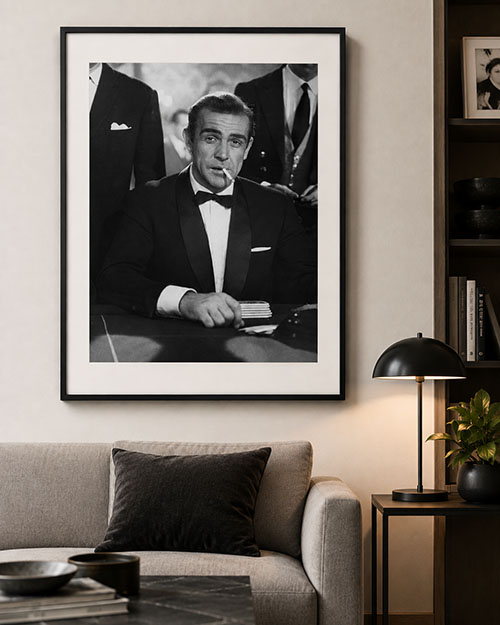
SEAN CONNERY appears as James Bond in this intense black-and-white close-up from the M’s office sequence in Dr. No (1962), during the famous exchange in which 007 is ordered to surrender his Beretta and carry a Walther instead. Still dressed in the black tuxedo jacket, white shirt and bow tie seen during his introductory London casino sequence, Connery looks sharply toward the conversation with a controlled but distinctly displeased expression. The close framing eliminates almost everything except Bond’s face and formal evening clothes, allowing his narrowed eyes, set jaw and restrained reaction to carry the photograph. Rather than an action image, this is a concentrated study of Sean Connery James Bond Dr. No 1962 at one of the foundational moments in the character’s screen history.
The photograph is especially effective because Bond’s reaction communicates his attitude without requiring the weapon itself to appear in the frame. Connery’s expression suggests a man accustomed to making his own decisions but forced to accept an order from his superior. The tuxedo also strengthens the image historically: only shortly before this meeting, audiences have been introduced to Connery’s Bond at the casino, establishing the combination of elegance, confidence and danger that would become central to the series.
Directed by Terence Young for Eon Productions, Dr. No introduced Connery as James Bond 007, with Bernard Lee as M, Ursula Andress as Honey Ryder, Joseph Wiseman as Dr. No, Jack Lord as Felix Leiter and John Kitzmiller as Quarrel. AFI confirms Peter Burton as Major Boothroyd, the armourer summoned into M’s office to assess Bond’s firearm, with Albert R. Broccoli and Harry Saltzman producing and Ted Moore serving as director of photography.
The scene established one of the most enduring pieces of Bond iconography. M orders Bond to give up the Beretta he has carried for years, and Boothroyd recommends the 7.65mm Walther PPK as its replacement. The official James Bond archive identifies Burton’s Boothroyd as the screen predecessor of Q and specifically notes that he replaces Bond’s Beretta with the Walther PPK in Dr. No. The association proved remarkably durable, with the compact Walther becoming one of the objects most closely identified with James Bond across the series.
There is also an interesting production distinction for serious collectors. Although the dialogue identifies Bond’s new weapon as a Walther PPK, Christie’s documented the surviving BAPTY-supplied handgun used by Connery in Dr. No as a Walther PP. Its auction provenance specifically records the discrepancy between the scripted PPK and the larger PP actually supplied for filming. This should not alter the customer-facing identification of the scene as the famous Walther PPK introduction, but it adds a valuable piece of verified prop history.
For collectors of Connery-era Bond photography, this image captures the character before Jamaica, Honey Ryder, Crab Key or Dr. No’s island complex enter the story. It preserves the disciplined intelligence-service world in which cinematic Bond is first defined—and the moment when one of his most recognizable trademarks is established.
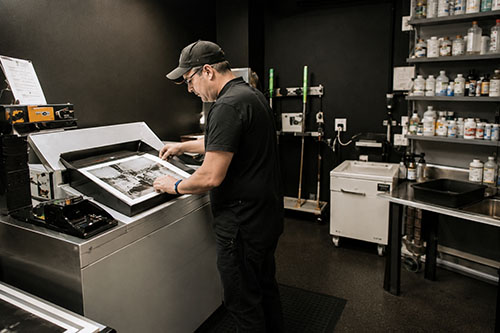
Carefully restored from historic photographic source material and professionally lab-developed, this museum-quality photograph is presented uncropped, preserving the complete image area contained in the source. Restoration recovers facial detail, eye definition, hair texture, tuxedo fabric and subtle shadow transitions while maintaining the natural tonal gradation and character of the historic black-and-white photograph. The finished photograph contains no AI-generated image content.
Product Enquiry
Kodak Professional Endura Paper
Kodak Endura papers provide an incredible amount of detail and smooth transition of tones. Designed for the professional photographer in mind, looking for a more traditional photo print style, Kodak Endura provides an extended print life and color gamut almost at the level of a high end fine art paper print.
Archival Matte Paper
Archival Matte Paper, also known as Moab Lasal Photo Matte, is our house stock fine art paper and is an economical favorite for fine art reproductions and photo prints. It features a smooth surface, heavy weight (230 g, 9.5-mil), neutral white, matte paper engineered for accurate color reproduction that provides high contrast and high-resolution output. This paper is acid-free, making it the perfect choice for both photography & fine art reproductions.
Giclee William Turner Paper by Hahnemühle
The William Turner by Hahnemühle is one of the most popular papers used in the Giclee printing industry. This is a 310g natural white mould made natural line paper with 100% rag content making it highly archival. It has a slight coarse texture which gives photos and artwork an elegant look. These fine art paper prints (also known as Giclee) are ordered by galleries, individual artists and photographers. The papers and inks are not only archival but use some of the most accurate print technology for full color prints.
- Giclee prints use very expensive archival pigmented inks.
- Highest level of color gamut available in printing (12 color printing).
- Exceptional black & white printing.
- Fade resistant, pigmented inks which provide a superior color range compared to other types of inks. Widely preferred in fine art and photography circles.
- We ONLY use professional grade fine art and photo paper that resist yellowing and aging.
Framing
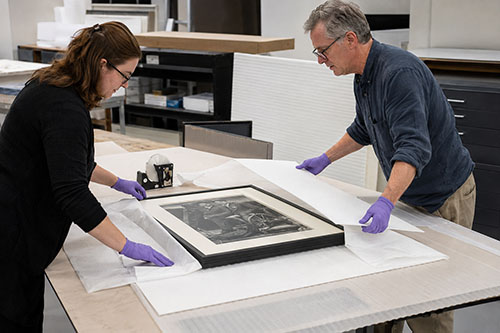
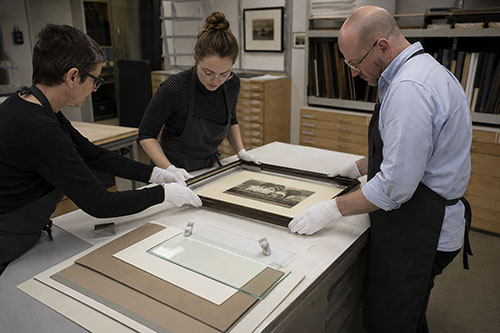
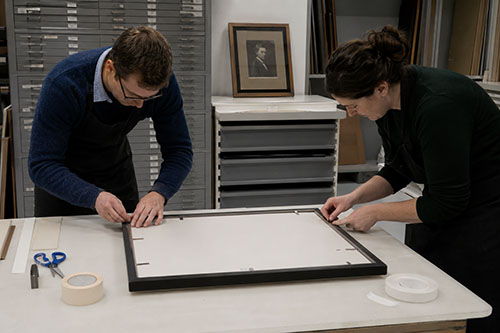
We offer wood and metal frames, custom cut & joined to order. Each framed print includes hanging hardware and foamcore backer.
Matting
We use conservation grade 100% virgin alpha-cellulose 2 ply mats with white core. Acid-free and lignin-free, these are both face resistant and meet all conservation quality standards set by the Fine Art Trade Guild. Mats are digitally cut for ultimate precision. The window will be 1/8″ smaller than the print dimensions.
Glazing (Acrylic Glass)
We offer custom cut panes of shatter-proof, acrylic glass, to protect your valuable artwork and prints.
Premium Clear
Framing grade clear acrylic is shatter resistant and lightweight.
Reflection Control
With its matte finish, Tru Vue Reflection Control® Acrylic scatters light to diminish unwanted glare.
Conservation Clear
Tru Vue Conservation Clear® Acrylic is a framing industry staple, blocking up to 99% of UV rays for ultimate protection.
Conservation Reflection Control
Tru Vue Conservation Reflection Control® Acrylic scatters and diffuses light to reduce unwanted glare. Blocks up to 99% of UV rays.
Related products
-

Sean Connery & Ursula Andress – Dr. No (1962) James Bond & Honey Ryder Beach Behind-the-Scenes Photo
$30.00 -
Sean Connery – Thunderball (1965) Shirtless Nassau Beach Location Behind-the-Scenes James Bond 007 Photo
$38.00 -
Sean Connery & Zena Marshall James Bond & Miss Taro Bedroom Kiss 007 Photo
$25.00 -
Sean Connery – Thunderball (1965) Scuba Equipment on Bahamas Beach Behind-the-Scenes James Bond 007 Photo
$38.00


