

Soledad Miranda – Vampyros Lesbos (1971) Countess Nadine Carody Mirror Reflection Jess Franco Cult Vampire Photo
Limited Edition Photograph (learn more)
In stock
Soledad Miranda as Countess Nadine Carody sits beside an enormous ornate mirror in this mesmerizing black-and-white photograph associated with Vampyros Lesbos (1971), her dark stockings, flowing costume and reflected figure transforming a single pose into a layered visual study of identity and desire. Miranda’s alert expression contrasts with the darker reflected space beside her, creating an image perfectly suited to the dreamlike atmosphere of Jess Franco’s cult vampire cinema.
The mirror is the photograph’s defining visual device. Rather than functioning simply as background decoration, it divides the composition into multiple planes, allowing Miranda to appear both physically present and strangely duplicated. Her reflection turns away from the viewer while her seated figure looks outward, creating a subtle sense of psychological distance and visual ambiguity.
Miranda’s styling adds further impact. Her long dark hair, sheer flowing garment, patterned stockings and poised seated posture give the photograph an unmistakably early-1970s European glamour quality, while the ornate mirror frame and candlelit surroundings introduce elements of Gothic theatricality.
Released in 1971, Vampyros Lesbos was directed by Jesús “Jess” Franco and became one of the most celebrated cult films of his prolific career. Soledad Miranda, credited as Susann Korda, stars as Countess Nadine Carody, an enigmatic vampire whose relationship with Linda Westinghouse gradually draws the young woman into a hypnotic world of supernatural attraction, dreams and psychological obsession.
The film also stars Ewa Strömberg as Linda Westinghouse, Dennis Price and Paul Muller. Produced as a West German-Spanish collaboration and filmed in 1970, the picture reimagines traditional vampire mythology through Franco’s distinctive mixture of eroticism, surrealism, modern locations and unconventional visual rhythms.
Rather than relying on traditional castles, fogbound graveyards and nineteenth-century Gothic settings, Vampyros Lesbos creates much of its atmosphere through modern architecture, dream imagery, music and sensual visual repetition. Mirrors, performance, fragmented space and ambiguous identities recur throughout the film, making this particular photograph especially representative of Franco’s approach.
Soledad Miranda’s performance became central to the film’s lasting reputation. Her combination of mystery, composure and screen magnetism gives Countess Nadine a presence that feels simultaneously elegant and threatening. This image captures that duality particularly well, presenting Miranda not in overt attack but within a carefully constructed visual environment that suggests seduction, doubling and concealed danger.
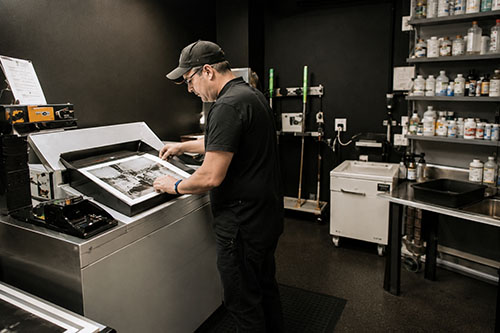
Carefully restored from archival source material and professionally lab-developed, this museum-quality photograph is presented uncropped, preserving the complete image area contained in the archival source. Meticulous restoration recovers facial clarity, mirror detail, fabric texture, tonal depth and photographic integrity while retaining the hypnotic character of the original black-and-white image.
For collectors of Soledad Miranda, Countess Nadine Carody and Vampyros Lesbos, this is an exceptionally evocative piece of Jess Franco cult vampire imagery—a surreal composition in which Miranda’s dark stockings, flowing costume, penetrating gaze, ornate mirror and mysterious reflected figure capture the film’s unique fusion of Gothic horror, European glamour and psychedelic dream logic, making it especially desirable for collectors of Euro horror, vampire cinema, 1970s cult film and classic exploitation photography.
Product Enquiry
Kodak Professional Endura Paper
Kodak Endura papers provide an incredible amount of detail and smooth transition of tones. Designed for the professional photographer in mind, looking for a more traditional photo print style, Kodak Endura provides an extended print life and color gamut almost at the level of a high end fine art paper print.
Archival Matte Paper
Archival Matte Paper, also known as Moab Lasal Photo Matte, is our house stock fine art paper and is an economical favorite for fine art reproductions and photo prints. It features a smooth surface, heavy weight (230 g, 9.5-mil), neutral white, matte paper engineered for accurate color reproduction that provides high contrast and high-resolution output. This paper is acid-free, making it the perfect choice for both photography & fine art reproductions.
Giclee William Turner Paper by Hahnemühle
The William Turner by Hahnemühle is one of the most popular papers used in the Giclee printing industry. This is a 310g natural white mould made natural line paper with 100% rag content making it highly archival. It has a slight coarse texture which gives photos and artwork an elegant look. These fine art paper prints (also known as Giclee) are ordered by galleries, individual artists and photographers. The papers and inks are not only archival but use some of the most accurate print technology for full color prints.
- Giclee prints use very expensive archival pigmented inks.
- Highest level of color gamut available in printing (12 color printing).
- Exceptional black & white printing.
- Fade resistant, pigmented inks which provide a superior color range compared to other types of inks. Widely preferred in fine art and photography circles.
- We ONLY use professional grade fine art and photo paper that resist yellowing and aging.
Framing
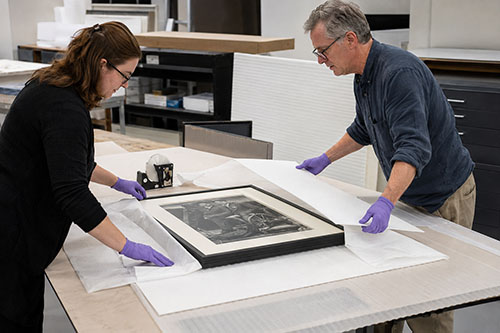
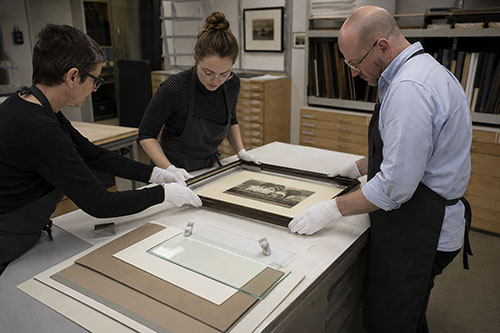
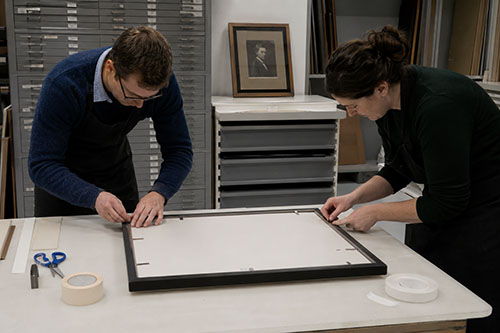
We offer wood and metal frames, custom cut & joined to order. Each framed print includes hanging hardware and foamcore backer.
Matting
We use conservation grade 100% virgin alpha-cellulose 2 ply mats with white core. Acid-free and lignin-free, these are both face resistant and meet all conservation quality standards set by the Fine Art Trade Guild. Mats are digitally cut for ultimate precision. The window will be 1/8″ smaller than the print dimensions.
Glazing (Acrylic Glass)
We offer custom cut panes of shatter-proof, acrylic glass, to protect your valuable artwork and prints.
Premium Clear
Framing grade clear acrylic is shatter resistant and lightweight.
Reflection Control
With its matte finish, Tru Vue Reflection Control® Acrylic scatters light to diminish unwanted glare.
Conservation Clear
Tru Vue Conservation Clear® Acrylic is a framing industry staple, blocking up to 99% of UV rays for ultimate protection.
Conservation Reflection Control
Tru Vue Conservation Reflection Control® Acrylic scatters and diffuses light to reduce unwanted glare. Blocks up to 99% of UV rays.
Related products
-

Yutte Stensgaard & Michael Johnson – Lust for a Vampire (1971) Mircalla & Richard Outdoor Embrace Photo
$38.00 -
Boris Karloff – Frankenstein (1931) Monster Reaching for Sunlight Universal Horror Photo
$38.00 -
Sean Connery & Ursula Andress – Dr. No (1962) Crab Key Water Scene Jamaica Behind-the-Scenes Photo
$38.00 -
Sean Connery & Ursula Andress – Dr. No (1962) Connery Brushing Hair on Beach Behind-the-Scenes Photo
$38.00


