

Colin Clive, Boris Karloff & Dwight Frye – Frankenstein (1931) Monster Creation Laboratory Wide View
Limited Edition Photograph (learn more)
In stock
COLIN CLIVE, BORIS KARLOFF and DWIGHT FRYE occupy the center of Henry Frankenstein’s immense laboratory in this extraordinary wide-view photograph from Frankenstein (1931). Karloff’s heavily bandaged Monster lies on the experimental platform while Clive’s Henry Frankenstein and Frye’s Fritz work beside the electrical controls. Across the chamber, Mae Clarke as Elizabeth, John Boles as Victor Moritz and Edward Van Sloan as Dr. Waldman observe the experiment. The unusually broad composition reveals far more of the environment than a conventional production still: towering brick walls curve around the chamber, electrical columns rise beside the operating area, and suspended apparatus, chains, cables, switches, gauges and laboratory equipment fill the vertical space. The human figures appear almost small within the enormous architecture, allowing the laboratory itself to become a major visual presence.
This scale is what makes the photograph particularly compelling. The experimental table and principal characters occupy a concentrated area near the center, while the surrounding architecture opens outward and upward around them. Hanging equipment emphasizes the extraordinary height of the set, and the network of machinery gives the room a convincing mixture of improvised science and Gothic fantasy. For a collector seeking a Frankenstein 1931 laboratory image, this wide composition provides an exceptional record of the entire creation environment rather than concentrating solely on Karloff’s Monster or Clive’s performance.
Directed by James Whale and produced by Carl Laemmle Jr. for Universal Pictures, Frankenstein stars Colin Clive as Henry Frankenstein, Boris Karloff as the Monster, Dwight Frye as Fritz, Mae Clarke as Elizabeth, John Boles as Victor Moritz and Edward Van Sloan as Dr. Waldman. AFI credits Arthur Edeson with cinematography and Charles D. Hall with the film’s production design.
The laboratory creation sequence became one of the defining visual achievements of early sound horror. Kenneth Strickfaden, an electrician and special-effects innovator, devised the spectacular electrical apparatus associated with Frankenstein’s experiments. MoMA specifically documents Strickfaden’s connection with Frankenstein and his extraordinary movie machinery, while the Smithsonian notes that he developed techniques for simulating lightning and electricity within the creation scene. The resulting combination of towering coils, electrical discharges, control panels and unusual scientific devices established a screen vocabulary that continued to influence depictions of Frankenstein laboratories for decades.
The photograph also shows how effectively Whale and his collaborators balanced spectacle with character. Henry and Fritz remain visually concentrated around their creation while the three observers are separated across the chamber, reinforcing the sense that an extraordinary experiment is unfolding within a dangerous and unfamiliar environment. Karloff’s concealed, bandaged form adds another layer of anticipation because the Monster’s now-famous finished appearance has not yet become the center of attention.
The film’s historical importance extends well beyond the Universal horror cycle. Frankenstein was selected for preservation in the National Film Registry in 1991, recognizing its cultural, historical and aesthetic significance.
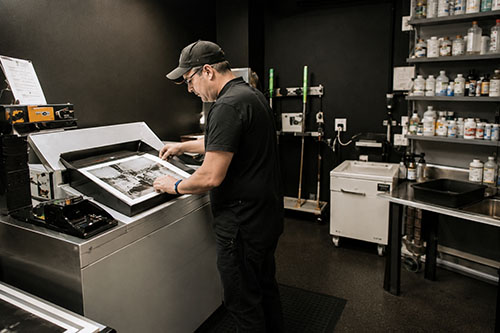
Carefully restored from historic photographic source material and professionally lab-developed, this museum-quality photograph is presented uncropped, preserving the complete image area contained in the source. Restoration recovers fine detail throughout the vast brick laboratory, electrical equipment, hanging chains, control panels, costumes, bandaged figure and distant characters while retaining the tonal character and dramatic depth of the original black-and-white photography. The finished photograph contains no AI-generated image content.
For collectors of Universal Monsters, classic horror, production design and cinematic special effects, this sweeping laboratory view offers an unusually complete visual record of one of the most influential creation sequences in film history.
Product Enquiry
Kodak Professional Endura Paper
Kodak Endura papers provide an incredible amount of detail and smooth transition of tones. Designed for the professional photographer in mind, looking for a more traditional photo print style, Kodak Endura provides an extended print life and color gamut almost at the level of a high end fine art paper print.
Archival Matte Paper
Archival Matte Paper, also known as Moab Lasal Photo Matte, is our house stock fine art paper and is an economical favorite for fine art reproductions and photo prints. It features a smooth surface, heavy weight (230 g, 9.5-mil), neutral white, matte paper engineered for accurate color reproduction that provides high contrast and high-resolution output. This paper is acid-free, making it the perfect choice for both photography & fine art reproductions.
Giclee William Turner Paper by Hahnemühle
The William Turner by Hahnemühle is one of the most popular papers used in the Giclee printing industry. This is a 310g natural white mould made natural line paper with 100% rag content making it highly archival. It has a slight coarse texture which gives photos and artwork an elegant look. These fine art paper prints (also known as Giclee) are ordered by galleries, individual artists and photographers. The papers and inks are not only archival but use some of the most accurate print technology for full color prints.
- Giclee prints use very expensive archival pigmented inks.
- Highest level of color gamut available in printing (12 color printing).
- Exceptional black & white printing.
- Fade resistant, pigmented inks which provide a superior color range compared to other types of inks. Widely preferred in fine art and photography circles.
- We ONLY use professional grade fine art and photo paper that resist yellowing and aging.
Framing
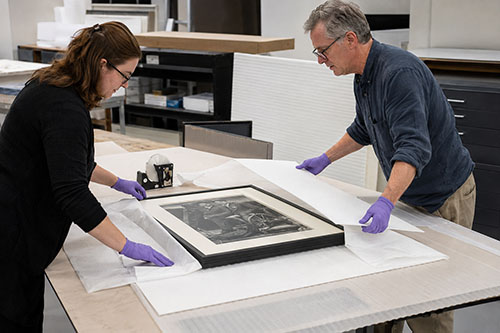
We offer wood and metal frames, custom cut & joined to order. Each framed print includes hanging hardware and foamcore backer.
Matting
We use conservation grade 100% virgin alpha-cellulose 2 ply mats with white core. Acid-free and lignin-free, these are both face resistant and meet all conservation quality standards set by the Fine Art Trade Guild. Mats are digitally cut for ultimate precision. The window will be 1/8″ smaller than the print dimensions.
Glazing (Acrylic Glass)
We offer custom cut panes of shatter-proof, acrylic glass, to protect your valuable artwork and prints.
Premium Clear
Framing grade clear acrylic is shatter resistant and lightweight.
Reflection Control
With its matte finish, Tru Vue Reflection Control® Acrylic scatters light to diminish unwanted glare.
Conservation Clear
Tru Vue Conservation Clear® Acrylic is a framing industry staple, blocking up to 99% of UV rays for ultimate protection.
Conservation Reflection Control
Tru Vue Conservation Reflection Control® Acrylic scatters and diffuses light to reduce unwanted glare. Blocks up to 99% of UV rays.
Related products
-

Dieter Eppler & Graziella Granata – Slaughter of the Vampires (1962) Vampire Bites Louise Bedroom Italian Gothic Horror Photo
$30.00 -
Yutte Stensgaard & Michael Johnson – Lust for a Vampire (1971) Mircalla & Richard Outdoor Embrace Photo
$38.00 -
Ingrid Pitt, Peter Cushing & Dawn Addams – The Vampire Lovers (1970) Savoy Hotel Seated Cast Press Photo
$30.00 -
Boris Karloff & Colin Clive – Frankenstein (1931) Monster & Creator Torch Confrontation Universal Horror Photo
$38.00


