

Catherine Deneuve – Repulsion (1965) Carol Ledoux Apartment Floor Camera BTS Photo
Limited Edition Photograph (learn more)
In stock
Catherine Deneuve is captured as Carol Ledoux during production of Repulsion (1965), lying on the apartment floor while filmmaking equipment remains prominently visible in the foreground. Deneuve rests on her side beside a telephone, her blonde hair falling across her face as she looks outward with the distant, vulnerable expression that defines Carol throughout the film. At the lower edge of the composition, the exposed camera apparatus breaks the illusion of the finished scene, transforming the photograph into a fascinating record of performance and filmmaking occurring simultaneously.
The unusual composition is what makes this image especially compelling. Carol occupies the middle distance, isolated against the patterned floor while doors, walls and domestic furnishings establish the apartment around her. In the foreground, large dark pieces of production equipment intrude directly into the frame. Rather than diminishing the atmosphere, their presence creates a rare perspective on how Roman Polanski’s claustrophobic visual world was constructed for the camera.
The telephone beside Carol provides an important connection between the behind-the-scenes environment and the psychological reality of the film. Ordinary household objects become increasingly charged with tension throughout Repulsion, and here the telephone lies within immediate reach as Deneuve remains almost motionless on the floor. Her posture appears physically exhausted and emotionally withdrawn, preserving the disturbing stillness of the character even while the visible equipment reminds us that a film crew is working just beyond the edges of the scene.
This Catherine Deneuve Repulsion 1965 photograph is therefore more than a conventional production still. It captures Deneuve maintaining Carol Ledoux’s fragile screen presence while simultaneously revealing part of the practical apparatus used to photograph her. The contrast between the actress’s intensely private performance and the machinery positioned only a few feet away offers an unusually revealing glimpse into the creation of one of the decade’s defining psychological horror films.
Directed by Roman Polanski and written by Polanski with Gérard Brach, Repulsion follows Carol, a young Belgian woman living with her sister in London, whose increasing isolation develops into paranoia, hallucination and violence. Yvonne Furneaux, Ian Hendry, John Fraser and Patrick Wymark appear alongside Deneuve. The apartment becomes fundamental to the film’s psychological design, gradually shifting from an ordinary domestic environment into an expression of Carol’s deteriorating perception.
That importance makes this behind-the-scenes view particularly valuable. Instead of showing only Deneuve or an empty set, the photograph connects character, location and filmmaking technique within a single frame. The visible camera equipment demonstrates how closely the production apparatus could be positioned to the performer while still producing the intensely subjective imagery seen on screen.
The wide black-and-white tonal range also preserves significant environmental detail: polished flooring, open doorways, furnishings and equipment all remain clearly readable without overwhelming Deneuve’s figure. Her comparatively small scale within the room reinforces the sense of isolation that dominates the completed film.
For collectors of Catherine Deneuve, Roman Polanski, Repulsion and classic film production photography, this image has exceptional appeal because it preserves both the psychological world of Carol Ledoux and the physical process used to create it. The apartment floor, telephone, Deneuve’s withdrawn pose and conspicuous camera equipment make it an unusually informative record of 1960s filmmaking.
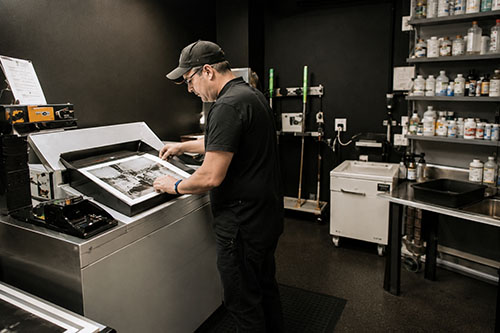
Carefully restored from historic photographic source material and professionally lab-developed, this museum-quality photograph is presented uncropped, preserving the complete image area contained in the source. Restoration recovers facial detail, hair texture, floor pattern, telephone definition, camera-equipment detail and subtle grayscale shadow gradation while maintaining the natural tonal gradation and character of the historic black-and-white photograph. The finished photograph contains no AI-generated image content.
Product Enquiry
Kodak Professional Endura Paper
Kodak Endura papers provide an incredible amount of detail and smooth transition of tones. Designed for the professional photographer in mind, looking for a more traditional photo print style, Kodak Endura provides an extended print life and color gamut almost at the level of a high end fine art paper print.
Archival Matte Paper
Archival Matte Paper, also known as Moab Lasal Photo Matte, is our house stock fine art paper and is an economical favorite for fine art reproductions and photo prints. It features a smooth surface, heavy weight (230 g, 9.5-mil), neutral white, matte paper engineered for accurate color reproduction that provides high contrast and high-resolution output. This paper is acid-free, making it the perfect choice for both photography & fine art reproductions.
Giclee William Turner Paper by Hahnemühle
The William Turner by Hahnemühle is one of the most popular papers used in the Giclee printing industry. This is a 310g natural white mould made natural line paper with 100% rag content making it highly archival. It has a slight coarse texture which gives photos and artwork an elegant look. These fine art paper prints (also known as Giclee) are ordered by galleries, individual artists and photographers. The papers and inks are not only archival but use some of the most accurate print technology for full color prints.
- Giclee prints use very expensive archival pigmented inks.
- Highest level of color gamut available in printing (12 color printing).
- Exceptional black & white printing.
- Fade resistant, pigmented inks which provide a superior color range compared to other types of inks. Widely preferred in fine art and photography circles.
- We ONLY use professional grade fine art and photo paper that resist yellowing and aging.
Framing
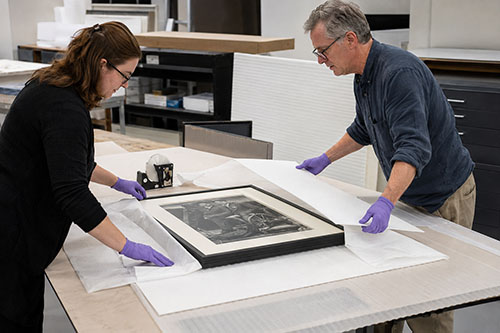
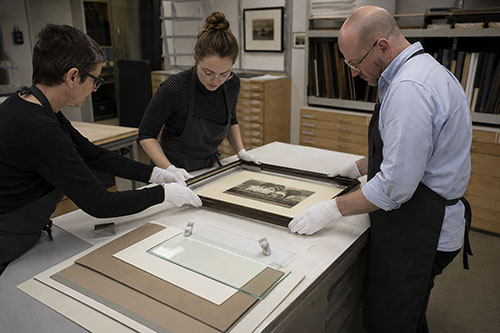
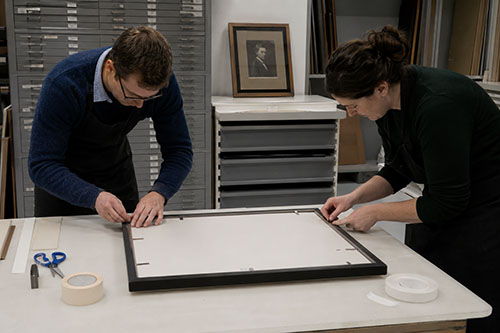
We offer wood and metal frames, custom cut & joined to order. Each framed print includes hanging hardware and foamcore backer.
Matting
We use conservation grade 100% virgin alpha-cellulose 2 ply mats with white core. Acid-free and lignin-free, these are both face resistant and meet all conservation quality standards set by the Fine Art Trade Guild. Mats are digitally cut for ultimate precision. The window will be 1/8″ smaller than the print dimensions.
Glazing (Acrylic Glass)
We offer custom cut panes of shatter-proof, acrylic glass, to protect your valuable artwork and prints.
Premium Clear
Framing grade clear acrylic is shatter resistant and lightweight.
Reflection Control
With its matte finish, Tru Vue Reflection Control® Acrylic scatters light to diminish unwanted glare.
Conservation Clear
Tru Vue Conservation Clear® Acrylic is a framing industry staple, blocking up to 99% of UV rays for ultimate protection.
Conservation Reflection Control
Tru Vue Conservation Reflection Control® Acrylic scatters and diffuses light to reduce unwanted glare. Blocks up to 99% of UV rays.
Related products
-

Christopher Lee – Dracula Has Risen from the Grave (1968) Count Dracula Staked in Coffin Scene Photo
$38.00 -
Ingrid Pitt, Peter Cushing & Dawn Addams – The Vampire Lovers (1970) Savoy Hotel Seated Cast Press Photo
$30.00 -
Klaus Kinski – Fitzcarraldo (1982) Brian Sweeney Fitzgerald Jungle Location Publicity Photo
$25.00 -
Sean Connery & Ursula Andress – Dr. No (1962) Crab Key Water Scene Jamaica Behind-the-Scenes Photo
$38.00


