

Sven Nykvist – The Tenant (1976) Oversized Apartment Set Forced Perspective Behind-the-Scenes Photo
Limited Edition Photograph (learn more)
In stock
Cinematographer Sven Nykvist is documented on the extraordinary oversized apartment set created for Roman Polanski’s The Tenant (1976) in this revealing black-and-white behind-the-scenes production photograph. Nykvist sits with members of the crew inside a deliberately distorted interior where the enormous bed, towering French windows, oversized chairs and exaggerated room proportions make the men appear dramatically reduced in scale. The human figures provide an immediate visual reference for the construction, transforming the photograph into a remarkable record of the practical filmmaking techniques used to make Trelkovsky’s surroundings feel increasingly unstable and unreal.
The photograph is especially fascinating because it strips away the illusion seen in the finished film. Furniture that appears merely strange or unsettling on screen is revealed here at its actual enormous scale, with the crew seated comfortably among pieces designed to manipulate spatial perception. The gigantic bed dominates the left side of the composition while the unusually tall windows and enlarged seating reinforce the deliberately altered proportions of the room.
Released in 1976, The Tenant was directed by Roman Polanski, who also stars as Trelkovsky, a solitary man who rents a Paris apartment previously occupied by a woman who attempted suicide. As his fixation on the former tenant deepens, everyday surroundings become increasingly threatening and his perception of his neighbors, apartment and ultimately his own identity begins to collapse. The cast includes Isabelle Adjani, Melvyn Douglas, Jo Van Fleet, Shelley Winters, Bernard Fresson and Lila Kedrova.
The film was photographed by Sven Nykvist, one of the most celebrated cinematographers of twentieth-century cinema and a longtime collaborator of Ingmar Bergman. His naturalistic approach to light and interior photography gave The Tenant a convincing visual reality against which Polanski could introduce increasingly disturbing distortions of space and perspective. Nykvist’s restrained cinematography helps the apartment remain believable even as Trelkovsky’s experience of it becomes progressively more surreal.
Production designer Pierre Guffroy, working with art directors Claude Moesching and Albert Rajau, was responsible for the film’s elaborate production environments. Major portions of the apartment building were constructed in the Épinay-sur-Seine studio complex, allowing Polanski and his collaborators to control architecture, camera position and spatial relationships in ways impossible within an ordinary Paris apartment.
One of the film’s most ingenious visual devices involves deliberately manipulated perspective inside Trelkovsky’s apartment. Production accounts describe the use of enlarged objects and forced perspective to make the character appear physically diminished within his own room, turning familiar domestic space into a visual expression of psychological disorientation. The oversized furniture visible in this photograph provides an exceptional behind-the-scenes look at the physical construction underlying that effect.
The production’s architectural illusions extended beyond the apartment itself. A large representation of the Parisian tenement was constructed at the Épinay studios, where studio design allowed Polanski to stage some of the film’s most elaborate courtyard and window sequences. The carefully controlled sets became fundamental to the film’s atmosphere, making architecture itself seem increasingly oppressive as Trelkovsky’s paranoia intensifies.
The Tenant is frequently grouped with Repulsion (1965) and Rosemary’s Baby (1968) as Polanski’s loosely defined Apartment Trilogy, three films in which enclosed urban living spaces become inseparable from psychological fear, isolation and deteriorating perception. In The Tenant, that relationship between character and environment reaches an extreme, with Trelkovsky’s apartment gradually becoming a physical manifestation of his collapsing sense of identity.
Production ran from November 1975 into March 1976, and the film was based on Roland Topor’s novel Le Locataire chimérique. Polanski and Gérard Brach adapted the screenplay, with Philippe Sarde composing the score and Françoise Bonnot editing. The combination of Polanski’s direction, Nykvist’s cinematography and Guffroy’s production design helped create one of the most visually distinctive psychological horror films of the 1970s.
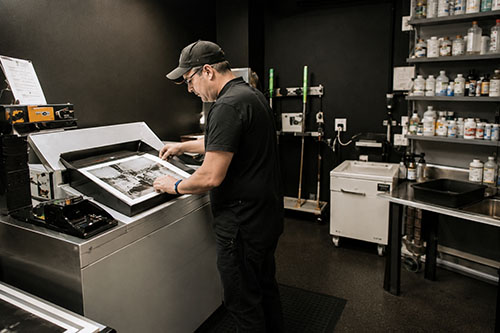
Carefully restored from historic photographic source material and professionally lab-developed, this museum-quality photograph is presented uncropped, preserving the complete image area contained in the source. Meticulous restoration recovers facial detail, furniture texture, architectural detail, fabric definition, tonal range and photographic clarity while retaining the documentary character of the original black-and-white behind-the-scenes production photograph.
For collectors of Sven Nykvist, The Tenant, Roman Polanski and motion-picture production history, this is an exceptionally revealing behind-the-scenes image—the film’s cinematographer and crew photographed inside an oversized apartment set designed for forced-perspective effects, preserving a rare visual record of the practical craftsmanship used to transform physical space into psychological horror.
Product Enquiry
Kodak Professional Endura Paper
Kodak Endura papers provide an incredible amount of detail and smooth transition of tones. Designed for the professional photographer in mind, looking for a more traditional photo print style, Kodak Endura provides an extended print life and color gamut almost at the level of a high end fine art paper print.
Archival Matte Paper
Archival Matte Paper, also known as Moab Lasal Photo Matte, is our house stock fine art paper and is an economical favorite for fine art reproductions and photo prints. It features a smooth surface, heavy weight (230 g, 9.5-mil), neutral white, matte paper engineered for accurate color reproduction that provides high contrast and high-resolution output. This paper is acid-free, making it the perfect choice for both photography & fine art reproductions.
Giclee William Turner Paper by Hahnemühle
The William Turner by Hahnemühle is one of the most popular papers used in the Giclee printing industry. This is a 310g natural white mould made natural line paper with 100% rag content making it highly archival. It has a slight coarse texture which gives photos and artwork an elegant look. These fine art paper prints (also known as Giclee) are ordered by galleries, individual artists and photographers. The papers and inks are not only archival but use some of the most accurate print technology for full color prints.
- Giclee prints use very expensive archival pigmented inks.
- Highest level of color gamut available in printing (12 color printing).
- Exceptional black & white printing.
- Fade resistant, pigmented inks which provide a superior color range compared to other types of inks. Widely preferred in fine art and photography circles.
- We ONLY use professional grade fine art and photo paper that resist yellowing and aging.
Framing
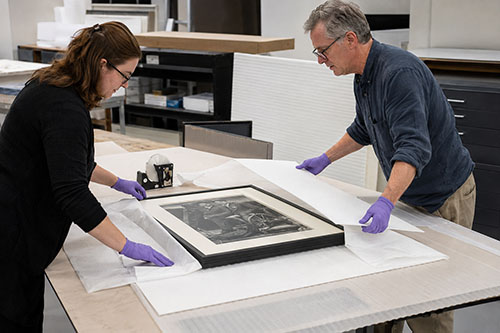
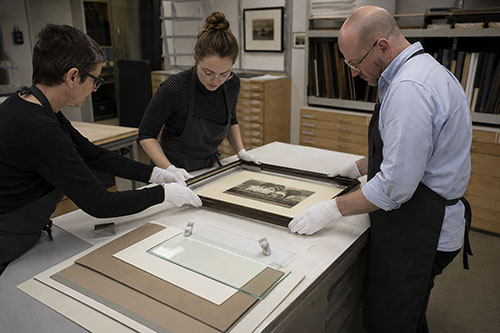
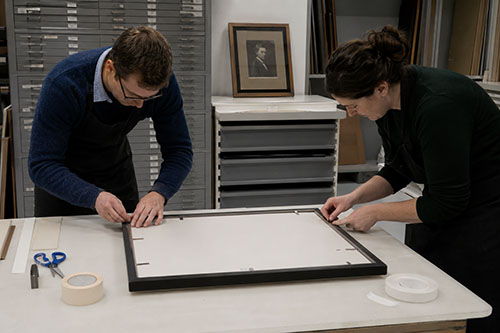
We offer wood and metal frames, custom cut & joined to order. Each framed print includes hanging hardware and foamcore backer.
Matting
We use conservation grade 100% virgin alpha-cellulose 2 ply mats with white core. Acid-free and lignin-free, these are both face resistant and meet all conservation quality standards set by the Fine Art Trade Guild. Mats are digitally cut for ultimate precision. The window will be 1/8″ smaller than the print dimensions.
Glazing (Acrylic Glass)
We offer custom cut panes of shatter-proof, acrylic glass, to protect your valuable artwork and prints.
Premium Clear
Framing grade clear acrylic is shatter resistant and lightweight.
Reflection Control
With its matte finish, Tru Vue Reflection Control® Acrylic scatters light to diminish unwanted glare.
Conservation Clear
Tru Vue Conservation Clear® Acrylic is a framing industry staple, blocking up to 99% of UV rays for ultimate protection.
Conservation Reflection Control
Tru Vue Conservation Reflection Control® Acrylic scatters and diffuses light to reduce unwanted glare. Blocks up to 99% of UV rays.
Related products
-

Ingrid Pitt, Peter Cushing & Dawn Addams – The Vampire Lovers (1970) Savoy Hotel Seated Cast Press Photo
$30.00 -
Boris Karloff – Frankenstein (1931) Monster Reaching for Sunlight Universal Horror Photo
$38.00 -
Klaus Kinski – Fitzcarraldo (1982) Brian Sweeney Fitzgerald Jungle Location Publicity Photo
$25.00 -
Barbara Steele – The Horrible Dr. Hichcock (1962) Skull Discovery Bedroom Scene Photo
$38.00


