

Veronica Carlson – Dracula Has Risen from the Grave (1968) Maria Bedroom Window Color Photo
Limited Edition Photograph (learn more)
In stock
Veronica Carlson appears as Maria Mueller beside her bedroom window in this atmospheric color photograph from Dracula Has Risen from the Grave (1968), her white nightgown illuminated against the darkened interior. Carlson’s alert expression and poised hand draw attention toward the window while the visible bed establishes the intimate domestic setting. The contrast of warm illumination, surrounding shadow and Maria’s pale costume creates a particularly restrained Hammer Gothic composition centered on vulnerability rather than overt horror.
The photograph is built around Carlson’s position between the safety of the bedroom and whatever may lie beyond the window. She stands in profile with her body angled toward the opening while her face turns slightly outward, creating a sense of watchfulness and uncertainty. One hand rests close to the window frame and fastening, while the other disappears into the darker foreground. Her long blonde hair falls over the shoulders of the loose white nightgown, its folds catching the strongest light in the composition and making Maria the clear visual focus.
The room itself contributes significantly to the mood. A bed is visible behind Maria, softly receding into shadow, immediately identifying the setting as private and domestic rather than one of Hammer’s more overtly Gothic castles, crypts or graveyards. The window frame introduces a strong vertical element on the right, while the deep darkness surrounding Carlson creates an impression of enclosure. Warm highlights on her hair and face contrast with the cooler white of the nightgown and the nearly black background, producing the rich color atmosphere associated with Hammer’s late-1960s Gothic productions.
This Veronica Carlson Dracula Has Risen from the Grave 1968 image is especially effective because the threat remains outside the frame. No vampire, blood or supernatural effect is needed to create tension. Instead, Maria’s expression and the direction of her attention imply that something has disturbed the apparent quiet of the room. The photograph therefore captures one of the essential visual ideas of Gothic horror: a familiar interior becoming threatening through darkness, expectation and the suggestion of an unseen presence.
Directed by Freddie Francis for Hammer Film Productions, Dracula Has Risen from the Grave was released in 1968 and marked Christopher Lee’s third appearance as Count Dracula for Hammer. Veronica Carlson plays Maria Mueller, the niece of Monsignor Ernst Mueller, portrayed by Rupert Davies. Maria’s relationship with Paul, played by Barry Andrews, becomes entangled with Dracula’s campaign of revenge after the Monsignor attempts to protect his village from the Count’s influence.
The production was photographed at Pinewood Studios, with cinematography by Arthur Grant. Freddie Francis directed after Terence Fisher, who had originally been intended for the film, was unable to proceed following a broken leg. Francis brought his own strong visual sensibility to the picture, and the film became notable for its saturated color, dramatic lighting and careful use of shadow. Those qualities are readily visible in this photograph, where the warm illumination on Carlson contrasts sharply with the darkness surrounding the bedroom.
For collectors of Veronica Carlson, Christopher Lee and classic Hammer Dracula imagery, this photograph offers a quieter but highly distinctive view of the film. Rather than relying on a confrontation with Dracula, it isolates Maria at a moment of apparent apprehension and allows Carlson’s expression, costume and surroundings to carry the suspense. The combination of the bedroom window, white nightgown, warm color and deep shadow gives the image a strong individual identity within Hammer’s extensive publicity photography.
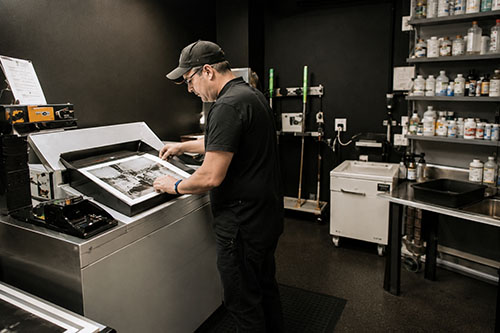
Carefully restored from historic photographic source material and professionally lab-developed, this museum-quality photograph is presented uncropped, preserving the complete image area contained in the source. Restoration recovers Carlson’s facial detail, blonde hair texture, white nightgown folds, window-frame definition, warm skin tones and shadow detail within the bedroom while maintaining the natural color balance and authentic character of the historic photograph. The finished photograph contains no AI-generated image content.
Product Enquiry
Kodak Professional Endura Paper
Kodak Endura papers provide an incredible amount of detail and smooth transition of tones. Designed for the professional photographer in mind, looking for a more traditional photo print style, Kodak Endura provides an extended print life and color gamut almost at the level of a high end fine art paper print.
Archival Matte Paper
Archival Matte Paper, also known as Moab Lasal Photo Matte, is our house stock fine art paper and is an economical favorite for fine art reproductions and photo prints. It features a smooth surface, heavy weight (230 g, 9.5-mil), neutral white, matte paper engineered for accurate color reproduction that provides high contrast and high-resolution output. This paper is acid-free, making it the perfect choice for both photography & fine art reproductions.
Giclee William Turner Paper by Hahnemühle
The William Turner by Hahnemühle is one of the most popular papers used in the Giclee printing industry. This is a 310g natural white mould made natural line paper with 100% rag content making it highly archival. It has a slight coarse texture which gives photos and artwork an elegant look. These fine art paper prints (also known as Giclee) are ordered by galleries, individual artists and photographers. The papers and inks are not only archival but use some of the most accurate print technology for full color prints.
- Giclee prints use very expensive archival pigmented inks.
- Highest level of color gamut available in printing (12 color printing).
- Exceptional black & white printing.
- Fade resistant, pigmented inks which provide a superior color range compared to other types of inks. Widely preferred in fine art and photography circles.
- We ONLY use professional grade fine art and photo paper that resist yellowing and aging.
Framing
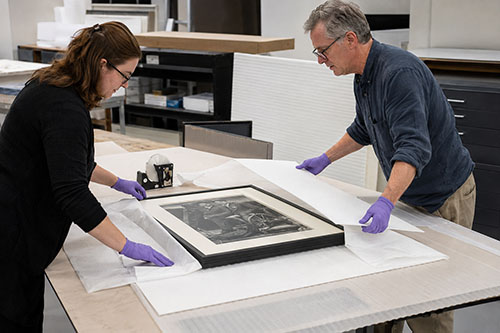
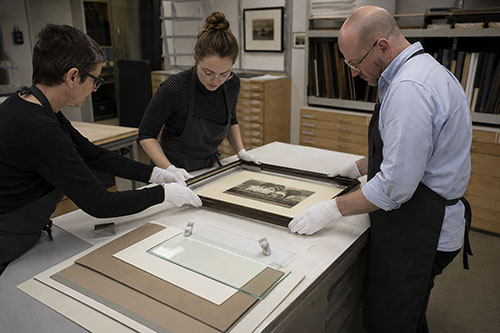
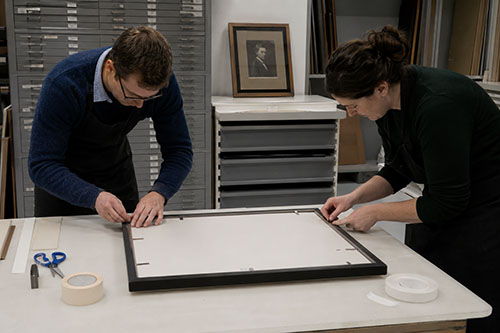
We offer wood and metal frames, custom cut & joined to order. Each framed print includes hanging hardware and foamcore backer.
Matting
We use conservation grade 100% virgin alpha-cellulose 2 ply mats with white core. Acid-free and lignin-free, these are both face resistant and meet all conservation quality standards set by the Fine Art Trade Guild. Mats are digitally cut for ultimate precision. The window will be 1/8″ smaller than the print dimensions.
Glazing (Acrylic Glass)
We offer custom cut panes of shatter-proof, acrylic glass, to protect your valuable artwork and prints.
Premium Clear
Framing grade clear acrylic is shatter resistant and lightweight.
Reflection Control
With its matte finish, Tru Vue Reflection Control® Acrylic scatters light to diminish unwanted glare.
Conservation Clear
Tru Vue Conservation Clear® Acrylic is a framing industry staple, blocking up to 99% of UV rays for ultimate protection.
Conservation Reflection Control
Tru Vue Conservation Reflection Control® Acrylic scatters and diffuses light to reduce unwanted glare. Blocks up to 99% of UV rays.
Related products
-

Susan Denberg – Frankenstein Created Woman (1967) Bray Studios Dressing Room Behind-the-Scenes Photo
$38.00 -
Sean Connery & Luciana Paluzzi – Thunderball (1965) Fiona Volpe Bedroom Set Behind-the-Scenes James Bond 007 Photo
$38.00 -
Sean Connery – Thunderball (1965) Shirtless Nassau Beach Location Behind-the-Scenes James Bond 007 Photo
$38.00 -
Akiko Wakabayashi – You Only Live Twice (1967) Aki Powder-Blue Dress 007 Photo
$38.00