

Vincent Price (c. 1964) – Classic Horror Icon Cigarette Close-Up Studio Publicity Portrait
Limited Edition Photograph (learn more)
In stock
Vincent Price projects relaxed sophistication in this striking circa-1964 black-and-white studio publicity portrait, photographed at close range with a cigarette raised casually beside his face. Dressed impeccably in a tailored suit, striped tie and crisp white pocket square, Price looks directly toward the camera with a restrained smile and characteristically expressive eyes. The uncluttered studio background places complete attention on his face, elegant styling and poised hand, creating an unusually intimate image of the actor behind one of classic horror cinema’s most recognizable screen personas.
The portrait is particularly effective because of its simplicity. Price’s raised cigarette introduces a small but distinctive gesture, while the close framing emphasizes his carefully groomed moustache, sharply defined features and relaxed expression. Unlike the companion photograph in which he smiles broadly from a seated pose, this image feels quieter and more self-contained, giving collectors a distinctly different study from what appears to be the same period of studio portraiture.
By the early-to-mid 1960s, Vincent Price had become firmly established as one of American cinema’s defining horror stars. House of Wax (1953) helped redirect his career toward horror, followed by films including The Fly (1958), House on Haunted Hill (1959) and The Tingler (1959). TCM identifies this period as the point at which Price’s elegant screen presence became increasingly associated with the genre.
His celebrated collaboration with Roger Corman further transformed that reputation. Beginning with House of Usher (1960), Price starred in a succession of Edgar Allan Poe-inspired productions for American International Pictures, including The Pit and the Pendulum (1961), The Raven (1963), The Masque of the Red Death (1964) and The Tomb of Ligeia (1964). TCM identifies The Tomb of Ligeia as the seventh and final film in Corman and Price’s AIP Poe cycle.
Those films made Price particularly suited to the world of Gothic horror. His cultivated voice, aristocratic bearing and ability to shift effortlessly between charm, melancholy, menace and dark humor gave his performances a sophistication unlike that of most conventional screen villains. He could appear threatening without abandoning elegance, a quality that became central to his enduring appeal.
That screen reputation makes this publicity portrait especially interesting. There are no decaying mansions, period costumes or macabre props here. Instead, Price appears as a polished contemporary personality in a modern suit, the cigarette held almost conversationally beside his face. The image preserves the urbane man whose natural refinement informed so many of his most memorable horror performances.
Price’s interests extended considerably beyond acting. He was a serious art collector and enthusiast, as well as an accomplished writer and noted gourmet who co-authored cookbooks. TCM’s biographical profile emphasizes his lifelong involvement with art, antiques and food, reinforcing the cultured public identity that existed alongside his status as a horror star.
For collectors, studio portraits such as this provide an important complement to Price’s film-character photography. Images from House of Wax, the Poe films or his William Castle productions preserve the fictional characters; this photograph presents Vincent Price himself, allowing the intelligence, humor and sophistication behind those performances to become the principal subject.
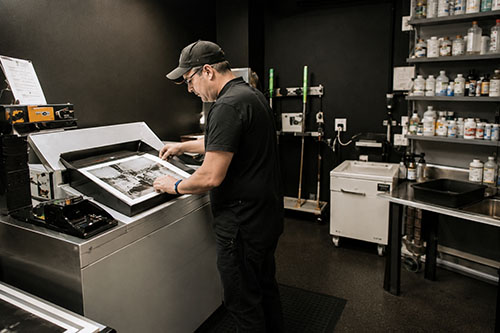
Carefully restored from historic photographic source material and professionally lab-developed, this museum-quality photograph is presented uncropped, preserving the complete image area contained in the source. Meticulous restoration recovers facial detail, moustache definition, suit and tie texture, cigarette detail, tonal range and photographic clarity while retaining the elegant character of the original black-and-white studio portrait.
For collectors of Vincent Price, classic horror and Gothic cinema, this is an especially refined publicity portrait—Price photographed at close range in a tailored suit, cigarette raised beside his face and eyes fixed directly upon the camera, preserving a sophisticated image of one of the most recognizable and enduring icons of classic horror cinema.
Product Enquiry
Kodak Professional Endura Paper
Kodak Endura papers provide an incredible amount of detail and smooth transition of tones. Designed for the professional photographer in mind, looking for a more traditional photo print style, Kodak Endura provides an extended print life and color gamut almost at the level of a high end fine art paper print.
Archival Matte Paper
Archival Matte Paper, also known as Moab Lasal Photo Matte, is our house stock fine art paper and is an economical favorite for fine art reproductions and photo prints. It features a smooth surface, heavy weight (230 g, 9.5-mil), neutral white, matte paper engineered for accurate color reproduction that provides high contrast and high-resolution output. This paper is acid-free, making it the perfect choice for both photography & fine art reproductions.
Giclee William Turner Paper by Hahnemühle
The William Turner by Hahnemühle is one of the most popular papers used in the Giclee printing industry. This is a 310g natural white mould made natural line paper with 100% rag content making it highly archival. It has a slight coarse texture which gives photos and artwork an elegant look. These fine art paper prints (also known as Giclee) are ordered by galleries, individual artists and photographers. The papers and inks are not only archival but use some of the most accurate print technology for full color prints.
- Giclee prints use very expensive archival pigmented inks.
- Highest level of color gamut available in printing (12 color printing).
- Exceptional black & white printing.
- Fade resistant, pigmented inks which provide a superior color range compared to other types of inks. Widely preferred in fine art and photography circles.
- We ONLY use professional grade fine art and photo paper that resist yellowing and aging.
Framing
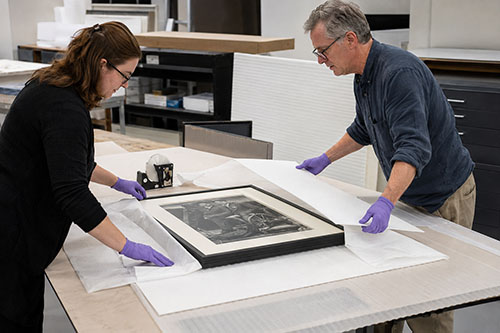
We offer wood and metal frames, custom cut & joined to order. Each framed print includes hanging hardware and foamcore backer.
Matting
We use conservation grade 100% virgin alpha-cellulose 2 ply mats with white core. Acid-free and lignin-free, these are both face resistant and meet all conservation quality standards set by the Fine Art Trade Guild. Mats are digitally cut for ultimate precision. The window will be 1/8″ smaller than the print dimensions.
Glazing (Acrylic Glass)
We offer custom cut panes of shatter-proof, acrylic glass, to protect your valuable artwork and prints.
Premium Clear
Framing grade clear acrylic is shatter resistant and lightweight.
Reflection Control
With its matte finish, Tru Vue Reflection Control® Acrylic scatters light to diminish unwanted glare.
Conservation Clear
Tru Vue Conservation Clear® Acrylic is a framing industry staple, blocking up to 99% of UV rays for ultimate protection.
Conservation Reflection Control
Tru Vue Conservation Reflection Control® Acrylic scatters and diffuses light to reduce unwanted glare. Blocks up to 99% of UV rays.
Related products
-

Barbara Steele – The Long Hair of Death (1964) Flowing Hair Over-Shoulder Gothic Photo
$38.00 -
Yutte Stensgaard – Lust for a Vampire (1971) Mircalla White Nightgown Stone Steps Publicity Photo
$38.00 -
King Kong (1933) Skull Island Log Bridge Chasm Attack Concept Artwork
$38.00 -
King Kong Escapes (1967) Gorosaurus & Mechani-Kong Toho Kaiju Battle Artwork
$25.00


