

Belinda Balaski – The Howling (1981) Terry Fisher Werewolf Shadow Confrontation Photo
Limited Edition Photograph (learn more)
In stock
Belinda Balaski appears as Terry Fisher in this atmospheric color photograph from The Howling (1981), confronted by the enormous shadowed silhouette of a werewolf looming directly before her. Warm light isolates Terry’s face and raised hand while the creature’s pointed ears, elongated muzzle and outstretched claw emerge almost entirely as a dark shape against the wall. The dramatic contrast between human vulnerability and supernatural threat gives the image an unusually graphic identity within Joe Dante’s landmark werewolf film.
The photograph’s power comes from how little of the creature needs to be fully revealed. Terry occupies the left side of the composition, illuminated just enough for her profile, dark hair and tense expression to remain clearly visible. Opposite her, the werewolf becomes a massive black silhouette, its head, muzzle and clawed forelimb projected across the brighter wall behind it. The result turns the monster into something almost larger than its physical form, allowing shadow itself to carry much of the menace.
The positioning of the two figures creates a remarkably effective visual confrontation. Terry’s face is angled upward toward the creature while one arm reaches forward, suggesting an instinctive attempt either to protect herself or react to what is suddenly before her. The werewolf’s paw extends toward her from the darkness, compressing the space between victim and attacker and giving the still an immediate sense of danger.
This Belinda Balaski The Howling 1981 image is particularly distinctive because it emphasizes suspense rather than transformation spectacle. Many of the film’s most famous photographs showcase Rob Bottin’s elaborate practical werewolf effects in full detail, but here the creature is deliberately withheld. Its silhouette becomes the horror, allowing the ears, muzzle and claws to communicate everything necessary while maintaining mystery.
Directed by Joe Dante, The Howling stars Dee Wallace as television reporter Karen White, Belinda Balaski as her friend and colleague Terry Fisher, Patrick Macnee as Dr. George Waggner and Robert Picardo as Eddie Quist. After Karen retreats to Waggner’s secluded Colony following a traumatic encounter, Terry begins investigating the circumstances surrounding the community and gradually uncovers its terrifying connection to werewolves.
Terry’s investigative role places her increasingly close to the danger Karen has entered. Balaski gives the character a practical, determined quality that contrasts effectively with the supernatural events surrounding her, making moments in which Terry directly encounters the werewolf threat especially important. The photograph captures that collision between investigation and horror in an exceptionally simple visual form.
The film’s enduring reputation is closely linked to Rob Bottin’s groundbreaking creature and makeup effects, which helped redefine cinematic werewolves for the 1980s. Rather than relying on restrained facial makeup, Bottin created heavily furred, elongated creatures with pronounced muzzles, pointed ears and articulated claws. In this photograph, those defining elements remain recognizable even though the animal is seen primarily in silhouette.
The lighting is therefore as important as the creature design itself. Bands of warm illumination define Terry while throwing the werewolf into near-total darkness, creating a dramatic exchange between visible fear and concealed monstrosity. The large shadowed profile gives the creature an almost expressionistic quality, linking modern practical-effects horror with much older traditions of Gothic shadow and suspense.
For collectors of 1980s horror and werewolf photography, this image has exceptional atmosphere. The close confrontation, dramatic silhouette and restrained reveal separate it from conventional monster stills, preserving a moment in which the werewolf’s shadow is nearly as frightening as the creature itself.
Carefully restored from historic photographic source material and professionally lab-developed, this museum-quality photograph is presented uncropped, preserving the complete image area contained in the source. Restoration recovers facial detail, claw definition, silhouette edges, warm interior highlights and subtle shadow gradation while maintaining the natural color balance and authentic character of the historic photograph. The finished photograph contains no AI-generated image content.
Product Enquiry
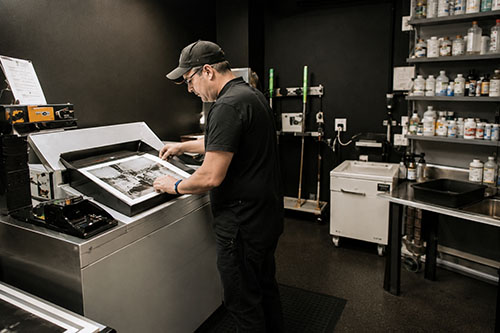
Kodak Professional Endura Paper
Kodak Endura papers provide an incredible amount of detail and smooth transition of tones. Designed for the professional photographer in mind, looking for a more traditional photo print style, Kodak Endura provides an extended print life and color gamut almost at the level of a high end fine art paper print.
Archival Matte Paper
Archival Matte Paper, also known as Moab Lasal Photo Matte, is our house stock fine art paper and is an economical favorite for fine art reproductions and photo prints. It features a smooth surface, heavy weight (230 g, 9.5-mil), neutral white, matte paper engineered for accurate color reproduction that provides high contrast and high-resolution output. This paper is acid-free, making it the perfect choice for both photography & fine art reproductions.
Giclee William Turner Paper by Hahnemühle
The William Turner by Hahnemühle is one of the most popular papers used in the Giclee printing industry. This is a 310g natural white mould made natural line paper with 100% rag content making it highly archival. It has a slight coarse texture which gives photos and artwork an elegant look. These fine art paper prints (also known as Giclee) are ordered by galleries, individual artists and photographers. The papers and inks are not only archival but use some of the most accurate print technology for full color prints.
- Giclee prints use very expensive archival pigmented inks.
- Highest level of color gamut available in printing (12 color printing).
- Exceptional black & white printing.
- Fade resistant, pigmented inks which provide a superior color range compared to other types of inks. Widely preferred in fine art and photography circles.
- We ONLY use professional grade fine art and photo paper that resist yellowing and aging.
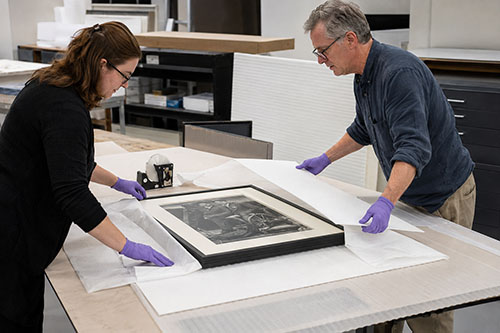
Framing
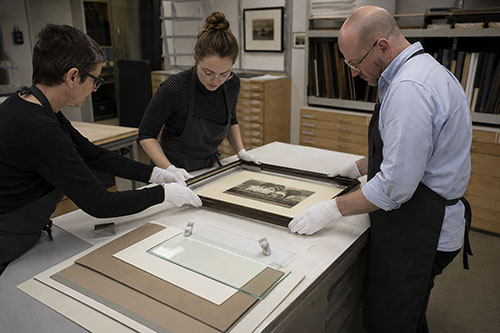
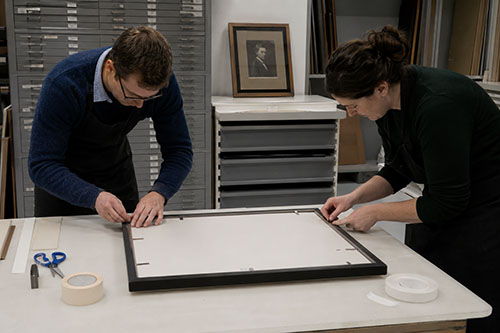
We offer wood and metal frames, custom cut & joined to order. Each framed print includes hanging hardware and foamcore backer.
Matting
We use conservation grade 100% virgin alpha-cellulose 2 ply mats with white core. Acid-free and lignin-free, these are both face resistant and meet all conservation quality standards set by the Fine Art Trade Guild. Mats are digitally cut for ultimate precision. The window will be 1/8″ smaller than the print dimensions.
Glazing (Acrylic Glass)
We offer custom cut panes of shatter-proof, acrylic glass, to protect your valuable artwork and prints.
Premium Clear
Framing grade clear acrylic is shatter resistant and lightweight.
Reflection Control
With its matte finish, Tru Vue Reflection Control® Acrylic scatters light to diminish unwanted glare.
Conservation Clear
Tru Vue Conservation Clear® Acrylic is a framing industry staple, blocking up to 99% of UV rays for ultimate protection.
Conservation Reflection Control
Tru Vue Conservation Reflection Control® Acrylic scatters and diffuses light to reduce unwanted glare. Blocks up to 99% of UV rays.
Related products
-

King Kong Escapes (1967) Gorosaurus & Mechani-Kong Toho Kaiju Battle Artwork
$25.00 -
Peter Cushing – The Curse of Frankenstein (1957) Baron Victor Frankenstein Publicity Photo
$30.00 -
Klaus Kinski – Fitzcarraldo (1982) Brian Sweeney Fitzgerald Leopard Tapestry Publicity Photo
$25.00 -
King Kong (1933) Ann Darrow Manhattan Empire State Building Promotional Artwork
$38.00


