

Leonard Whiting – Frankenstein: The True Story (1973) Victor Assembling the Creature Scene Photo
Limited Edition Photograph (learn more)
In stock
Leonard Whiting appears as Victor Frankenstein working over the unfinished body of the Creature in this vivid color scene photograph from Frankenstein: The True Story (1973). The recumbent body stretches across the foreground beneath articulated laboratory apparatus while Victor concentrates on the surgical work before him. Bandaging, exposed flesh and medical equipment give the image a distinctly clinical character, presenting the creation of life not as abstract Gothic science but as an unsettling physical procedure.
The layered composition is especially effective because the unfinished Creature and the machinery separate Victor from the viewer. Dark metal arms cross diagonally through the center of the frame, directing attention toward Whiting while also emphasizing the elaborate apparatus surrounding the experiment. The Creature’s body occupies the lower portion of the image, partially obscured by equipment and coverings, creating the sense that we are observing a work still in progress rather than the completed being seen later in the story.
Whiting’s expression provides the photograph’s emotional focus. His eyes remain fixed on the task in front of him, and his controlled posture suggests concentration rather than horror. That restraint suits this interpretation of Victor, whose involvement in the experiment develops through fascination with the possibility of restoring life. The image captures the crucial boundary at which medical knowledge gives way to forbidden creation.
This Leonard Whiting Frankenstein The True Story 1973 photograph is particularly compelling because it shows the practical mechanics of assembling the Creature. The body is not hidden beneath a sheet or presented only after animation; instead, the photograph emphasizes the physical construction itself. Surgical materials, metal instruments and exposed anatomical detail make the experiment seem tactile and disturbingly plausible within the production’s nineteenth-century world.
Directed by Jack Smight from a teleplay by Christopher Isherwood and Don Bachardy, Frankenstein: The True Story was an ambitious Universal Television adaptation of Mary Shelley’s mythology. Whiting stars as Victor alongside David McCallum as Dr. Henry Clerval, Michael Sarrazin as the Creature, James Mason, Jane Seymour, Agnes Moorehead and Ralph Richardson.
Within this version of the story, Victor initially works with Clerval, who has developed techniques aimed at restoring life to dead tissue. Following Clerval’s death, Victor continues the experiment, using his colleague’s brain as part of the creation of a new human being. Michael Sarrazin’s Creature is initially handsome and apparently successful, a major departure from the immediately grotesque appearance associated with many earlier Frankenstein films. His later physical deterioration becomes one of the production’s most memorable reinterpretations of the familiar story.
That later transformation gives this construction-stage photograph additional significance. The viewer sees the Creature before animation and before his changing appearance becomes central to the drama, while Victor remains absorbed in the scientific process that will ultimately escape his control.
For collectors of Leonard Whiting, Frankenstein cinema and classic horror production photography, the image offers an unusually detailed view of the creation process. The unfinished body, articulated laboratory equipment and Whiting’s concentrated performance make it clearly different from conventional Creature portraits or finished laboratory scenes.
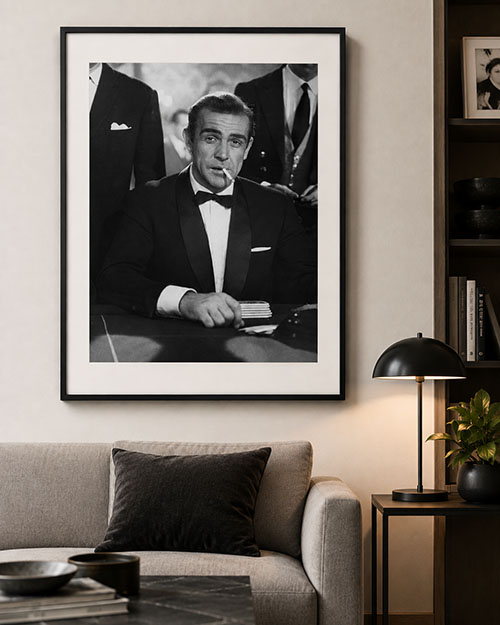
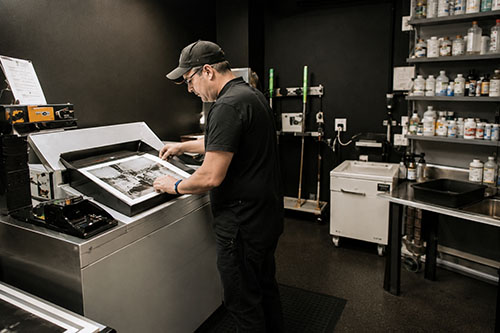
Carefully restored from historic photographic source material and professionally lab-developed, this museum-quality photograph is presented uncropped, preserving the complete image area contained in the source. Restoration recovers facial detail, laboratory apparatus, surgical materials, exposed anatomical detail and subtle color and shadow gradation while maintaining the natural color balance and authentic character of the historic photograph. The finished photograph contains no AI-generated image content.
Product Enquiry
Kodak Professional Endura Paper
Kodak Endura papers provide an incredible amount of detail and smooth transition of tones. Designed for the professional photographer in mind, looking for a more traditional photo print style, Kodak Endura provides an extended print life and color gamut almost at the level of a high end fine art paper print.
Archival Matte Paper
Archival Matte Paper, also known as Moab Lasal Photo Matte, is our house stock fine art paper and is an economical favorite for fine art reproductions and photo prints. It features a smooth surface, heavy weight (230 g, 9.5-mil), neutral white, matte paper engineered for accurate color reproduction that provides high contrast and high-resolution output. This paper is acid-free, making it the perfect choice for both photography & fine art reproductions.
Giclee William Turner Paper by Hahnemühle
The William Turner by Hahnemühle is one of the most popular papers used in the Giclee printing industry. This is a 310g natural white mould made natural line paper with 100% rag content making it highly archival. It has a slight coarse texture which gives photos and artwork an elegant look. These fine art paper prints (also known as Giclee) are ordered by galleries, individual artists and photographers. The papers and inks are not only archival but use some of the most accurate print technology for full color prints.
- Giclee prints use very expensive archival pigmented inks.
- Highest level of color gamut available in printing (12 color printing).
- Exceptional black & white printing.
- Fade resistant, pigmented inks which provide a superior color range compared to other types of inks. Widely preferred in fine art and photography circles.
- We ONLY use professional grade fine art and photo paper that resist yellowing and aging.
Framing
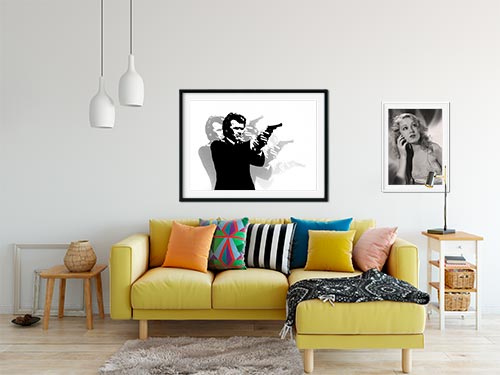
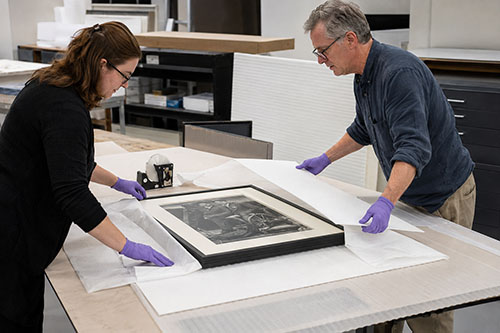
We offer wood and metal frames, custom cut & joined to order. Each framed print includes hanging hardware and foamcore backer.
Matting
We use conservation grade 100% virgin alpha-cellulose 2 ply mats with white core. Acid-free and lignin-free, these are both face resistant and meet all conservation quality standards set by the Fine Art Trade Guild. Mats are digitally cut for ultimate precision. The window will be 1/8″ smaller than the print dimensions.
Glazing (Acrylic Glass)
We offer custom cut panes of shatter-proof, acrylic glass, to protect your valuable artwork and prints.
Premium Clear
Framing grade clear acrylic is shatter resistant and lightweight.
Reflection Control
With its matte finish, Tru Vue Reflection Control® Acrylic scatters light to diminish unwanted glare.
Conservation Clear
Tru Vue Conservation Clear® Acrylic is a framing industry staple, blocking up to 99% of UV rays for ultimate protection.
Conservation Reflection Control
Tru Vue Conservation Reflection Control® Acrylic scatters and diffuses light to reduce unwanted glare. Blocks up to 99% of UV rays.
Related products
-

King Kong Escapes (1967) Mechani-Kong Battle Toho Kaiju Promotional Artwork
$25.00 -
Barbara Steele – The Long Hair of Death (1964) Flowing Hair Over-Shoulder Gothic Photo
$38.00 -
King Kong (1933) Ann Darrow Manhattan Empire State Building Promotional Artwork
$38.00 -
The Howling (1981) Werewolf Venetian Blind Shadows Rob Bottin Creature Photo
$25.00


