

Barbara Steele – Black Sunday (1960) Princess Asa Vajda Witch’s Crypt Mario Bava Italian Gothic Horror Photo
Limited Edition Photograph (learn more)
In stock
Barbara Steele as Princess Asa Vajda lies within the immense crypt in this extraordinary black-and-white image from Black Sunday (1960), while John Richardson as Dr. Andrej Gorobec and Antonio Pierfederici as the Priest stand amid the cavernous Gothic chamber. Monumental stone arches, broad steps, rough masonry and enormous curtains of cobwebs overwhelm the human figures, turning the crypt itself into one of the photograph’s dominant presences. Steele’s witch rests at the center of this decaying subterranean world, creating a remarkable image in which architecture, shadow and supernatural menace become inseparable.
The photograph is especially powerful because of its enormous sense of scale. Gorobec and the Priest appear almost reduced to silhouettes beneath the arches, while thick webs hang across the stonework and disappear into the darkness above them. The massive tomb, ruined surfaces and deep recesses create a suffocating atmosphere that illustrates why Mario Bava’s visual treatment of Gothic space became so influential.
Released in 1960 in Italy as La Maschera del Demonio, Black Sunday marked Mario Bava’s official directorial debut and stars Barbara Steele in the dual roles of Princess Asa Vajda and Katia Vajda. John Richardson plays Dr. Andrej Gorobec, with Andrea Checchi as Dr. Choma Kruvajan, Ivo Garrani as Prince Vajda, Arturo Dominici as Javutich and Antonio Pierfederici as the Priest.
The film opens with Princess Asa, condemned as a witch, being brutally executed alongside Javutich. Two centuries later, Asa is accidentally reawakened and begins attempting to possess her descendant Katia, also played by Steele. The dual role allowed Steele to embody both supernatural evil and endangered innocence, establishing the extraordinary visual duality that would become central to her reputation in European Gothic horror.
Bava did far more than direct the film. He also served as director of photography and supervised important visual effects, allowing lighting, camera placement and effects work to function as a unified Gothic design. La Cinémathèque française credits Bava with the cinematography and Giorgio Giovannini with the sets, while Tina Loriedo Grani designed the costumes.
Giovannini’s elaborate environments are particularly important in this photograph. The crypt is not simply a background for the actors; its immense arches, tomb architecture, stairways and decaying surfaces make the characters appear physically trapped inside a supernatural world. Bava’s black-and-white photography amplifies those forms through deep shadows and sharply controlled highlights, turning stone, mist and cobwebs into essential components of the horror.
Black Sunday drew loosely upon Nikolai Gogol’s tale Viy, but Bava and his collaborators transformed the material into a distinctly Italian Gothic nightmare. The film’s combination of witchcraft, vampirism, resurrection, ancestral curse and elaborate architectural horror helped establish a new direction for Italian genre cinema.
For Barbara Steele, the film became the defining breakthrough of her career. The British Film Institute describes Black Sunday as the film that introduced full-scale Gothic horror to Italian cinema while establishing Steele’s extraordinary screen image. Her dual portrayal of Asa and Katia launched an enduring association with Italian horror and helped establish her as one of the genre’s great Gothic Horror Queens.
Steele’s Princess Asa Vajda remains especially iconic. The character combines aristocratic beauty with witchcraft, vengeance and supernatural corruption, while the famous imagery surrounding her execution, resurrection and crypt has become inseparable from Bava’s visual legacy. Photographs such as this capture the scale of the environments surrounding Asa as effectively as they preserve Steele herself.
The film circulated internationally under several titles, most famously Black Sunday and The Mask of Satan, while its original Italian title remains La Maschera del Demonio. Its reputation has continued to grow, with BFI identifying it as the ideal starting point for Bava’s work and emphasizing its importance in reshaping cinematic horror.
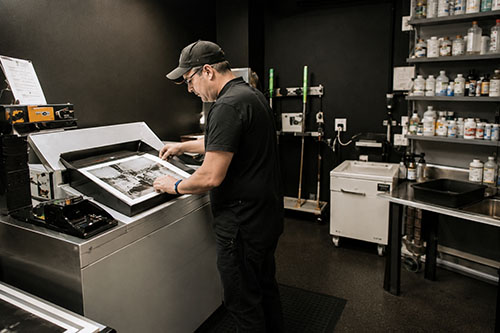
Carefully restored from historic photographic source material and professionally lab-developed, this museum-quality photograph is presented uncropped, preserving the complete image area contained in the source. Meticulous restoration recovers stone texture, cobweb detail, architectural depth, costume definition, shadow separation, tonal range and photographic clarity while retaining the extraordinary atmosphere of the original black-and-white image.
For collectors of Barbara Steele, Mario Bava, Black Sunday and Italian Gothic horror, this is an exceptional image from Princess Asa Vajda’s crypt—Steele surrounded by monumental stone architecture, vast cobwebs and shadow while Gorobec and the Priest stand within the chamber, preserving the extraordinary combination of Gothic production design and expressionistic photography that made Black Sunday one of the defining horror films of 1960.
Product Enquiry
Kodak Professional Endura Paper
Kodak Endura papers provide an incredible amount of detail and smooth transition of tones. Designed for the professional photographer in mind, looking for a more traditional photo print style, Kodak Endura provides an extended print life and color gamut almost at the level of a high end fine art paper print.
Archival Matte Paper
Archival Matte Paper, also known as Moab Lasal Photo Matte, is our house stock fine art paper and is an economical favorite for fine art reproductions and photo prints. It features a smooth surface, heavy weight (230 g, 9.5-mil), neutral white, matte paper engineered for accurate color reproduction that provides high contrast and high-resolution output. This paper is acid-free, making it the perfect choice for both photography & fine art reproductions.
Giclee William Turner Paper by Hahnemühle
The William Turner by Hahnemühle is one of the most popular papers used in the Giclee printing industry. This is a 310g natural white mould made natural line paper with 100% rag content making it highly archival. It has a slight coarse texture which gives photos and artwork an elegant look. These fine art paper prints (also known as Giclee) are ordered by galleries, individual artists and photographers. The papers and inks are not only archival but use some of the most accurate print technology for full color prints.
- Giclee prints use very expensive archival pigmented inks.
- Highest level of color gamut available in printing (12 color printing).
- Exceptional black & white printing.
- Fade resistant, pigmented inks which provide a superior color range compared to other types of inks. Widely preferred in fine art and photography circles.
- We ONLY use professional grade fine art and photo paper that resist yellowing and aging.
Framing
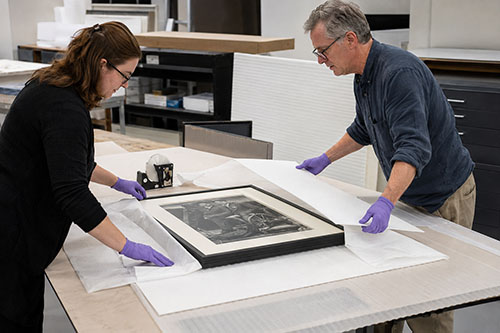
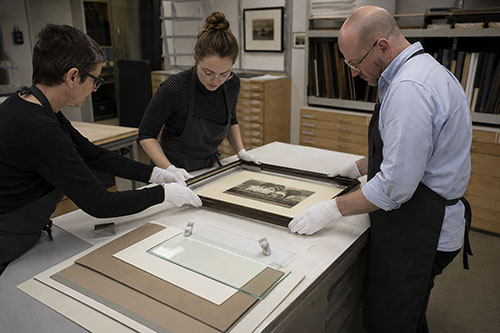
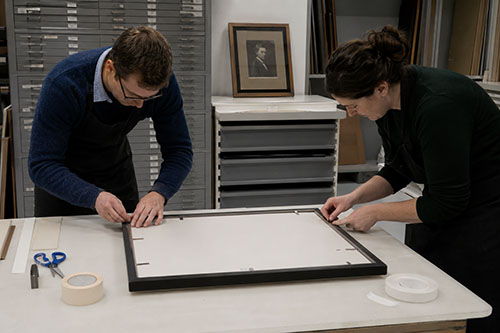
We offer wood and metal frames, custom cut & joined to order. Each framed print includes hanging hardware and foamcore backer.
Matting
We use conservation grade 100% virgin alpha-cellulose 2 ply mats with white core. Acid-free and lignin-free, these are both face resistant and meet all conservation quality standards set by the Fine Art Trade Guild. Mats are digitally cut for ultimate precision. The window will be 1/8″ smaller than the print dimensions.
Glazing (Acrylic Glass)
We offer custom cut panes of shatter-proof, acrylic glass, to protect your valuable artwork and prints.
Premium Clear
Framing grade clear acrylic is shatter resistant and lightweight.
Reflection Control
With its matte finish, Tru Vue Reflection Control® Acrylic scatters light to diminish unwanted glare.
Conservation Clear
Tru Vue Conservation Clear® Acrylic is a framing industry staple, blocking up to 99% of UV rays for ultimate protection.
Conservation Reflection Control
Tru Vue Conservation Reflection Control® Acrylic scatters and diffuses light to reduce unwanted glare. Blocks up to 99% of UV rays.
Related products
-

Ingrid Pitt – The Vampire Lovers (1970) Bloodied Carmilla Vampire Fangs Photo
$25.00 -
Terence Fisher, Janina Faye & Robert Lynn – Horror of Dracula (1958) Candid Behind-the-Scenes Photo
$30.00 -
Anthony Higgins, Laurence Payne & Robert Tayman – Vampire Circus (1972) Crypt Battle Stake Photo
$25.00 -
Sean Connery & Ursula Andress – Dr. No (1962) Connery Brushing Hair on Beach Behind-the-Scenes Photo
$38.00