

The Brides of Dracula (1960) – Joseph Smith U.S. One-Sheet Poster Artwork Hammer Horror Photo
Limited Edition Photograph (learn more)
In stock
Joseph Smith’s extraordinary illustrated artwork for the 1960 U.S. theatrical campaign of The Brides of Dracula is presented here without the title lettering, advertising copy or credits of the finished one-sheet poster. Freed from typography, the densely layered Gothic composition becomes the entire focus: the commanding vampire figure rises through the center, surrounded by women, victims and principal characters arranged in overlapping layers of shadow and dramatic expression. The monochromatic presentation emphasizes Smith’s drawing, facial studies and sweeping vertical construction, revealing the underlying artistry behind one of Hammer Horror’s most recognizable American poster campaigns.
The image is particularly compelling because removing the commercial lettering changes the way the artwork is experienced. On the theatrical one-sheet, illustration and advertising function together; here, the composition can be studied almost as a standalone piece of Gothic art. Faces emerge from darkness around the dominant central vampire, while the lower figures introduce movement and vulnerability. The result has the quality of an elaborate horror montage rather than a conventional photographic film still.
The original U.S. one-sheet for The Brides of Dracula was issued by Universal International in 1960 and is documented with artwork by Joseph Smith. The same underlying Smith campaign imagery appeared across multiple American poster formats, making his illustration an important part of the film’s U.S. visual identity.
Directed by Terence Fisher for Hammer Film Productions, The Brides of Dracula stars Peter Cushing as Doctor Van Helsing, David Peel as Baron Meinster, Yvonne Monlaur as Marianne, Martita Hunt as Baroness Meinster, Freda Jackson as Greta and Andrée Melly as Gina. Produced by Anthony Hinds, the film continued the vampire world Hammer had established with Dracula in 1958.
Despite its title, Count Dracula does not appear in the film. Instead, Peter Cushing’s Van Helsing confronts Baron Meinster, a young aristocratic vampire whose corruption spreads through the women surrounding him. That distinction allowed Hammer to expand its vampire mythology without simply repeating the earlier confrontation between Van Helsing and Christopher Lee’s Dracula.
Baron Meinster gives the poster artwork its own distinctive visual identity. Rather than relying on Dracula’s familiar cape and silhouette, Smith builds the campaign around a broader assemblage of vampire menace, female victims and Gothic beauty. The montage reflects the film’s mixture of aristocratic horror, seduction and supernatural danger while maintaining the dramatic promotional style expected of American horror advertising at the beginning of the 1960s.
The Brides of Dracula also occupies an important place in Hammer history. Terence Fisher returned as director, while Peter Cushing’s Van Helsing provided continuity with Dracula (1958). The film helped demonstrate that Hammer’s emerging vampire cycle could continue beyond a single monster, expanding the studio’s Gothic world through new characters, settings and supernatural threats.
For collectors of vintage movie-poster artwork, the typography-free presentation is especially interesting. It offers a rare opportunity to concentrate on the illustrator’s composition rather than the finished advertising design. The absence of titles and billing allows details that normally compete with printed copy—faces, gesture, shadow and figure placement—to become much more prominent.
Carefully restored from historic photographic source material and professionally lab-developed, this museum-quality photograph is presented uncropped, preserving the complete artwork contained in the source. Meticulous restoration recovers illustrative detail, facial definition, tonal gradation, shadow depth and linework while retaining the dramatic character of Joseph Smith’s original poster imagery.
For collectors of Hammer Horror, Joseph Smith poster art, Peter Cushing and The Brides of Dracula, this is an exceptional presentation of the 1960 U.S. one-sheet artwork without typography—a striking opportunity to appreciate the Gothic illustration itself as a piece of classic horror-film art.
Product Enquiry
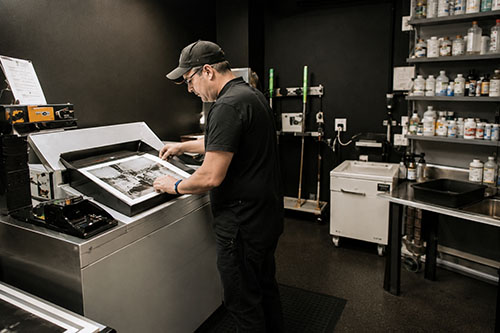
Kodak Professional Endura Paper
Kodak Endura papers provide an incredible amount of detail and smooth transition of tones. Designed for the professional photographer in mind, looking for a more traditional photo print style, Kodak Endura provides an extended print life and color gamut almost at the level of a high end fine art paper print.
Archival Matte Paper
Archival Matte Paper, also known as Moab Lasal Photo Matte, is our house stock fine art paper and is an economical favorite for fine art reproductions and photo prints. It features a smooth surface, heavy weight (230 g, 9.5-mil), neutral white, matte paper engineered for accurate color reproduction that provides high contrast and high-resolution output. This paper is acid-free, making it the perfect choice for both photography & fine art reproductions.
Giclee William Turner Paper by Hahnemühle
The William Turner by Hahnemühle is one of the most popular papers used in the Giclee printing industry. This is a 310g natural white mould made natural line paper with 100% rag content making it highly archival. It has a slight coarse texture which gives photos and artwork an elegant look. These fine art paper prints (also known as Giclee) are ordered by galleries, individual artists and photographers. The papers and inks are not only archival but use some of the most accurate print technology for full color prints.
- Giclee prints use very expensive archival pigmented inks.
- Highest level of color gamut available in printing (12 color printing).
- Exceptional black & white printing.
- Fade resistant, pigmented inks which provide a superior color range compared to other types of inks. Widely preferred in fine art and photography circles.
- We ONLY use professional grade fine art and photo paper that resist yellowing and aging.
Framing
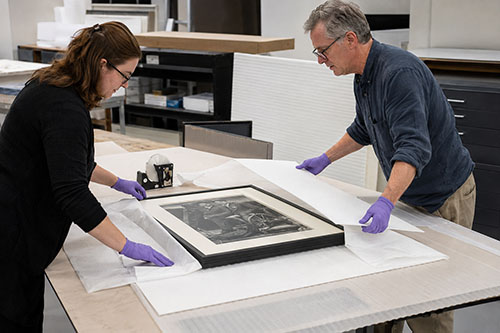
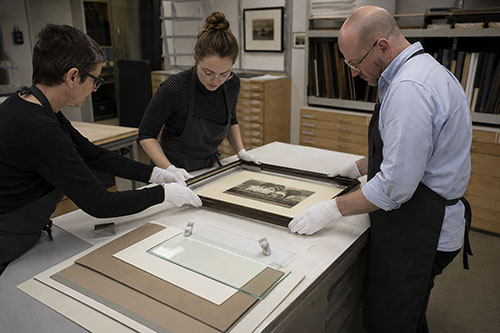
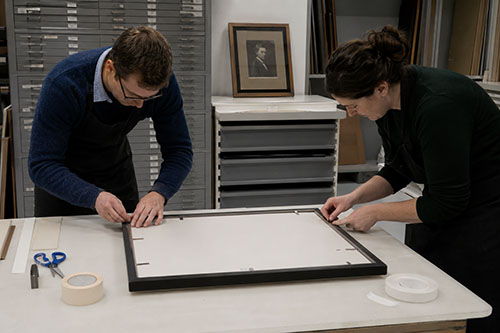
We offer wood and metal frames, custom cut & joined to order. Each framed print includes hanging hardware and foamcore backer.
Matting
We use conservation grade 100% virgin alpha-cellulose 2 ply mats with white core. Acid-free and lignin-free, these are both face resistant and meet all conservation quality standards set by the Fine Art Trade Guild. Mats are digitally cut for ultimate precision. The window will be 1/8″ smaller than the print dimensions.
Glazing (Acrylic Glass)
We offer custom cut panes of shatter-proof, acrylic glass, to protect your valuable artwork and prints.
Premium Clear
Framing grade clear acrylic is shatter resistant and lightweight.
Reflection Control
With its matte finish, Tru Vue Reflection Control® Acrylic scatters light to diminish unwanted glare.
Conservation Clear
Tru Vue Conservation Clear® Acrylic is a framing industry staple, blocking up to 99% of UV rays for ultimate protection.
Conservation Reflection Control
Tru Vue Conservation Reflection Control® Acrylic scatters and diffuses light to reduce unwanted glare. Blocks up to 99% of UV rays.
Related products
-

King Kong Escapes (1967) Mechani-Kong Battle Toho Kaiju Promotional Artwork
$25.00 -
King Kong Escapes (1967) Gorosaurus & Mechani-Kong Toho Kaiju Battle Artwork
$25.00 -
Barbara Steele – The Long Hair of Death (1964) Flowing Hair Over-Shoulder Gothic Photo
$38.00 -
Klaus Kinski – Fitzcarraldo (1982) Brian Sweeney Fitzgerald Leopard Tapestry Publicity Photo
$25.00


