

Christopher Lee & Heinz Drache – The Brides of Fu Manchu (1966) Big Ben Westminster Bridge Cast Publicity Photo
Limited Edition Photograph (learn more)
In stock
Christopher Lee and Heinz Drache stand among nine of the international “brides” in this extraordinary black-and-white publicity photograph for The Brides of Fu Manchu (1966), posed across rain-darkened Westminster Bridge with Big Ben rising dramatically behind them. Lee’s exceptional height makes him instantly recognizable near the center of the group, while Drache stands several places to his left amid an extraordinary lineup of women in distinctly mid-1960s coats, dresses and shoes. The wet pavement, Houses of Parliament, period London traffic and monumental tower backdrop turn the image into much more than a conventional cast portrait—it is also a remarkable photographic time capsule of 1960s London.
The carefully arranged ensemble gives the photograph unusual scale and character. The published caption for this exact image identifies the group from left to right as Yvonne Ekmann, Anje Langstraat, Grete-Lill Henden, Katerina Quest, Heinz Drache, Christine Rau, Christopher Lee, Gaby Schär, Évelyne Dhéliat, Danielle Defrère and Janette Napper. Contemporary cast records confirm these women among the international brides or captives represented in the production, including Danish, Dutch, Norwegian, German, Austrian, Swiss, French, Belgian and English characters.
Released in 1966, The Brides of Fu Manchu was directed by Don Sharp and produced by Harry Alan Towers, who also wrote the screenplay under his Peter Welbeck pseudonym. Christopher Lee stars as Dr. Fu Manchu, with Douglas Wilmer as Nayland Smith, Heinz Drache as Franz Baumer, Marie Versini as Marie Lentz, Howard Marion-Crawford as Dr. Petrie and Tsai Chin as Lin Tang.
The film was the second of five Fu Manchu films starring Christopher Lee, following The Face of Fu Manchu (1965). It was followed by The Vengeance of Fu Manchu (1967), The Blood of Fu Manchu (1968) and The Castle of Fu Manchu (1969), giving Lee one of the recurring screen roles of his enormously varied 1960s career outside Hammer Horror.
In the story, Fu Manchu kidnaps the daughters and wives of prominent scientists and industrialists, holding the women hostage in order to force their relatives to assist in the construction of a powerful weapon. That premise explains the unusually international group of women promoted as the film’s “brides,” making this Westminster Bridge gathering especially relevant to the picture’s central concept.
Heinz Drache plays Franz Baumer, while Lee dominates the film as the calculating Fu Manchu. The large ensemble represented in this publicity photograph gives the image a different character from the film’s more conventional portraits and action stills: rather than emphasizing villainy or danger, it presents the production as a major international adventure spectacle against one of London’s most immediately recognizable landmarks.
The photograph is also an exceptional piece of London film-publicity history. The sheen of the rain on Westminster Bridge, the period vehicles visible beyond the group and the fashions worn by the nine women preserve details of the city and its visual culture during the mid-1960s. Big Ben and the Palace of Westminster transform the location into an unmistakably British backdrop, reinforcing the London setting central to much of the film’s action.
Production records identify The Brides of Fu Manchu as a British–West German production, with Hallam Productions and Fu Manchu Films among the production companies. Principal photography began in January 1966, with England among the documented filming locations; Bray Studios is also recorded as the studio base.
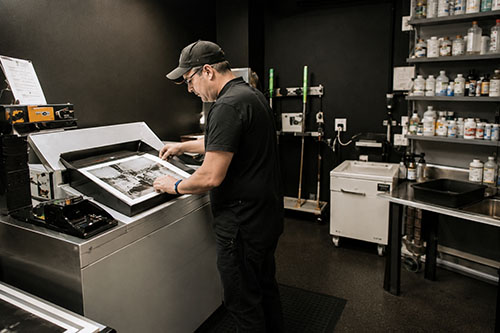
Carefully restored from historic photographic source material and professionally lab-developed, this museum-quality photograph is presented uncropped, preserving the complete image area contained in the source. Meticulous restoration recovers facial detail, clothing texture, pavement reflections, architectural detail, period vehicles, tonal range and photographic clarity while retaining the authentic atmosphere of the original black-and-white publicity photograph.
For collectors of Christopher Lee, Heinz Drache, The Brides of Fu Manchu and 1960s British cult cinema, this is an exceptional ensemble publicity photograph—Lee, Drache and nine international brides standing together on Westminster Bridge beneath Big Ben, preserving not only a distinctive image from the Fu Manchu series but also a remarkable visual record of London in 1966.
Product Enquiry
Kodak Professional Endura Paper
Kodak Endura papers provide an incredible amount of detail and smooth transition of tones. Designed for the professional photographer in mind, looking for a more traditional photo print style, Kodak Endura provides an extended print life and color gamut almost at the level of a high end fine art paper print.
Archival Matte Paper
Archival Matte Paper, also known as Moab Lasal Photo Matte, is our house stock fine art paper and is an economical favorite for fine art reproductions and photo prints. It features a smooth surface, heavy weight (230 g, 9.5-mil), neutral white, matte paper engineered for accurate color reproduction that provides high contrast and high-resolution output. This paper is acid-free, making it the perfect choice for both photography & fine art reproductions.
Giclee William Turner Paper by Hahnemühle
The William Turner by Hahnemühle is one of the most popular papers used in the Giclee printing industry. This is a 310g natural white mould made natural line paper with 100% rag content making it highly archival. It has a slight coarse texture which gives photos and artwork an elegant look. These fine art paper prints (also known as Giclee) are ordered by galleries, individual artists and photographers. The papers and inks are not only archival but use some of the most accurate print technology for full color prints.
- Giclee prints use very expensive archival pigmented inks.
- Highest level of color gamut available in printing (12 color printing).
- Exceptional black & white printing.
- Fade resistant, pigmented inks which provide a superior color range compared to other types of inks. Widely preferred in fine art and photography circles.
- We ONLY use professional grade fine art and photo paper that resist yellowing and aging.
Framing
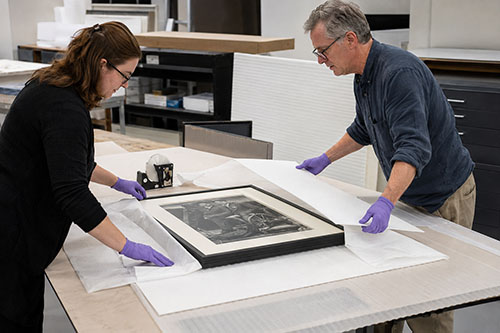
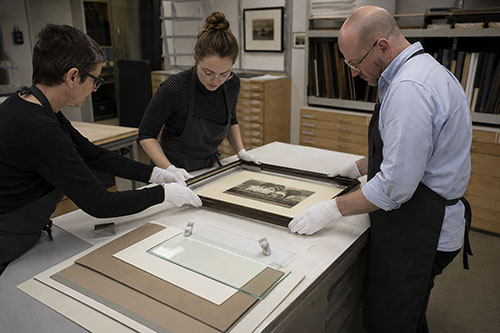
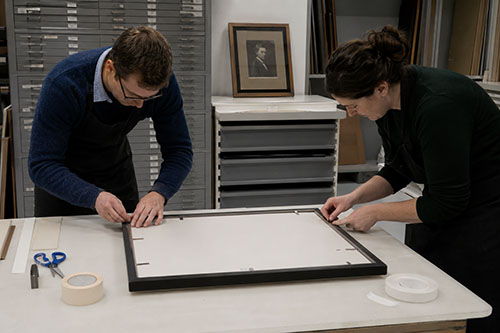
We offer wood and metal frames, custom cut & joined to order. Each framed print includes hanging hardware and foamcore backer.
Matting
We use conservation grade 100% virgin alpha-cellulose 2 ply mats with white core. Acid-free and lignin-free, these are both face resistant and meet all conservation quality standards set by the Fine Art Trade Guild. Mats are digitally cut for ultimate precision. The window will be 1/8″ smaller than the print dimensions.
Glazing (Acrylic Glass)
We offer custom cut panes of shatter-proof, acrylic glass, to protect your valuable artwork and prints.
Premium Clear
Framing grade clear acrylic is shatter resistant and lightweight.
Reflection Control
With its matte finish, Tru Vue Reflection Control® Acrylic scatters light to diminish unwanted glare.
Conservation Clear
Tru Vue Conservation Clear® Acrylic is a framing industry staple, blocking up to 99% of UV rays for ultimate protection.
Conservation Reflection Control
Tru Vue Conservation Reflection Control® Acrylic scatters and diffuses light to reduce unwanted glare. Blocks up to 99% of UV rays.
Related products
-

Dracula Has Risen from the Grave (1968) Christopher Lee Japanese Theatrical Design Hammer Horror 18×24 Fine Art Poster
$149.85 -
Peter Cushing & Christopher Lee – The Curse of Frankenstein (1957) Baron Frankenstein & Suspended Creature Laboratory Hammer Horror Photo
$25.00 -
Christopher Lee – Scars of Dracula (1970) Count Dracula Crest Ring Behind-the-Scenes Hammer Horror Photo
$30.00 -
Christopher Lee & Fred Williams – Count Dracula (1970) Castle Dinner with Jonathan Harker Jess Franco Gothic Horror Photo
$25.00