

Christopher Lee – Horror of Dracula (1958) Bloodied Dracula Reaching Hands Photo
Limited Edition Photograph (learn more)
In stock
Christopher Lee appears as Count Dracula in this extraordinary black-and-white photograph from Horror of Dracula (1958), blood streaking from his mouth as exposed fangs, widened eyes and outstretched hands transform the portrait into an image of immediate predatory menace. Lee leans toward the camera from the surrounding darkness, his hands thrust dramatically into the foreground while his face remains sharply illuminated behind them. The unusual perspective creates the startling impression that Dracula is advancing beyond the photograph itself.
The reaching hands are crucial to the composition. Rather than keeping Lee confined to a conventional head-and-shoulders pose, the photographer uses the foreground to create depth and physical movement. One hand extends directly toward the viewer while the other rises beneath it, their slight softness contrasting with the sharper definition of Lee’s face. The effect makes Dracula appear active, aggressive and dangerously close.
Lee’s expression intensifies that impression. His eyes are opened wide beneath the strongly lit forehead, his mouth partially open and his fangs clearly visible through the blood surrounding his lips. The dark costume and cape merge almost completely with the black background, leaving the face, fangs and reaching hands as the dominant elements. Very little scenery is required; the horror comes almost entirely from Lee’s physical performance.
This Christopher Lee Horror of Dracula 1958 image captures the qualities that radically distinguished Hammer’s Count Dracula from many earlier screen interpretations. Lee combined aristocratic bearing with sudden, animalistic violence, allowing the character to shift rapidly from controlled stillness to explosive aggression. His imposing stature and intense facial expressions helped create a Dracula who felt physically dangerous rather than merely supernatural or hypnotic.
Directed by Terence Fisher for Hammer Film Productions, Horror of Dracula—released in Britain simply as Dracula—stars Christopher Lee as Count Dracula opposite Peter Cushing as Doctor Van Helsing. The cast also includes Michael Gough, Melissa Stribling, Carol Marsh and John Van Eyssen, with a screenplay by Jimmy Sangster. The film became one of Hammer’s defining Gothic productions and established the celebrated Lee-Cushing screen partnership at the center of a new era of British horror cinema.
The bloodied mouth is particularly significant within Hammer’s visual interpretation of Dracula. The production embraced the possibilities of more direct vampire imagery, presenting blood, fangs and physical attack with a force that distinguished the film from earlier Gothic treatments. In black-and-white photography such as this, the blood reads through texture and tonal contrast rather than color, producing an image that remains remarkably graphic and immediate.
The photograph also works exceptionally well as a character portrait because Lee does not merely pose as Dracula—he performs the vampire directly toward the camera. His hands break the traditional boundary between subject and viewer, while the intense stare creates the sense of an attack already in progress. That combination gives the image far greater energy than a standard studio publicity portrait.
For collectors of Christopher Lee, Hammer Horror and classic Dracula photography, this photograph captures one of the defining screen monsters of the 1950s at his most ferocious. The bloodied mouth, visible fangs, piercing gaze and dramatic reaching hands create an unmistakable representation of Lee’s revolutionary Count Dracula.
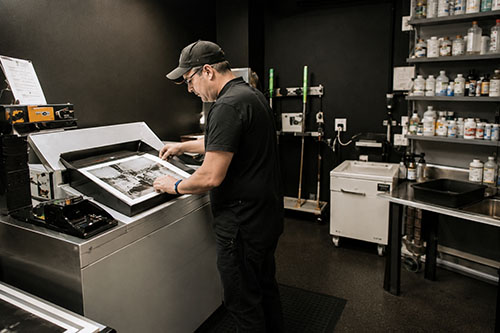
Carefully restored from historic photographic source material and professionally lab-developed, this museum-quality photograph is presented uncropped, preserving the complete image area contained in the source. Restoration recovers facial detail, fang definition, blood texture, hand contours, costume detail and deep shadow gradation while maintaining the natural tonal gradation and character of the historic black-and-white photograph. The finished photograph contains no AI-generated image content.
Product Enquiry
Kodak Professional Endura Paper
Kodak Endura papers provide an incredible amount of detail and smooth transition of tones. Designed for the professional photographer in mind, looking for a more traditional photo print style, Kodak Endura provides an extended print life and color gamut almost at the level of a high end fine art paper print.
Archival Matte Paper
Archival Matte Paper, also known as Moab Lasal Photo Matte, is our house stock fine art paper and is an economical favorite for fine art reproductions and photo prints. It features a smooth surface, heavy weight (230 g, 9.5-mil), neutral white, matte paper engineered for accurate color reproduction that provides high contrast and high-resolution output. This paper is acid-free, making it the perfect choice for both photography & fine art reproductions.
Giclee William Turner Paper by Hahnemühle
The William Turner by Hahnemühle is one of the most popular papers used in the Giclee printing industry. This is a 310g natural white mould made natural line paper with 100% rag content making it highly archival. It has a slight coarse texture which gives photos and artwork an elegant look. These fine art paper prints (also known as Giclee) are ordered by galleries, individual artists and photographers. The papers and inks are not only archival but use some of the most accurate print technology for full color prints.
- Giclee prints use very expensive archival pigmented inks.
- Highest level of color gamut available in printing (12 color printing).
- Exceptional black & white printing.
- Fade resistant, pigmented inks which provide a superior color range compared to other types of inks. Widely preferred in fine art and photography circles.
- We ONLY use professional grade fine art and photo paper that resist yellowing and aging.
Framing
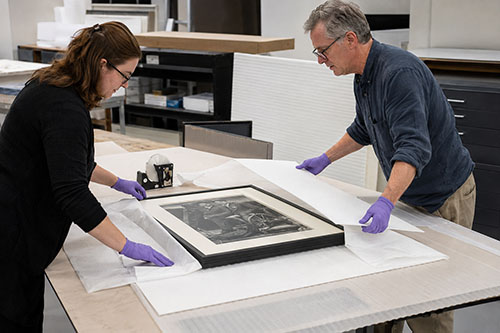
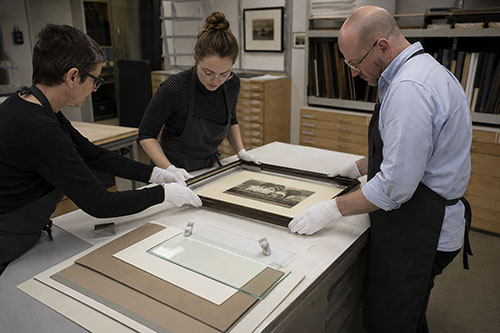
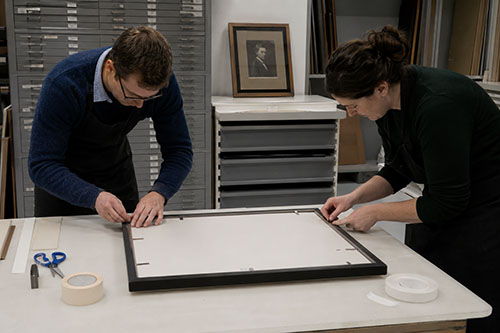
We offer wood and metal frames, custom cut & joined to order. Each framed print includes hanging hardware and foamcore backer.
Matting
We use conservation grade 100% virgin alpha-cellulose 2 ply mats with white core. Acid-free and lignin-free, these are both face resistant and meet all conservation quality standards set by the Fine Art Trade Guild. Mats are digitally cut for ultimate precision. The window will be 1/8″ smaller than the print dimensions.
Glazing (Acrylic Glass)
We offer custom cut panes of shatter-proof, acrylic glass, to protect your valuable artwork and prints.
Premium Clear
Framing grade clear acrylic is shatter resistant and lightweight.
Reflection Control
With its matte finish, Tru Vue Reflection Control® Acrylic scatters light to diminish unwanted glare.
Conservation Clear
Tru Vue Conservation Clear® Acrylic is a framing industry staple, blocking up to 99% of UV rays for ultimate protection.
Conservation Reflection Control
Tru Vue Conservation Reflection Control® Acrylic scatters and diffuses light to reduce unwanted glare. Blocks up to 99% of UV rays.
Related products
-

Christopher Lee & Christopher Matthews – Scars of Dracula (1970) Paul Discovers Dracula in Coffin Hammer Horror Photo
$30.00 -
Circus of Fear (1966) Christopher Lee Australian One-Sheet Artwork 30×41 Fine Art Poster
$149.85 -
Dracula: Prince of Darkness (1966) Christopher Lee Original French Theatrical Design Hammer Horror 18×22 Fine Art Poster
$149.85 -
Christopher Lee – Dracula Has Risen from the Grave (1968) Count Dracula Bloody Lips Coffin Photo
$30.00