

Christopher Lee – Scars of Dracula (1970) Red-Eyed Count Dracula Hammer Horror Photo
Limited Edition Photograph (learn more)
In stock
Christopher Lee as Count Dracula emerges from near-total darkness in this extraordinary color character photograph from Scars of Dracula (1970), his deathly pale face sharply illuminated while the surrounding background dissolves into deep shadow. Lee’s slicked-back hair, severe black costume and subtly blood-red eyes intensify a controlled upward gaze, creating a powerful image of Hammer Horror’s legendary vampire at his most watchful and ominous.
Unlike more overtly aggressive images of Dracula, this photograph derives its power from restraint. Lee’s expression is rigid and composed, yet the inflamed crimson eyes immediately betray the supernatural predator beneath the Count’s aristocratic exterior. With virtually nothing competing with his face, the composition becomes an exceptionally concentrated character study of Christopher Lee’s Count Dracula.
Released in 1970, Scars of Dracula continued Hammer Film Productions’ celebrated Dracula cycle while presenting the Count as an especially physical and dangerous incarnation of the character. The story follows Simon Carlson and Sarah Framsen as they search for Simon’s missing brother Paul, whose disappearance leads them into the isolated castle ruled by Dracula.
Directed by Roy Ward Baker from a screenplay by Anthony Hinds, Scars of Dracula stars Christopher Lee as Count Dracula, Dennis Waterman as Simon Carlson, Jenny Hanley as Sarah Framsen, Christopher Matthews as Paul Carlson and Patrick Troughton as Klove.
The photograph illustrates one of the qualities that made Lee’s portrayal so distinctive: his ability to suggest menace through stillness, posture and expression rather than constant physical action. Here, the Count appears almost statuesque. His gaze is directed upward and slightly away from the viewer, creating the unsettling impression that Dracula is observing something beyond the frame while remaining completely in control.
The subdued background also gives the image an unusually atmospheric quality. Rather than relying on elaborate Gothic architecture, candles or castle interiors, the photograph uses shadow and facial illumination to create its sense of danger. Lee’s pale complexion seems almost spectral against the darkness, while the red eyes provide the only vivid suggestion of the violence concealed beneath his formal appearance.
Christopher Lee first portrayed Dracula for Hammer in Dracula (1958), establishing a physically commanding and overtly dangerous interpretation that became one of the defining performances of British Gothic horror cinema. By Scars of Dracula, Lee’s image had become inseparable from Hammer Films and from the modern visual identity of Count Dracula himself.
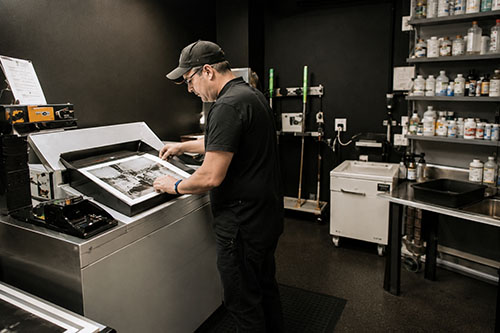
Carefully restored from archival source material and professionally lab-developed, this museum-quality photograph is presented uncropped, preserving the complete image area contained in the archival source. Meticulous restoration recovers natural color balance, facial clarity, tonal depth, costume detail and photographic integrity while retaining the dark atmospheric character of the original image.
For collectors of Christopher Lee, Count Dracula and Scars of Dracula, this is an exceptionally powerful piece of Hammer Horror imagery—a stark vampire portrait in which Lee’s blood-red eyes, pallid face, formal black costume and shadow-filled composition create pure Gothic menace, making it especially desirable for collectors of Hammer Films, vampire cinema, British horror and classic monster photography.
Product Enquiry
Kodak Professional Endura Paper
Kodak Endura papers provide an incredible amount of detail and smooth transition of tones. Designed for the professional photographer in mind, looking for a more traditional photo print style, Kodak Endura provides an extended print life and color gamut almost at the level of a high end fine art paper print.
Archival Matte Paper
Archival Matte Paper, also known as Moab Lasal Photo Matte, is our house stock fine art paper and is an economical favorite for fine art reproductions and photo prints. It features a smooth surface, heavy weight (230 g, 9.5-mil), neutral white, matte paper engineered for accurate color reproduction that provides high contrast and high-resolution output. This paper is acid-free, making it the perfect choice for both photography & fine art reproductions.
Giclee William Turner Paper by Hahnemühle
The William Turner by Hahnemühle is one of the most popular papers used in the Giclee printing industry. This is a 310g natural white mould made natural line paper with 100% rag content making it highly archival. It has a slight coarse texture which gives photos and artwork an elegant look. These fine art paper prints (also known as Giclee) are ordered by galleries, individual artists and photographers. The papers and inks are not only archival but use some of the most accurate print technology for full color prints.
- Giclee prints use very expensive archival pigmented inks.
- Highest level of color gamut available in printing (12 color printing).
- Exceptional black & white printing.
- Fade resistant, pigmented inks which provide a superior color range compared to other types of inks. Widely preferred in fine art and photography circles.
- We ONLY use professional grade fine art and photo paper that resist yellowing and aging.
Framing
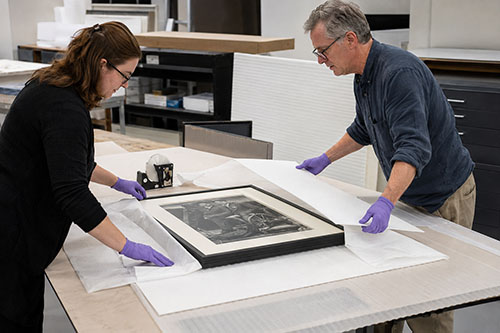
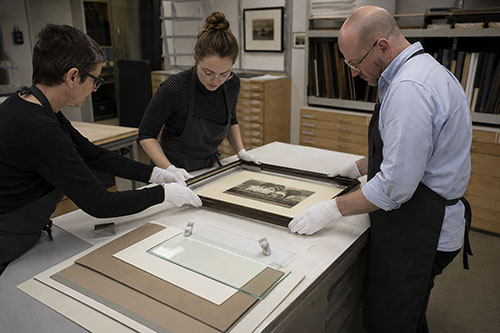
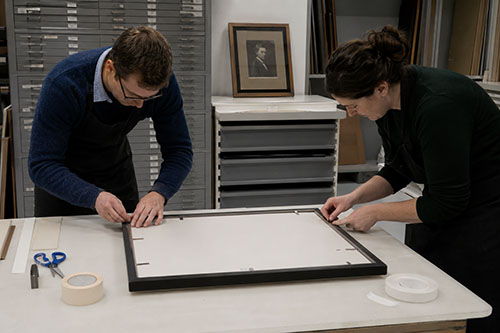
We offer wood and metal frames, custom cut & joined to order. Each framed print includes hanging hardware and foamcore backer.
Matting
We use conservation grade 100% virgin alpha-cellulose 2 ply mats with white core. Acid-free and lignin-free, these are both face resistant and meet all conservation quality standards set by the Fine Art Trade Guild. Mats are digitally cut for ultimate precision. The window will be 1/8″ smaller than the print dimensions.
Glazing (Acrylic Glass)
We offer custom cut panes of shatter-proof, acrylic glass, to protect your valuable artwork and prints.
Premium Clear
Framing grade clear acrylic is shatter resistant and lightweight.
Reflection Control
With its matte finish, Tru Vue Reflection Control® Acrylic scatters light to diminish unwanted glare.
Conservation Clear
Tru Vue Conservation Clear® Acrylic is a framing industry staple, blocking up to 99% of UV rays for ultimate protection.
Conservation Reflection Control
Tru Vue Conservation Reflection Control® Acrylic scatters and diffuses light to reduce unwanted glare. Blocks up to 99% of UV rays.
Related products
-

Circus of Fear (1966) Christopher Lee Australian One-Sheet Artwork 30×41 Fine Art Poster
$149.85 -
Dracula: Prince of Darkness (1966) Christopher Lee Original French Theatrical Design Hammer Horror 18×22 Fine Art Poster
$149.85 -
Peter Cushing & Christopher Lee – The Curse of Frankenstein (1957) Baron Frankenstein & Bandaged Creature Awakening Hammer Horror Photo
$25.00 -
Christopher Lee – Dracula: Prince of Darkness (1966) Count Dracula Frozen Moat Finale Bray Studios Behind-the-Scenes Photo
$30.00


