

Clint Eastwood – Dirty Harry (1971) .44 Magnum & Play Misty for Me Marquee Scene Photo
Limited Edition Photograph (learn more)
In stock
Clint Eastwood as Inspector Harry Callahan stands squarely in the street during the bank-robbery sequence from Dirty Harry (1971), his .44 Magnum lowered at his side while a theater marquee advertising Play Misty for Me appears directly behind him. Eastwood’s wide-legged stance, tailored jacket and revolver deliver the unmistakable visual identity of Callahan, while the marquee places two pivotal 1971 Clint Eastwood films within a single composition—an unusually rich detail for collectors of his early Malpaso work.
The photograph is built around Eastwood’s commanding stillness. Positioned almost centrally in the frame, he stands with his legs apart and his shoulders squared, facing directly forward in the familiar posture that helped define Harry Callahan as one of the great screen policemen of the 1970s. His handgun hangs low in his right hand rather than being raised dramatically, which gives the image an even greater sense of control. The suit jacket, tie and plain shirt reinforce Callahan’s plainclothes detective identity, while the rigid stance and direct forward gaze convey readiness, confidence and intimidation without any need for visible motion.
The surrounding street details add enormously to the appeal of the image. Behind Eastwood, the sidewalk, storefronts and scattered pedestrians create a convincing urban environment, but the dominant background feature is the theater marquee reading Play Misty for Me. That single detail gives the still unusual historical value, since it brings together Eastwood’s performance as Harry Callahan and his feature directorial debut within one frame. For collectors, the Dirty Harry Play Misty for Me marquee image offers more than a standard action still; it preserves an unexpected meeting point between two major milestones in Eastwood’s career during the same year.
The composition also uses foreground and depth effectively. The hood of a car intrudes at the lower edge of the frame, while debris or a disturbed street element near Eastwood’s feet helps suggest the aftermath of the robbery confrontation. The distant figures on the sidewalk remain secondary, allowing the frame to retain its emphasis on Callahan while still preserving the sense of a real public street. The black-and-white photography sharpens the contrast between Eastwood’s suit, the bright pavement, the building facades and the marquee lettering, making the image feel crisp, immediate and documentary in character.
Directed and produced by Don Siegel for The Malpaso Company, Dirty Harry introduced Eastwood as San Francisco Police Inspector Harry Callahan, a role that became one of the defining performances of his career. Much of the film’s identity depends on its location shooting in San Francisco, yet this particular sequence has its own special production interest. Although the picture is widely associated with real San Francisco streets and landmarks, the diner and bank-robbery material was filmed on the Universal Studios lot in Los Angeles, making this scene an interesting exception within the production.
That production context makes the marquee especially meaningful. Play Misty for Me, also released in 1971, marked Eastwood’s directorial debut and represented an important expansion of his career beyond acting. Its appearance here turns the still into a compact document of Eastwood’s emerging creative control during the early Malpaso period. Instead of merely showing Callahan confronting criminals, the photograph quietly records a larger moment in film history through the background signage.
For collectors of Clint Eastwood, Dirty Harry, Don Siegel and American crime cinema, this is a particularly rewarding image. It combines Harry Callahan’s most iconic visual elements—the suit, the stance and the .44 Magnum—with an unusual period detail that deepens the still’s historical significance and sets it apart from more common promotional and scene photography from the film.
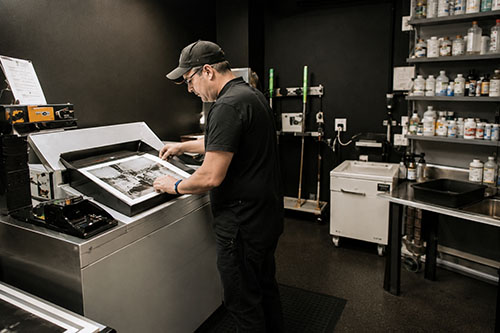
Carefully restored from historic photographic source material and professionally lab-developed, this museum-quality photograph is presented uncropped, preserving the complete image area contained in the source. Restoration recovers Eastwood’s facial detail, suit texture, revolver definition, marquee lettering, street background detail and the full tonal range of the urban setting while maintaining the natural tonal gradation and character of the historic black-and-white photograph. The finished photograph contains no AI-generated image content.
Product Enquiry
Kodak Professional Endura Paper
Kodak Endura papers provide an incredible amount of detail and smooth transition of tones. Designed for the professional photographer in mind, looking for a more traditional photo print style, Kodak Endura provides an extended print life and color gamut almost at the level of a high end fine art paper print.
Archival Matte Paper
Archival Matte Paper, also known as Moab Lasal Photo Matte, is our house stock fine art paper and is an economical favorite for fine art reproductions and photo prints. It features a smooth surface, heavy weight (230 g, 9.5-mil), neutral white, matte paper engineered for accurate color reproduction that provides high contrast and high-resolution output. This paper is acid-free, making it the perfect choice for both photography & fine art reproductions.
Giclee William Turner Paper by Hahnemühle
The William Turner by Hahnemühle is one of the most popular papers used in the Giclee printing industry. This is a 310g natural white mould made natural line paper with 100% rag content making it highly archival. It has a slight coarse texture which gives photos and artwork an elegant look. These fine art paper prints (also known as Giclee) are ordered by galleries, individual artists and photographers. The papers and inks are not only archival but use some of the most accurate print technology for full color prints.
- Giclee prints use very expensive archival pigmented inks.
- Highest level of color gamut available in printing (12 color printing).
- Exceptional black & white printing.
- Fade resistant, pigmented inks which provide a superior color range compared to other types of inks. Widely preferred in fine art and photography circles.
- We ONLY use professional grade fine art and photo paper that resist yellowing and aging.
Framing
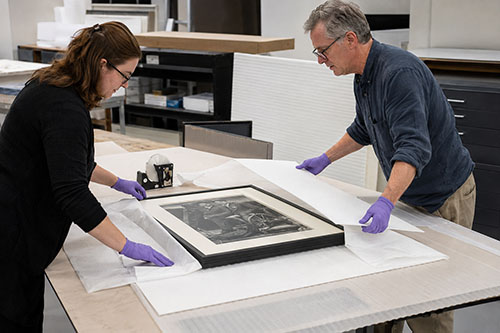
We offer wood and metal frames, custom cut & joined to order. Each framed print includes hanging hardware and foamcore backer.
Matting
We use conservation grade 100% virgin alpha-cellulose 2 ply mats with white core. Acid-free and lignin-free, these are both face resistant and meet all conservation quality standards set by the Fine Art Trade Guild. Mats are digitally cut for ultimate precision. The window will be 1/8″ smaller than the print dimensions.
Glazing (Acrylic Glass)
We offer custom cut panes of shatter-proof, acrylic glass, to protect your valuable artwork and prints.
Premium Clear
Framing grade clear acrylic is shatter resistant and lightweight.
Reflection Control
With its matte finish, Tru Vue Reflection Control® Acrylic scatters light to diminish unwanted glare.
Conservation Clear
Tru Vue Conservation Clear® Acrylic is a framing industry staple, blocking up to 99% of UV rays for ultimate protection.
Conservation Reflection Control
Tru Vue Conservation Reflection Control® Acrylic scatters and diffuses light to reduce unwanted glare. Blocks up to 99% of UV rays.
Related products
-

Katya Wyeth & Damien Thomas – Twins of Evil (1971) Mircalla Vampire Bite Photo
$30.00 -
Jimmy Sangster & Cast – Lust for a Vampire (1971) Hunton Park Lawn Behind-the-Scenes Photo
$38.00 -
Clint Eastwood – Dirty Harry (1971) Panavision Camera Behind-the-Scenes Photo
$38.00 -
Clint Eastwood & Don Siegel – Dirty Harry (1971) On-Set Discussion Behind-the-Scenes Photo
$38.00


