

Klaus Kinski – Nosferatu the Vampyre (1979) Count Dracula Raised Claw Outdoor Scene Photo
Limited Edition Photograph (learn more)
In stock
Klaus Kinski appears as Count Dracula in this atmospheric color photograph from Nosferatu the Vampyre (1979), extending one long-fingered hand outward while standing against a dark natural landscape. His bald head, pallid complexion, deeply shadowed eyes and severe black clothing immediately identify Werner Herzog’s distinctive vampire, while the raised claw-like hand gives the image an eerie sense of movement. The open-air setting creates an unusual contrast between the natural world and Dracula’s corpse-like presence.
The extended hand is the photograph’s defining visual element. Kinski reaches across the left side of the composition with fingers spread and slightly curved, making the unnaturally long nails especially noticeable. His other hand rests lower against his body, allowing both the character’s face and unusual hands to remain clearly visible. The gesture suggests warning, command or predatory intent without requiring a conventional attack scene.
Kinski’s expression adds considerably to the unease. His eyes are directed away from the camera, his mouth slightly open and his features held in a tense, almost watchful expression. Against the dark trees and muted landscape, his pale head appears almost detached from the surrounding environment. Klaus Kinski Nosferatu the Vampyre 1979 imagery is often defined by precisely this contrast: an unmistakably supernatural figure placed within otherwise believable locations.
Written and directed by Werner Herzog, Nosferatu the Vampyre stars Klaus Kinski as Count Dracula, Isabelle Adjani as Lucy Harker and Bruno Ganz as Jonathan Harker. Herzog conceived the film as both a tribute to and reinterpretation of F. W. Murnau’s Nosferatu (1922), deliberately recalling the visual legacy of Max Schreck’s Count Orlok while developing a vampire with a more mournful and tragic personality.
The physical design of Kinski’s Dracula is essential to that connection. The bald scalp, elongated ears, sunken eyes, pale skin and extraordinarily long fingernails reject the polished aristocratic image associated with many later versions of Dracula. Instead, he appears ancient, diseased and physically separated from ordinary humanity. In this photograph, the exposed hands make that transformation particularly clear.
The outdoor environment also makes the image distinctive within the film’s photography. Rather than surrounding Dracula with dark interiors, candlelight or Gothic architecture, the composition places him against vegetation and open space. His black costume absorbs much of the available light while his face and hands remain sharply visible, making him appear almost like an unnatural intrusion into the landscape.
Kinski’s performance gives this otherwise simple pose considerable psychological weight. Herzog’s Dracula is threatening, but he is also portrayed as a creature exhausted by immortality and isolation. The raised claw can therefore be read not simply as aggression but as part of the character’s strange, deliberate physical language.
For collectors of Klaus Kinski, Werner Herzog, Nosferatu and European vampire cinema, this photograph has strong visual identity because it combines the unmistakable Dracula makeup with an expressive full-arm gesture and uncommon outdoor setting.
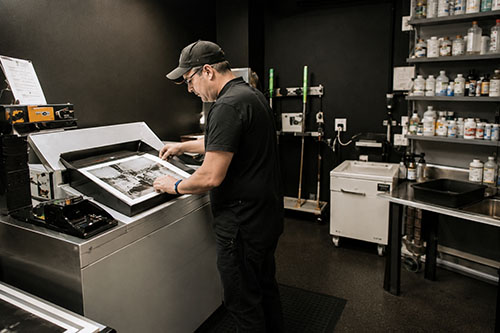
Carefully restored from historic photographic source material and professionally lab-developed, this museum-quality photograph is presented uncropped, preserving the complete image area contained in the source. Restoration recovers facial detail, long fingernail definition, hand texture, black-costume detail and subtle outdoor shadow tones while maintaining the natural color balance and authentic character of the historic photograph. The finished photograph contains no AI-generated image content.
Product Enquiry
Kodak Professional Endura Paper
Kodak Endura papers provide an incredible amount of detail and smooth transition of tones. Designed for the professional photographer in mind, looking for a more traditional photo print style, Kodak Endura provides an extended print life and color gamut almost at the level of a high end fine art paper print.
Archival Matte Paper
Archival Matte Paper, also known as Moab Lasal Photo Matte, is our house stock fine art paper and is an economical favorite for fine art reproductions and photo prints. It features a smooth surface, heavy weight (230 g, 9.5-mil), neutral white, matte paper engineered for accurate color reproduction that provides high contrast and high-resolution output. This paper is acid-free, making it the perfect choice for both photography & fine art reproductions.
Giclee William Turner Paper by Hahnemühle
The William Turner by Hahnemühle is one of the most popular papers used in the Giclee printing industry. This is a 310g natural white mould made natural line paper with 100% rag content making it highly archival. It has a slight coarse texture which gives photos and artwork an elegant look. These fine art paper prints (also known as Giclee) are ordered by galleries, individual artists and photographers. The papers and inks are not only archival but use some of the most accurate print technology for full color prints.
- Giclee prints use very expensive archival pigmented inks.
- Highest level of color gamut available in printing (12 color printing).
- Exceptional black & white printing.
- Fade resistant, pigmented inks which provide a superior color range compared to other types of inks. Widely preferred in fine art and photography circles.
- We ONLY use professional grade fine art and photo paper that resist yellowing and aging.
Framing
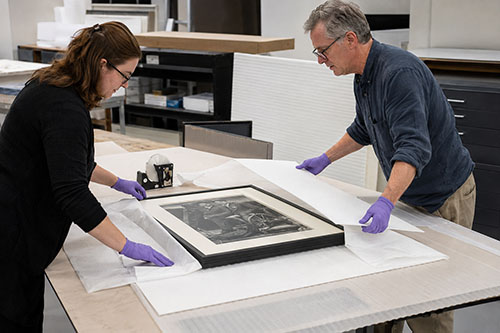
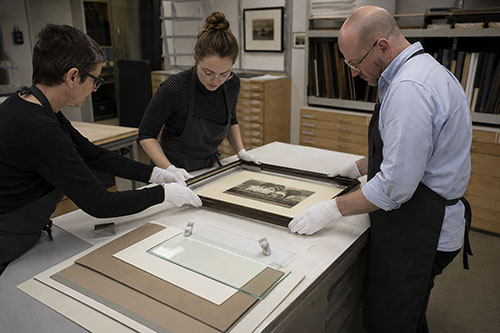
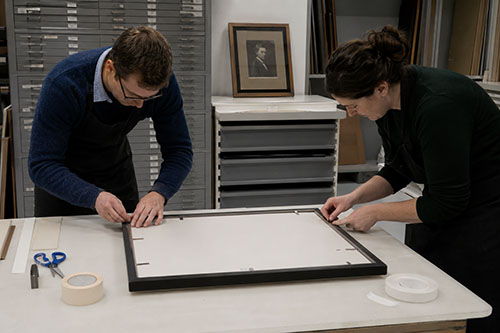
We offer wood and metal frames, custom cut & joined to order. Each framed print includes hanging hardware and foamcore backer.
Matting
We use conservation grade 100% virgin alpha-cellulose 2 ply mats with white core. Acid-free and lignin-free, these are both face resistant and meet all conservation quality standards set by the Fine Art Trade Guild. Mats are digitally cut for ultimate precision. The window will be 1/8″ smaller than the print dimensions.
Glazing (Acrylic Glass)
We offer custom cut panes of shatter-proof, acrylic glass, to protect your valuable artwork and prints.
Premium Clear
Framing grade clear acrylic is shatter resistant and lightweight.
Reflection Control
With its matte finish, Tru Vue Reflection Control® Acrylic scatters light to diminish unwanted glare.
Conservation Clear
Tru Vue Conservation Clear® Acrylic is a framing industry staple, blocking up to 99% of UV rays for ultimate protection.
Conservation Reflection Control
Tru Vue Conservation Reflection Control® Acrylic scatters and diffuses light to reduce unwanted glare. Blocks up to 99% of UV rays.
Related products
-

Robert Picardo – The Howling (1981) Eddie Quist Werewolf Transformation Close-Up Photo
$30.00 -
Ingrid Pitt – The Vampire Lovers (1970) Carmilla Ferocious Close-Up Photo
$30.00 -
Terence Young & Ursula Andress – Dr. No (1962) Director Briefing James Bond 007 BTS Photo
$38.00 -
Peter Cushing – Torture Garden (1967) Lancelot Canning Poe Collector Close-Up Photo
$30.00


