

Clint Eastwood – Dirty Harry (1971) Panavision Camera Behind-the-Scenes Photo
Limited Edition Photograph (learn more)
In stock
Clint Eastwood stands beside a towering Panavision motion-picture camera in this revealing color behind-the-scenes photograph from Dirty Harry (1971), wearing Harry Callahan’s brown suit, patterned tie and dark sunglasses as crew members gather around the production equipment. The large camera rig dominates the left side of the composition while Eastwood anchors the right, bringing the star and the machinery used to create the film together in a particularly strong piece of production imagery.
The photograph is especially compelling because the camera is not merely background equipment—it is one of the principal visual subjects. Mounted high on a substantial support, the Panavision unit rises above Eastwood, with its large magazine, lens assembly, cables and mechanical components clearly visible. The familiar Panavision name can be seen prominently across the upper section of the equipment, giving the image immediate historical and technical interest for collectors of filmmaking photography.
Eastwood stands only a short distance from the camera, his body angled slightly away while his head turns toward the activity around him. The brown suit, white shirt and patterned tie identify the clothing associated with Inspector Harry Callahan, but the dark sunglasses and relaxed off-camera stance make this clearly different from a conventional scene photograph. Rather than performing for the lens, Eastwood appears to be between takes or observing the production process while technicians work nearby.
Several crew members are visible around the camera and in the background, reinforcing the candid production atmosphere. A figure in red stands behind the rig handling equipment, while others occupy the open exterior location farther back. The mixture of cables, camera hardware, people and architectural elements creates a layered image that reveals something of the practical working environment surrounding a major location production. The broad blue sky and bright daylight also distinguish the photograph from the darker, more dramatic urban imagery associated with many of the film’s finished scenes.
This Clint Eastwood Dirty Harry behind-the-scenes photo is particularly valuable because it links the actor directly with the filmmaking technology used on the production. Dirty Harry was photographed by Bruce Surtees, whose cinematography contributed strongly to the film’s hard-edged visual character. The prominently visible Panavision equipment provides a tangible reminder that the movie’s famous San Francisco imagery depended not only on Eastwood and Don Siegel’s direction, but also on the camera crews and technical apparatus working just outside the completed frame.
Released in 1971, Dirty Harry was directed and produced by Don Siegel for The Malpaso Company, with Warner Bros. handling distribution. Eastwood’s performance as San Francisco police inspector Harry Callahan became one of the defining roles of his career, while extensive location photography helped give the picture an unusually strong sense of place. The film’s streets, rooftops, stadiums and civic spaces became inseparable from Callahan’s pursuit of the killer at the center of the story.
For collectors of Clint Eastwood, Dirty Harry, Panavision history and motion-picture production photography, this image offers far more than a conventional star still. It preserves Eastwood in character wardrobe while simultaneously exposing the sophisticated camera equipment and working crew normally hidden from audiences, making it a distinctive visual record of the filmmaking process behind one of the landmark American crime films of the 1970s.
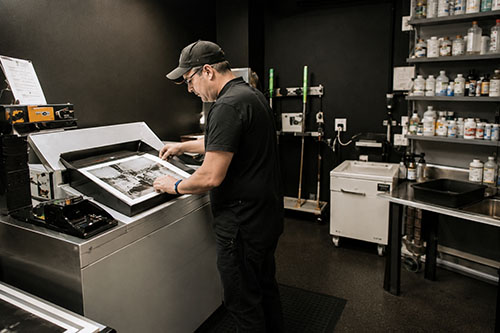
Carefully restored from historic photographic source material and professionally lab-developed, this museum-quality photograph is presented uncropped, preserving the complete image area contained in the source. Restoration recovers Eastwood’s facial and costume detail, sunglasses, Panavision camera lettering, lens and magazine components, crew figures, cables and the sunlit exterior background while maintaining the natural color balance and authentic character of the historic photograph. The finished photograph contains no AI-generated image content.
Product Enquiry
Kodak Professional Endura Paper
Kodak Endura papers provide an incredible amount of detail and smooth transition of tones. Designed for the professional photographer in mind, looking for a more traditional photo print style, Kodak Endura provides an extended print life and color gamut almost at the level of a high end fine art paper print.
Archival Matte Paper
Archival Matte Paper, also known as Moab Lasal Photo Matte, is our house stock fine art paper and is an economical favorite for fine art reproductions and photo prints. It features a smooth surface, heavy weight (230 g, 9.5-mil), neutral white, matte paper engineered for accurate color reproduction that provides high contrast and high-resolution output. This paper is acid-free, making it the perfect choice for both photography & fine art reproductions.
Giclee William Turner Paper by Hahnemühle
The William Turner by Hahnemühle is one of the most popular papers used in the Giclee printing industry. This is a 310g natural white mould made natural line paper with 100% rag content making it highly archival. It has a slight coarse texture which gives photos and artwork an elegant look. These fine art paper prints (also known as Giclee) are ordered by galleries, individual artists and photographers. The papers and inks are not only archival but use some of the most accurate print technology for full color prints.
- Giclee prints use very expensive archival pigmented inks.
- Highest level of color gamut available in printing (12 color printing).
- Exceptional black & white printing.
- Fade resistant, pigmented inks which provide a superior color range compared to other types of inks. Widely preferred in fine art and photography circles.
- We ONLY use professional grade fine art and photo paper that resist yellowing and aging.
Framing
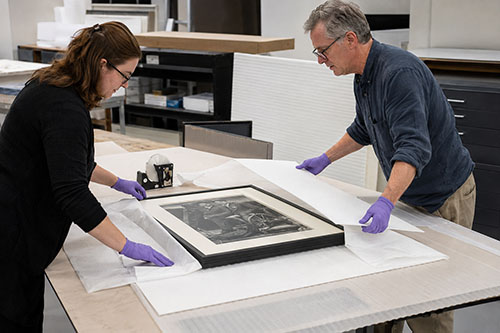
We offer wood and metal frames, custom cut & joined to order. Each framed print includes hanging hardware and foamcore backer.
Matting
We use conservation grade 100% virgin alpha-cellulose 2 ply mats with white core. Acid-free and lignin-free, these are both face resistant and meet all conservation quality standards set by the Fine Art Trade Guild. Mats are digitally cut for ultimate precision. The window will be 1/8″ smaller than the print dimensions.
Glazing (Acrylic Glass)
We offer custom cut panes of shatter-proof, acrylic glass, to protect your valuable artwork and prints.
Premium Clear
Framing grade clear acrylic is shatter resistant and lightweight.
Reflection Control
With its matte finish, Tru Vue Reflection Control® Acrylic scatters light to diminish unwanted glare.
Conservation Clear
Tru Vue Conservation Clear® Acrylic is a framing industry staple, blocking up to 99% of UV rays for ultimate protection.
Conservation Reflection Control
Tru Vue Conservation Reflection Control® Acrylic scatters and diffuses light to reduce unwanted glare. Blocks up to 99% of UV rays.
Related products
-

Susan Denberg – Frankenstein Created Woman (1967) Bray Studios Dressing Room Behind-the-Scenes Photo
$38.00 -
Clint Eastwood & Don Siegel – Dirty Harry (1971) Relaxed On-Set Conversation Behind-the-Scenes Photo
$38.00 -
Clint Eastwood & Don Siegel – Dirty Harry (1971) Rooftop Behind-the-Scenes Photo
$38.00 -
Peter Cushing & Susan Denberg – Frankenstein Created Woman (1967) Christina on Laboratory Table Publicity Photo
$38.00


