

Clint Eastwood & Don Siegel – Dirty Harry (1971) Relaxed On-Set Conversation Behind-the-Scenes Photo
Limited Edition Photograph (learn more)
In stock
CLINT EASTWOOD and director DON SIEGEL share a relaxed moment during production of Dirty Harry (1971) in this wonderfully informal black-and-white behind-the-scenes photograph. Eastwood stands at left still dressed as Inspector Harry Callahan in his distinctive checked jacket, sweater, shirt and tie, smiling toward Siegel as the director examines a small object in his hands. Their easy expressions contrast sharply with the tension and violence of the finished film. Behind them, production personnel remain at work within the practical interior setting, while cups and equipment in the foreground reinforce the sense of an ordinary pause during filming rather than a formal publicity pose. The photograph succeeds because nothing feels staged: it simply captures two filmmakers comfortable in one another’s company while the production continues around them.
The image is particularly appealing because the working relationship between star and director becomes its entire subject. Eastwood’s familiar Callahan wardrobe immediately connects the photograph to the film, but his relaxed stance, hands in pockets and genuine smile reveal the actor between takes rather than the severe detective audiences see on screen. Siegel appears equally informal, creating an unusually warm portrait of the collaboration behind one of the defining police thrillers of the period. For collectors seeking Clint Eastwood Don Siegel Dirty Harry 1971 material, the photograph offers something more personal than a conventional character still: a direct visual record of Eastwood and Siegel working together.
Directed and produced by Don Siegel, Dirty Harry stars Clint Eastwood as Inspector Harry Callahan, with Harry Guardino as Lt. Bressler, Reni Santoni as Chico Gonzalez, John Vernon as the Mayor and Andrew Robinson as Scorpio. AFI credits The Malpaso Company as the production company, Bruce Surtees as director of photography and Eastwood himself as executive producer. Most interestingly, AFI also records Eastwood as a “Fill-In director” during production, confirming that his contribution extended beyond his starring and executive-producing roles.
The film follows Callahan’s pursuit of Scorpio, a sniper and extortionist terrorizing San Francisco. Principal photography ran from April to mid-June 1971, with extensive use of real San Francisco locations helping give the film its hard-edged urban character. AFI documents the city as the center of production, while BFI describes Dirty Harry as the film that helped transform Eastwood into a household-name superstar.
The photograph also represents an important stage in the Eastwood-Siegel partnership. Before Dirty Harry, the pair had already collaborated on Coogan’s Bluff (1968), Two Mules for Sister Sara (1970) and The Beguiled (1971), making this their fourth major feature together. BFI notes that Siegel’s economical, direct filmmaking approach had a lasting influence on Eastwood’s own career behind the camera.
For collectors, that history gives this seemingly casual image considerable significance. It captures not Harry Callahan confronting Scorpio, but the creative partnership responsible for shaping the film’s distinctive tone—a moment of conversation, humor and familiarity amid the practical surroundings of production.
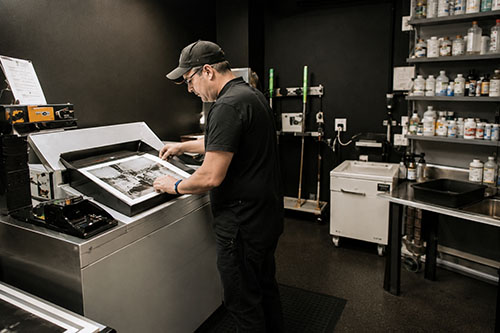
Carefully restored from historic photographic source material and professionally lab-developed, this museum-quality photograph is presented uncropped, preserving the complete image area contained in the source. Restoration recovers facial detail, hair texture, Callahan’s checked jacket, clothing fabrics and subtle detail throughout the surrounding production environment while maintaining the natural tonal gradation and character of the historic black-and-white photograph. The finished photograph contains no AI-generated image content.
A warm and revealing production image, this photograph offers collectors an unusually personal view of Clint Eastwood and Don Siegel during the making of one of the defining films of their collaboration.
Product Enquiry
Kodak Professional Endura Paper
Kodak Endura papers provide an incredible amount of detail and smooth transition of tones. Designed for the professional photographer in mind, looking for a more traditional photo print style, Kodak Endura provides an extended print life and color gamut almost at the level of a high end fine art paper print.
Archival Matte Paper
Archival Matte Paper, also known as Moab Lasal Photo Matte, is our house stock fine art paper and is an economical favorite for fine art reproductions and photo prints. It features a smooth surface, heavy weight (230 g, 9.5-mil), neutral white, matte paper engineered for accurate color reproduction that provides high contrast and high-resolution output. This paper is acid-free, making it the perfect choice for both photography & fine art reproductions.
Giclee William Turner Paper by Hahnemühle
The William Turner by Hahnemühle is one of the most popular papers used in the Giclee printing industry. This is a 310g natural white mould made natural line paper with 100% rag content making it highly archival. It has a slight coarse texture which gives photos and artwork an elegant look. These fine art paper prints (also known as Giclee) are ordered by galleries, individual artists and photographers. The papers and inks are not only archival but use some of the most accurate print technology for full color prints.
- Giclee prints use very expensive archival pigmented inks.
- Highest level of color gamut available in printing (12 color printing).
- Exceptional black & white printing.
- Fade resistant, pigmented inks which provide a superior color range compared to other types of inks. Widely preferred in fine art and photography circles.
- We ONLY use professional grade fine art and photo paper that resist yellowing and aging.
Framing
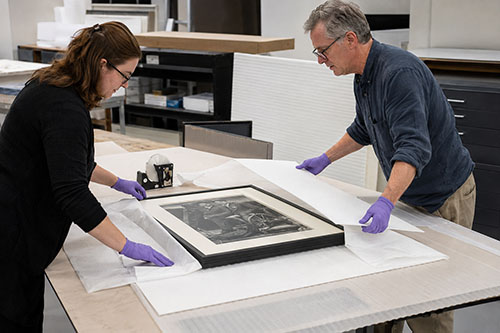
We offer wood and metal frames, custom cut & joined to order. Each framed print includes hanging hardware and foamcore backer.
Matting
We use conservation grade 100% virgin alpha-cellulose 2 ply mats with white core. Acid-free and lignin-free, these are both face resistant and meet all conservation quality standards set by the Fine Art Trade Guild. Mats are digitally cut for ultimate precision. The window will be 1/8″ smaller than the print dimensions.
Glazing (Acrylic Glass)
We offer custom cut panes of shatter-proof, acrylic glass, to protect your valuable artwork and prints.
Premium Clear
Framing grade clear acrylic is shatter resistant and lightweight.
Reflection Control
With its matte finish, Tru Vue Reflection Control® Acrylic scatters light to diminish unwanted glare.
Conservation Clear
Tru Vue Conservation Clear® Acrylic is a framing industry staple, blocking up to 99% of UV rays for ultimate protection.
Conservation Reflection Control
Tru Vue Conservation Reflection Control® Acrylic scatters and diffuses light to reduce unwanted glare. Blocks up to 99% of UV rays.
Related products
-

Clint Eastwood – Dirty Harry (1971) Aiming .44 Magnum with Motorcycle Officers Behind-the-Scenes Photo
$38.00 -
Peter Cushing & Veronica Carlson – Frankenstein Must Be Destroyed (1969) Holding Script at Elstree Studios Publicity Photo
$30.00 -
Susan Denberg – Frankenstein Created Woman (1967) Bray Studios Dressing Room Behind-the-Scenes Photo
$38.00 -
Martine Beswick – Thunderball (1965) Paula Caplan 007 Bond Girl Tiger-Stripe Swimsuit on Boat Bahamas Publicity Photo
$30.00


