

Freddie Francis & Katy Wild – The Evil of Frankenstein (1964) Rena on Set Hammer Horror Behind-the-Scenes Photo
Limited Edition Photograph (learn more)
In stock
Freddie Francis and Katy Wild are captured during production of The Evil of Frankenstein (1964) in this exceptional black-and-white behind-the-scenes photograph. Francis crouches in the foreground on the damp outdoor set, holding production material prominently marked HAMMER, while Wild stands behind him in costume as Rena, the young beggar girl. The muddy ground, informal clothing and completely unstaged interaction create a wonderfully direct record of director, performer and Hammer production material together during the making of the film.
The photograph is especially appealing because nothing has been arranged to disguise the realities of production. Francis appears absorbed in the work at hand rather than posing as a director, while Wild waits quietly behind him in character. The clearly visible Hammer-marked case or production material gives the image an unusually tangible connection to the studio itself, making this more than a conventional cast photograph—it is a genuine glimpse of Hammer Films at work during the early 1960s.
Released in 1964, The Evil of Frankenstein was directed by Freddie Francis for Hammer Film Productions and stars Peter Cushing as Baron Victor Frankenstein, Peter Woodthorpe as Zoltan, Sandor Elès as Hans, Katy Wild as Rena / the Beggar Girl and Kiwi Kingston as the Creature. Anthony Hinds produced the film and wrote the screenplay under his familiar pseudonym John Elder.
Wild’s Rena is an outsider who encounters Frankenstein and Hans after they flee into the mountains. She leads them to the cave where Frankenstein discovers his former Creature preserved in ice and subsequently becomes closely connected with the revived monster. Her sympathy toward the Creature gives the character a quietly humane role within a story dominated by scientific obsession, manipulation and violence.
The film was the third entry in Hammer’s Frankenstein series, following The Curse of Frankenstein (1957) and The Revenge of Frankenstein (1958). Unlike those earlier films, The Evil of Frankenstein was directed by Freddie Francis rather than Terence Fisher, giving this installment a noticeably different visual and dramatic personality.
The production also marked an important connection between Hammer Films and Universal Pictures. MoMA notes that Hammer and Universal reached an agreement allowing the new Creature to resemble the famous monster design associated with Universal’s classic Frankenstein films. As a result, Kiwi Kingston’s Creature, laboratory apparatus and elements of the film’s visual presentation deliberately evoke the Universal Frankenstein tradition more directly than Hammer’s earlier entries had been able to do.
That connection gives The Evil of Frankenstein a distinctive place in horror history. Hammer’s vivid Gothic style and Peter Cushing’s cerebral Baron Frankenstein meet imagery recalling the earlier Universal Monsters cycle, creating an unusual bridge between two of the most influential traditions in cinematic horror.
Production records place filming between 14 October and 16 November 1963, with Bray Studios serving as the principal studio base and Oakley Court used for location work. Hammer’s production archive describes the film as a Hammer production released by Universal Pictures, reinforcing the close relationship between the two companies on this particular project.
For Freddie Francis, the film represents an important chapter in a remarkable career that moved between directing and cinematography. His strong visual instincts are evident throughout The Evil of Frankenstein, particularly in the laboratory sequences, mountain environments and carefully constructed Gothic interiors. This photograph provides the opposite perspective: Francis not through the finished imagery, but physically present on the set overseeing the work required to create it.
For Katy Wild, Rena became one of her best-known horror roles. Her vulnerable, sympathetic presence offers an important counterpoint to the film’s more aggressive personalities, particularly in her scenes with the Creature. The surviving script material associated with Wild has also helped document the character and her place within the production.
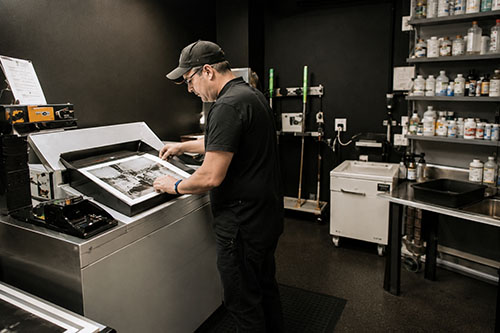
Carefully restored from historic photographic source material and professionally lab-developed, this museum-quality photograph is presented uncropped, preserving the complete image area contained in the source. Meticulous restoration recovers facial detail, clothing texture, production-material lettering, background detail, tonal range and photographic clarity while retaining the spontaneous documentary character of the original black-and-white behind-the-scenes photograph.
For collectors of Freddie Francis, Katy Wild, The Evil of Frankenstein and Hammer Horror, this is an exceptional production image—Francis crouched on the working set with Hammer-marked material in hand while Wild waits behind him as Rena, preserving an unusually candid visual record from Hammer’s 1964 Frankenstein production and its important collaboration with Universal Pictures.
Product Enquiry
Kodak Professional Endura Paper
Kodak Endura papers provide an incredible amount of detail and smooth transition of tones. Designed for the professional photographer in mind, looking for a more traditional photo print style, Kodak Endura provides an extended print life and color gamut almost at the level of a high end fine art paper print.
Archival Matte Paper
Archival Matte Paper, also known as Moab Lasal Photo Matte, is our house stock fine art paper and is an economical favorite for fine art reproductions and photo prints. It features a smooth surface, heavy weight (230 g, 9.5-mil), neutral white, matte paper engineered for accurate color reproduction that provides high contrast and high-resolution output. This paper is acid-free, making it the perfect choice for both photography & fine art reproductions.
Giclee William Turner Paper by Hahnemühle
The William Turner by Hahnemühle is one of the most popular papers used in the Giclee printing industry. This is a 310g natural white mould made natural line paper with 100% rag content making it highly archival. It has a slight coarse texture which gives photos and artwork an elegant look. These fine art paper prints (also known as Giclee) are ordered by galleries, individual artists and photographers. The papers and inks are not only archival but use some of the most accurate print technology for full color prints.
- Giclee prints use very expensive archival pigmented inks.
- Highest level of color gamut available in printing (12 color printing).
- Exceptional black & white printing.
- Fade resistant, pigmented inks which provide a superior color range compared to other types of inks. Widely preferred in fine art and photography circles.
- We ONLY use professional grade fine art and photo paper that resist yellowing and aging.
Framing
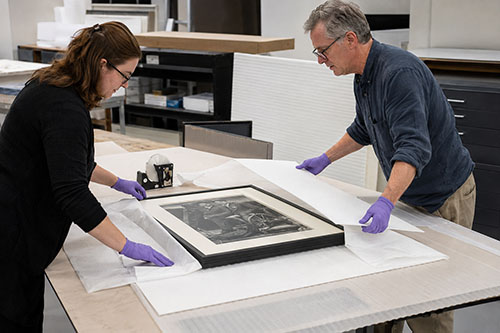
We offer wood and metal frames, custom cut & joined to order. Each framed print includes hanging hardware and foamcore backer.
Matting
We use conservation grade 100% virgin alpha-cellulose 2 ply mats with white core. Acid-free and lignin-free, these are both face resistant and meet all conservation quality standards set by the Fine Art Trade Guild. Mats are digitally cut for ultimate precision. The window will be 1/8″ smaller than the print dimensions.
Glazing (Acrylic Glass)
We offer custom cut panes of shatter-proof, acrylic glass, to protect your valuable artwork and prints.
Premium Clear
Framing grade clear acrylic is shatter resistant and lightweight.
Reflection Control
With its matte finish, Tru Vue Reflection Control® Acrylic scatters light to diminish unwanted glare.
Conservation Clear
Tru Vue Conservation Clear® Acrylic is a framing industry staple, blocking up to 99% of UV rays for ultimate protection.
Conservation Reflection Control
Tru Vue Conservation Reflection Control® Acrylic scatters and diffuses light to reduce unwanted glare. Blocks up to 99% of UV rays.
Related products
-

King Kong Escapes (1967) Gorosaurus & Mechani-Kong Toho Kaiju Battle Artwork
$25.00 -
Kiwi Kingston – The Evil of Frankenstein (1964) Frankenstein Creature Metal Stake Hammer Horror Photo
$25.00 -
Yutte Stensgaard – Lust for a Vampire (1971) Mircalla White Nightgown Stone Steps Publicity Photo
$38.00 -
Peter Cushing, Sandor Elès & Kiwi Kingston – The Evil of Frankenstein (1964) Monster Restraint Laboratory Photo
$25.00


