

Julie Ege – Creatures the World Forgot (1971) Topless “1971” Hammer Glamour Publicity Photo
Limited Edition Photograph (learn more)
In stock
JULIE EGE turns toward the camera with a radiant smile in this striking color Hammer glamour publicity photograph associated with Creatures the World Forgot (1971). Posed with her back toward the camera, Ege is topless and wears bright bikini bottoms dramatically printed with the enormous numerals “1971.” Her long auburn hair falls across her shoulders and back while the warm, plain studio background removes every distracting element from the composition. The backward glance, playful smile and bold year lettering give the photograph an unmistakably early-1970s character, creating an image that works simultaneously as star portrait, Hammer promotional photography and period glamour. Unlike a production still depicting Ege as Nala within the prehistoric story, this is clearly conceived around the actress herself and the publicity value of her image.
The composition is deliberately simple but exceptionally effective. Ege’s figure creates a strong diagonal through the frame while her turned face returns the viewer’s attention directly toward the camera. The oversized 1971 numerals provide the photograph’s strongest visual hook and immediately anchor it to the year of the film’s release. For collectors seeking Julie Ege Creatures the World Forgot 1971 material, this is a particularly distinctive image because the film connection, performer and period are communicated without relying on scenery, props or an elaborate costume.
Directed by Don Chaffey, Creatures the World Forgot was written and produced by Michael Carreras for Hammer Film Productions. AFI credits Ege alongside Tony Bonner, Robert John and Brian O’Shaughnessy, with Vincent Cox as cinematographer and John Stoll as production designer. AFI also records the picture as the first starring film role for Julie Ege, giving the production particular importance within her screen career.
The film follows a prehistoric tribe struggling for survival in a harsh Stone Age environment, with rivalry developing between two brothers competing for leadership. Unlike some of Hammer’s earlier prehistoric adventures, the story relies heavily on physical action, gesture and atmosphere rather than conventional dialogue. Sony’s current description likewise notes the film’s extremely limited spoken language and its emphasis on tribal conflict and survival.
Production took Hammer well beyond its familiar British studio settings. AFI records location filming in the Namib Desert, while Hammer production records identify work in both Namibia and South Africa, with additional studio production at Pinewood. The film was a Hammer production released by Columbia Pictures and formed part of the studio’s continuing cycle of prehistoric adventure pictures following the success of titles such as One Million Years B.C.
For collectors, this photograph represents the promotional side of that production rather than its fictional prehistoric world. Ege’s relaxed expression, flowing hair and deliberately contemporary 1971 bikini lettering make no attempt to disguise the period in which the photograph was created. That contrast gives the image considerable appeal as both Hammer glamour photography and a vivid document of early-1970s film publicity.
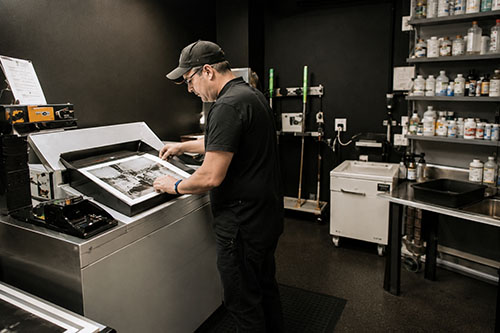
Carefully restored from historic photographic source material and professionally lab-developed, this museum-quality photograph is presented uncropped, preserving the complete image area contained in the source. Restoration recovers facial detail, hair texture, natural skin tones, fabric texture and the bold 1971 lettering while maintaining the natural color balance and character of the historic photograph. The finished photograph contains no AI-generated image content.
A memorable promotional portrait from an important early starring role, this image combines Julie Ege, Hammer Films and unmistakable 1971 glamour styling in one highly distinctive collector photograph.
Product Enquiry
Kodak Professional Endura Paper
Kodak Endura papers provide an incredible amount of detail and smooth transition of tones. Designed for the professional photographer in mind, looking for a more traditional photo print style, Kodak Endura provides an extended print life and color gamut almost at the level of a high end fine art paper print.
Archival Matte Paper
Archival Matte Paper, also known as Moab Lasal Photo Matte, is our house stock fine art paper and is an economical favorite for fine art reproductions and photo prints. It features a smooth surface, heavy weight (230 g, 9.5-mil), neutral white, matte paper engineered for accurate color reproduction that provides high contrast and high-resolution output. This paper is acid-free, making it the perfect choice for both photography & fine art reproductions.
Giclee William Turner Paper by Hahnemühle
The William Turner by Hahnemühle is one of the most popular papers used in the Giclee printing industry. This is a 310g natural white mould made natural line paper with 100% rag content making it highly archival. It has a slight coarse texture which gives photos and artwork an elegant look. These fine art paper prints (also known as Giclee) are ordered by galleries, individual artists and photographers. The papers and inks are not only archival but use some of the most accurate print technology for full color prints.
- Giclee prints use very expensive archival pigmented inks.
- Highest level of color gamut available in printing (12 color printing).
- Exceptional black & white printing.
- Fade resistant, pigmented inks which provide a superior color range compared to other types of inks. Widely preferred in fine art and photography circles.
- We ONLY use professional grade fine art and photo paper that resist yellowing and aging.
Framing
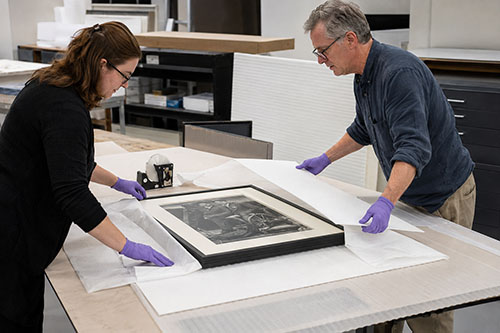
We offer wood and metal frames, custom cut & joined to order. Each framed print includes hanging hardware and foamcore backer.
Matting
We use conservation grade 100% virgin alpha-cellulose 2 ply mats with white core. Acid-free and lignin-free, these are both face resistant and meet all conservation quality standards set by the Fine Art Trade Guild. Mats are digitally cut for ultimate precision. The window will be 1/8″ smaller than the print dimensions.
Glazing (Acrylic Glass)
We offer custom cut panes of shatter-proof, acrylic glass, to protect your valuable artwork and prints.
Premium Clear
Framing grade clear acrylic is shatter resistant and lightweight.
Reflection Control
With its matte finish, Tru Vue Reflection Control® Acrylic scatters light to diminish unwanted glare.
Conservation Clear
Tru Vue Conservation Clear® Acrylic is a framing industry staple, blocking up to 99% of UV rays for ultimate protection.
Conservation Reflection Control
Tru Vue Conservation Reflection Control® Acrylic scatters and diffuses light to reduce unwanted glare. Blocks up to 99% of UV rays.
Related products
-

Roman Polanski – The Tenant (1976) Trelkovsky Paranoid Close-Up Publicity Photo
$25.00 -
Ursula Andress – She (1965) Queen Ayesha Flowing Gown Classical Goddess Hammer Fantasy Glamour Photo
$38.00 -
Robert Hossein & Marie-France Pisier – Le Vampire de Düsseldorf (1965) Peter Kürten & Anna Death Scene High-Angle Crime Thriller Photo
$30.00 -
Ingrid Pitt – The Vampire Lovers (1970) Marcilla Red Gown Moor Park Mansion Photo
$25.00


