

Leonard Whiting – Frankenstein: The True Story (1973) Victor with Severed Arm Medical Bag Publicity Photo
Limited Edition Photograph (learn more)
In stock
Leonard Whiting appears as Victor Frankenstein in this striking color publicity photograph for Frankenstein: The True Story (1973), crouched beside an open leather medical bag containing a bloodied severed human arm. Photographed from an elevated angle, Whiting looks upward with an intense, controlled expression while the white cloth lining the bag sharply isolates the gruesome limb. The unusual overhead composition creates a disturbing contrast between the young physician’s refined appearance and the unmistakable evidence of death positioned directly beside him.
The open medical bag is the photograph’s defining visual element. Its warm brown leather forms a natural frame around the pale cloth and bloodied arm, immediately directing attention toward the macabre contents. Whiting’s hand rests close to the bag while his other arm supports his crouched position, visually connecting Victor to the human remains without presenting the image as an active surgical scene. The result has the carefully arranged quality of a publicity photograph designed to communicate the production’s themes of medicine, death and forbidden experimentation in a single image.
This Leonard Whiting Frankenstein The True Story 1973 photograph is especially distinctive because it presents Victor at the boundary between respectable nineteenth-century medicine and the darker scientific ambitions associated with the Frankenstein story. His youthful appearance and formal dark clothing contrast strongly with the severed limb, reinforcing the idea of an educated man being drawn toward experiments that challenge accepted boundaries between life and death.
Directed by Jack Smight, Frankenstein: The True Story was produced by Universal Television from a teleplay by Christopher Isherwood and Don Bachardy. The ambitious television production stars Whiting as Victor alongside James Mason, David McCallum, Jane Seymour, Michael Sarrazin, Agnes Moorehead and Ralph Richardson, offering an expansive reinterpretation of Mary Shelley’s Frankenstein mythology.
An important distinction gives this publicity image additional interest. Within the story, Dr. Henri Clerval, played by David McCallum, is responsible for secretly preserving a freshly amputated arm and later revealing his experiments in reanimation to Victor. The photograph is therefore best understood as a staged promotional composition rather than a literal scene record of Victor personally retrieving the limb. That difference makes the image particularly revealing as publicity photography: recognizable story elements have been combined around Whiting to create an immediate visual shorthand for the production’s scientific horror.
The overhead viewpoint further separates this photograph from conventional character stills. Whiting appears partially enclosed by the rocky surroundings and dark clothing, while his upward gaze establishes direct visual contact with the camera above. The severed arm remains lower within the frame but is sufficiently prominent that the viewer discovers it almost immediately after seeing Whiting’s face.
The photograph also reflects the production’s approach to Frankenstein as both Gothic drama and medical horror. Rather than relying exclusively on laboratories, electrical machinery or the completed Creature, this image focuses on the raw material of experimentation—the human body itself. The leather bag, cloth and severed limb give the concept a disturbing physical reality.
For collectors of Leonard Whiting, Frankenstein cinema and classic horror production photography, this image has an unusually strong visual identity. Its combination of Victor Frankenstein, the open medical bag and the prominently displayed severed arm distinguishes it immediately from more traditional laboratory or character photographs from the production.
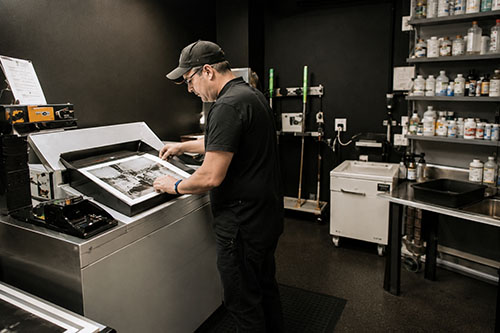
Carefully restored from historic photographic source material and professionally lab-developed, this museum-quality photograph is presented uncropped, preserving the complete image area contained in the source. Restoration recovers facial detail, leather-bag texture, bloodied-arm definition, white-cloth detail and subtle color and shadow gradation while maintaining the natural color balance and authentic character of the historic photograph. The finished photograph contains no AI-generated image content.
Product Enquiry
Kodak Professional Endura Paper
Kodak Endura papers provide an incredible amount of detail and smooth transition of tones. Designed for the professional photographer in mind, looking for a more traditional photo print style, Kodak Endura provides an extended print life and color gamut almost at the level of a high end fine art paper print.
Archival Matte Paper
Archival Matte Paper, also known as Moab Lasal Photo Matte, is our house stock fine art paper and is an economical favorite for fine art reproductions and photo prints. It features a smooth surface, heavy weight (230 g, 9.5-mil), neutral white, matte paper engineered for accurate color reproduction that provides high contrast and high-resolution output. This paper is acid-free, making it the perfect choice for both photography & fine art reproductions.
Giclee William Turner Paper by Hahnemühle
The William Turner by Hahnemühle is one of the most popular papers used in the Giclee printing industry. This is a 310g natural white mould made natural line paper with 100% rag content making it highly archival. It has a slight coarse texture which gives photos and artwork an elegant look. These fine art paper prints (also known as Giclee) are ordered by galleries, individual artists and photographers. The papers and inks are not only archival but use some of the most accurate print technology for full color prints.
- Giclee prints use very expensive archival pigmented inks.
- Highest level of color gamut available in printing (12 color printing).
- Exceptional black & white printing.
- Fade resistant, pigmented inks which provide a superior color range compared to other types of inks. Widely preferred in fine art and photography circles.
- We ONLY use professional grade fine art and photo paper that resist yellowing and aging.
Framing
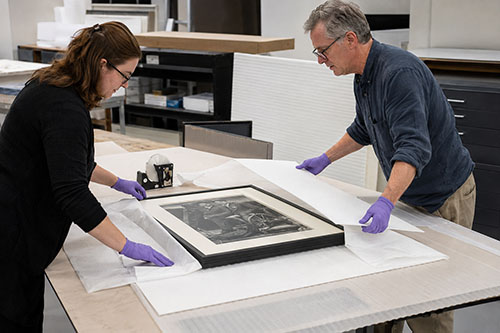
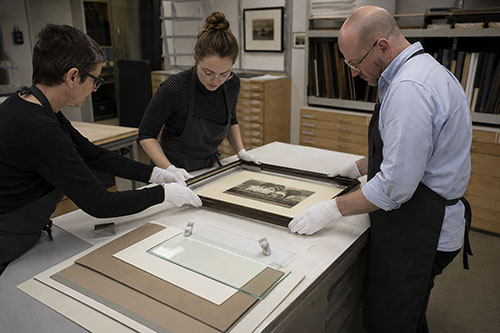
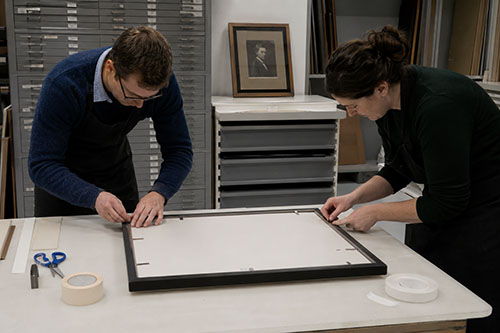
We offer wood and metal frames, custom cut & joined to order. Each framed print includes hanging hardware and foamcore backer.
Matting
We use conservation grade 100% virgin alpha-cellulose 2 ply mats with white core. Acid-free and lignin-free, these are both face resistant and meet all conservation quality standards set by the Fine Art Trade Guild. Mats are digitally cut for ultimate precision. The window will be 1/8″ smaller than the print dimensions.
Glazing (Acrylic Glass)
We offer custom cut panes of shatter-proof, acrylic glass, to protect your valuable artwork and prints.
Premium Clear
Framing grade clear acrylic is shatter resistant and lightweight.
Reflection Control
With its matte finish, Tru Vue Reflection Control® Acrylic scatters light to diminish unwanted glare.
Conservation Clear
Tru Vue Conservation Clear® Acrylic is a framing industry staple, blocking up to 99% of UV rays for ultimate protection.
Conservation Reflection Control
Tru Vue Conservation Reflection Control® Acrylic scatters and diffuses light to reduce unwanted glare. Blocks up to 99% of UV rays.
Related products
-

Sylvia Kristel & Catherine Rivet – Emmanuelle 2 (1975) Intimate Close-Up Paramount Publicity Photo
$30.00 -
Christopher Lee – Taste the Blood of Dracula (1970) Red-Eyed Fanged Count Dracula Extreme Close-Up Hammer Horror Photo
$30.00 -
Jenny Hanley – Scars of Dracula (1970) Sarah Framsen Vampire Bat Attack Hammer Horror Color Photo
$30.00 -
Christopher Lee & Christopher Matthews – Scars of Dracula (1970) Paul Discovers Dracula in Coffin Hammer Horror Photo
$30.00


