

Klaus Kinski – Fitzcarraldo (1982) Brian Sweeney Fitzgerald Jungle Location Publicity Photo
Limited Edition Photograph (learn more)
In stock
Klaus Kinski stands as Brian Sweeney Fitzgerald in this commanding black-and-white publicity photograph associated withFitzcarraldo (1982), dressed in his pale suit and broad-brimmed hat with one boot planted on fallen timber amid dense jungle vegetation. His upright stance and direct gaze contrast sharply with the tangled wilderness surrounding him, while the raised-leg pose and unmistakable Fitzcarraldo costume give this image a strong visual identity distinct from the companion leopard-tapestry publicity photograph.
The composition places Kinski squarely within the physical environment that defines Werner Herzog’s film. Fitzgerald stands slightly forward of the dense vegetation, his light-colored suit creating a strong tonal separation from the dark foliage, branches and fallen timber behind him. One hand disappears into his jacket pocket while the other rests casually on his raised knee, producing a pose that appears confident without becoming theatrical. His broad pale hat creates another strong area of contrast and immediately identifies the eccentric, determined figure at the center of the story.
The surrounding terrain is equally important to the photograph. Broken branches, rough undergrowth and uneven ground fill almost every available space around Fitzgerald, making the jungle feel dense and resistant rather than picturesque. There is no elegant interior, steamship or elaborate staging needed to convey the central conflict of the film: one man’s extraordinary ambition set against an environment that seems capable of overwhelming every human plan. The image therefore works not simply as a costume study but as a compact visual statement of the film’s larger themes.
Written and directed by Werner Herzog, Fitzcarraldo follows Brian Sweeney Fitzgerald, an opera enthusiast living in the Peruvian Amazon whose consuming dream is to build an opera house in Iquitos. To finance the project, Fitzgerald develops an audacious plan involving access to remote rubber territory. The scheme ultimately requires moving a large steamship from one river system to another by hauling it across a steep jungle hillside, transforming his cultural obsession into an undertaking of almost impossible physical scale.
This Klaus Kinski Fitzcarraldo jungle publicity photo gains additional significance from the extraordinary circumstances of the production itself. Herzog filmed extensively on location in Peru and pursued the central steamship sequence on a monumental practical scale. Rather than relying solely on miniature effects to represent the vessel’s movement across the hillside, the production used a full-size ship for the celebrated engineering spectacle. The resulting struggle between machinery, landscape and human determination became inseparable from the film’s reputation.
Kinski joined the production after an earlier version starring Jason Robards as Fitzgerald was abandoned, and his performance became one of the defining collaborations between Herzog and the actor. His Fitzgerald is obsessive, idealistic, stubborn and grandly impractical, yet Kinski often expresses those qualities through concentrated physical presence rather than conventional heroic posing. That quality is especially visible here. Standing amid the rough jungle debris in an immaculate light suit and oversized hat, he appears simultaneously out of place and completely committed to his surroundings.
For collectors of Klaus Kinski, Werner Herzog and major international cinema, the photograph offers a particularly strong location-based image from Fitzcarraldo. The direct gaze, raised-leg stance, pale costume and dense Amazonian vegetation establish the character and setting immediately, while the monochrome photography emphasizes the extraordinary textures of foliage, clothing, timber and earth.
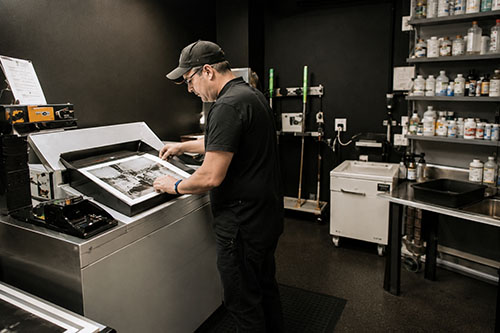
Carefully restored from historic photographic source material and professionally lab-developed, this museum-quality photograph is presented uncropped, preserving the complete image area contained in the source. Restoration recovers Kinski’s facial detail, suit and hat texture, foliage definition, fallen timber and the layered jungle background while maintaining the natural tonal gradation and character of the historic black-and-white photograph. The finished photograph contains no AI-generated image content.
Product Enquiry
Kodak Professional Endura Paper
Kodak Endura papers provide an incredible amount of detail and smooth transition of tones. Designed for the professional photographer in mind, looking for a more traditional photo print style, Kodak Endura provides an extended print life and color gamut almost at the level of a high end fine art paper print.
Archival Matte Paper
Archival Matte Paper, also known as Moab Lasal Photo Matte, is our house stock fine art paper and is an economical favorite for fine art reproductions and photo prints. It features a smooth surface, heavy weight (230 g, 9.5-mil), neutral white, matte paper engineered for accurate color reproduction that provides high contrast and high-resolution output. This paper is acid-free, making it the perfect choice for both photography & fine art reproductions.
Giclee William Turner Paper by Hahnemühle
The William Turner by Hahnemühle is one of the most popular papers used in the Giclee printing industry. This is a 310g natural white mould made natural line paper with 100% rag content making it highly archival. It has a slight coarse texture which gives photos and artwork an elegant look. These fine art paper prints (also known as Giclee) are ordered by galleries, individual artists and photographers. The papers and inks are not only archival but use some of the most accurate print technology for full color prints.
- Giclee prints use very expensive archival pigmented inks.
- Highest level of color gamut available in printing (12 color printing).
- Exceptional black & white printing.
- Fade resistant, pigmented inks which provide a superior color range compared to other types of inks. Widely preferred in fine art and photography circles.
- We ONLY use professional grade fine art and photo paper that resist yellowing and aging.
Framing
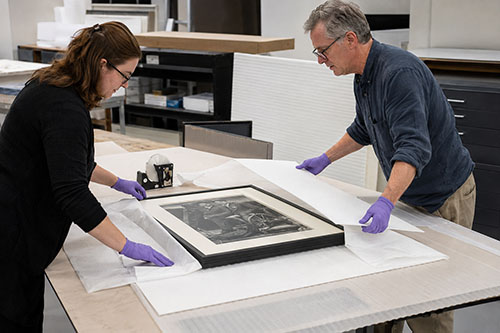
We offer wood and metal frames, custom cut & joined to order. Each framed print includes hanging hardware and foamcore backer.
Matting
We use conservation grade 100% virgin alpha-cellulose 2 ply mats with white core. Acid-free and lignin-free, these are both face resistant and meet all conservation quality standards set by the Fine Art Trade Guild. Mats are digitally cut for ultimate precision. The window will be 1/8″ smaller than the print dimensions.
Glazing (Acrylic Glass)
We offer custom cut panes of shatter-proof, acrylic glass, to protect your valuable artwork and prints.
Premium Clear
Framing grade clear acrylic is shatter resistant and lightweight.
Reflection Control
With its matte finish, Tru Vue Reflection Control® Acrylic scatters light to diminish unwanted glare.
Conservation Clear
Tru Vue Conservation Clear® Acrylic is a framing industry staple, blocking up to 99% of UV rays for ultimate protection.
Conservation Reflection Control
Tru Vue Conservation Reflection Control® Acrylic scatters and diffuses light to reduce unwanted glare. Blocks up to 99% of UV rays.
Related products
-

Christopher Lee – Dracula Has Risen from the Grave (1968) Count Dracula Staked in Coffin Scene Photo
$38.00 -
Clint Eastwood – Dirty Harry (1971) Aiming .44 Magnum with Motorcycle Officers Behind-the-Scenes Photo
$38.00 -
Gianna Maria Canale – I Vampiri (1957) Gisèle Du Grand Candlelit Gothic Interior Photo
$30.00 -
Catherine Deneuve – Repulsion (1965) Carol Ledoux Apartment Floor Camera BTS Photo
$30.00


